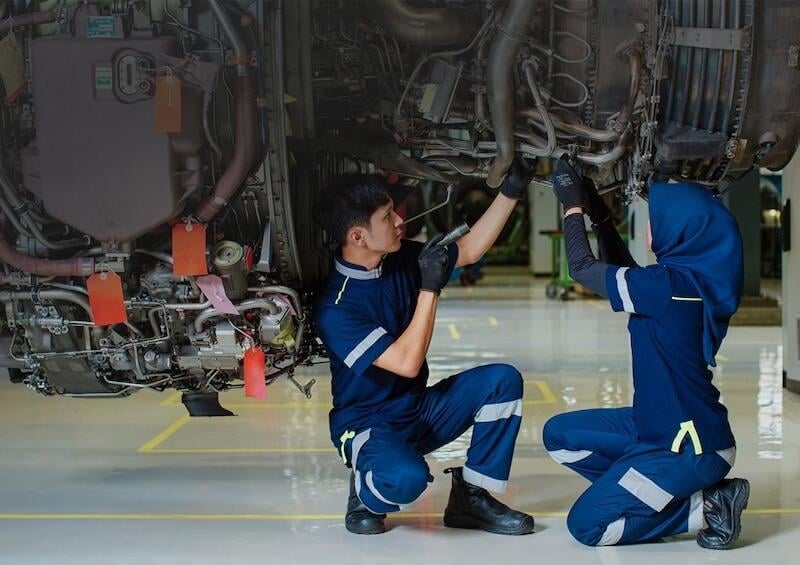
Flag carrier Garuda Indonesia intends to align its economic and operational interests in sister company GMF Aeroasia by taking a majority stake in the MRO provider.
While Garuda already exerts control over GMF Aeroasia, the majority of the latter’s shares have been owned by another state-owned company, airport operator Angkasa Pura Indonesia, since Garuda’s COVID-induced restructuring.
In accordance with Garuda’s latest restructuring plan, the airline group is now seeking shareholder approval to acquire an additional 66% of GMF via a rights issue involving state holding company Danantara.
In 2025, Indonesian media reported that Danantara would extend a shareholder loan totaling $405 million to Garuda to improve the operational capacity and readiness of its fleet and that of low-cost carrier subsidiary Citilink, with much of that money earmarked for maintenance at GMF.
The MRO provider suffered several years of losses during the pandemic when its main customer, Garuda, entered restructuring. This pushed GMF into breach of certain financial covenants and forced it to request a waiver from creditors and a restructure of its bank loans.
As well as aligning Garuda’s ownership structure, control and economic interest in GMF, the new deal is intended to strengthen “the strategic nexus between [Garuda’s] flight operations and [GMF’s] MRO activities,” according to a stock exchange filing.
It will also enhance Garuda’s economic interest in the performance and economic value of GMF, which is projected to generate $212 million of net profit over 2026-30. This includes estimates of $35 million in 2026 and $36 million in 2027.
Earlier this year, FTAI Aviation announced a new maintenance partnership with GMF Aeroasia in Jakarta.
FTAI management told investors that its priority is to build a presence close to customers, with new sites in Indonesia and Egypt set to be its first facilities east of Rome.
“We’re going to put a lot of throughput through those shops, and they will guarantee capacity,” FTAI President David Moreno said. “The key is getting closer to airlines in those regions and getting closer to the country.”

Related Content