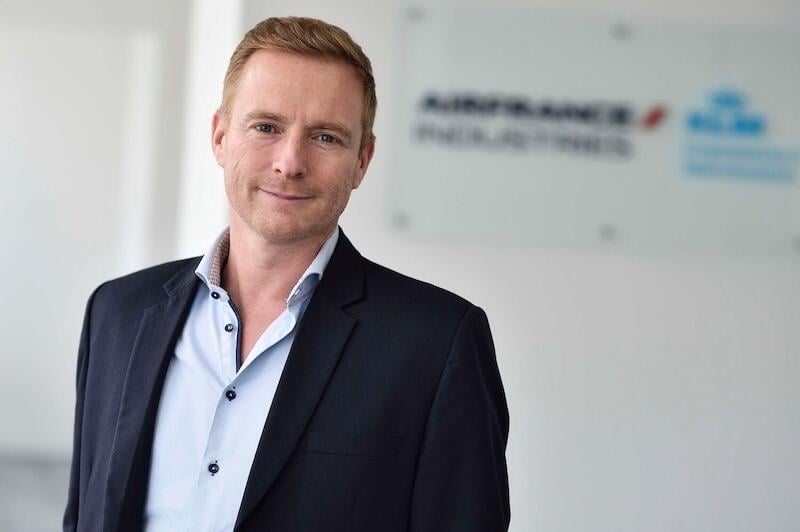
Roy de Vries.
Roy de Vries, director of Engines Product, Network and Industrial Development at Air France Industries KLM Engineering & Maintenance (AFI KLM E&M), discusses how the company is accelerating its Leap MRO capabilities, scaling industrial capacity and advancing repair technologies.
Can you give us an overview of what’s happening at AFI KLM E&M on the Leap program?
For the Leap program, covering both Leap-1A and Leap-1B, we’ve fully implemented and industrialized capabilities in both Amsterdam and Paris. That includes full performance shop visit capability and test engine support line. The key advantage is flexibility. With both engine variants supported at both sites, we can balance workload between Amsterdam and Paris depending on capacity and customer needs. That flexibility is critical in today’s environment. We’re ready for our first performance restoration shop visit and expect that to come in quite soon.
What’s your focus for this year on Leap development?
This year, our focus is clearly on parts repair—with a strong emphasis on advanced repair capabilities. We’re moving full speed ahead with the industrialization of piece-part repairs, both at CRMA (our subsidiary dedicated to engine parts repair) and within AFI and KLM E&M engine shops. At CRMA, we’re happy to announce that we are now fully operational for combustor repairs for both Leap-1A and Leap-1B. On AFI and KLM E&M engine shops (parts repair), development is progressing on high-pressure turbine disks (stages 1 and 2) and the compressor discharge pressure seal, with both expected to be ready later this year. Advanced repair capability is crucial for managing Leap maintenance costs, and it is mandatory to expedite repair industrialization. The more you can repair—and the smarter you can repair—the better you control your economics. The limiting factor today is that the OEM is still finalizing some advanced repair approvals and releases. Until those are available, we can’t fully industrialize them. But as soon as those repairs are released, we will be ready.
Is this mostly related to life-limited parts and piece parts?
Yes, particularly life-limited parts-related work on KLM Engine services (parts repair) side and piece parts work at CRMA—for example, the combustor. Our expertise in combustors is built on our experience repairing General Electric’s GEnx combustion chamber, which is closer to the Leap in many ways. Since this GEnx expertise is already deeply embedded in our organization, we have a clear and tangible competitive advantage. At KLM E&M, we built extensive knowledge of rotating parts, including the GEnx Fan Mid Shaft. Especially the unique repair of the inner wall coating is a great example of our technological experience. It is worth noting that many shops claim to have repaired the CFM56 and are therefore ready for the Leap. While there are similarities, the technological gap between the CFM56 and the Leap remains significant. In many ways, the Leap engine is closer to GEnx technology.
Does being part of the Leap Premier MRO network help with advancing repairs?
Definitely. We have a strong relationship with the OEM and have co-developed repairs in the past, including on Leap-related technologies. Building on that, we are working together with GE Aerospace on our repair and technology roadmaps. Since the OEM is also seeking repair capacity, I expect to see greater cooperation in industrializing advanced repairs. That collaboration is essential, especially as advanced repairs are important to operators' cost control. In parallel, we’re significantly ramping up capacity. We’re doubling our Leap capacity across Amsterdam and Paris this year. Again, flexibility between the two sites is a major strength. If one site is short on slots, we can shift work to the other site.
What are the biggest challenges you’re seeing on the Leap program right now?
Three main challenges: supply chain, time-on-wing and repairability. First: supply chain interruptions—not just in Leap but across all engine programs. As a result, if parts aren’t flowing, you lose shop performance and capacity. Second: time on wing. The big question is how much improvement the OEM can achieve with durability kits and enhancements. Ultimately, the proof will be in the operational results—especially as engines move into second-run performance. For this reason, we offer spare-engine support for Leap to our customers. And third, consider repairability. Leap uses more advanced materials and complex designs, eliciting questions about how much can truly be repaired and what level of investment is required to make those repairs viable. This is where cost control becomes critical. Building on our status as centers of excellence in engine parts repair, heavily reliant on expertise in new technologies already imported, we are undoubtedly perfectly positioned for the industrialization of repairs with very high added value.

Related Content