This article is published in Aerospace Daily & Defense Report part of Aviation Week Intelligence Network (AWIN), and is complimentary through Oct 31, 2026. For information on becoming an AWIN Member to access more content like this, click here.
The service is opening advanced manufacturing facilities on sites it owns.
The U.S. Army has awarded Siemens Government Technologies an $80 million contract to set up an advanced manufacturing facility for drone components at Anniston Army Depot in Alabama.
The contract is the latest example of the U.S. Army Organic Industrial Base Transformation Strategy, an initiative signed in April to overhaul some of its depots into production plants.
The “fixed-price contract [is] to establish a secure, government-controlled, and highly flexible advanced manufacturing capability, including an initial production capability for electric motor stator assemblies for unmanned aircraft systems,” the service said on July 23.
Siemens Government Technologies said on Aug. 10 that it will use “a born digital approach, providing an integrated digital production environment driven by process-rich digital twins, directly informing and validating the commissioning of optimal stator assembly production lines with digitally connected advanced manufacturing elements, all before a single bolt is turned.”
Much U.S. defense production occurs at private-sector facilities. However, as the Pentagon tries to drastically ramp up production of drones and munitions, it has embraced a mixed strategy of funding private-sector producers while expanding its own manufacturing capacity.
For example, the Defense Innovation Unit’s (DIU) Drone Dominance program is funding private companies to manufacture their own drones, mostly one-way attack quadcopters. DIU’s goal is to seed a U.S. industry by procuring several hundred thousand examples by 2027. The Pentagon hopes that three-four national champions would then go on to support a larger commercial and defense drone industry capable of manufacturing millions of uncrewed aircraft vehicles (UAS) per year.
One-way attack drones are essentially munitions and the U.S. Army appears to be hewing closer to its tradition of owning munitions manufacturing facilities. Many of those are operated by private companies, such as American Ordnance, which manufacturers 155-mm artillery rounds, or BAE Systems, which makes high explosives for warheads in government-owned facilities.
For example, in March the U.S. Army awarded Hadrian Automation a contract to set up an advanced manufacturing facility at Red River Army Depot in Texas to produce components for weapons systems, including small drones.
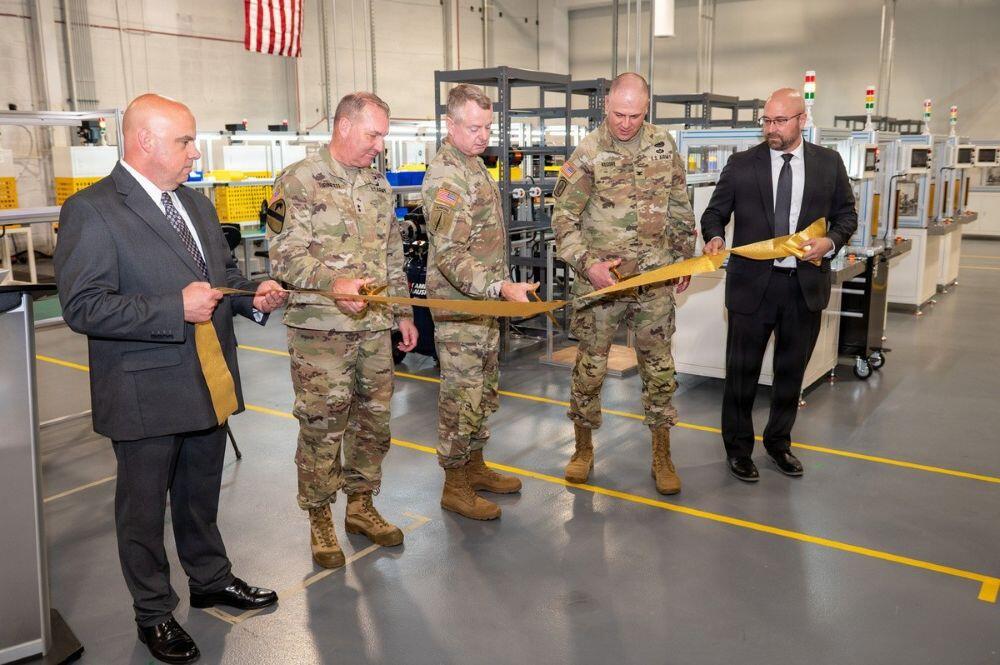
In June, the service cut the ribbon on an advanced manufacturing facility at Tobyhanna Army Depot, Pennsylvania, that includes a brushless DC motor assembly line. The facility has capacity to produce more than 500,000 motors per year, depot officials said.

Related Content