This article is published in Aviation Week & Space Technology and is free to read until Nov 04, 2026. If you want to read more articles from this publication, please click the link to subscribe.
U.S. Army Opens Depots To Drone Part Production To Fill Massive Demand
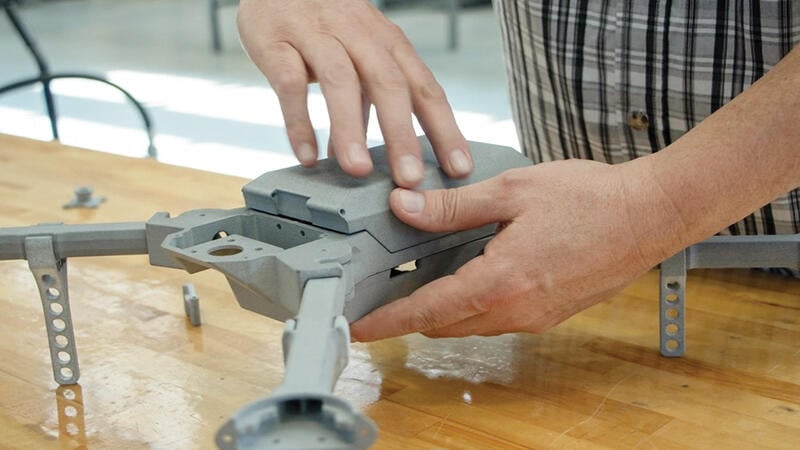
The U.S. Army sees a need for tens of millions of drone components.
It seems like every few months, the number of drones Ukraine is projected to produce this year rises by a few million. The country manufactured 4 million small uncrewed air vehicles, mostly explosive quadcopters, in 2025. Now, depending on who you ask, it is on track to produce 9 or possibly 10 million drones before year-end.
- U.S. Army lends equipment and personnel to help private companies ramp up production
- Pentagon needs huge number of drones for practice
The U.S. Army expects small, first-person-view drones like those fielded by Kyiv to be essential in potential fights from Europe to the Pacific Ocean. But production of drones in the U.S. is miniscule. When the service looks at Ukraine’s ever-accelerating totals, it sees a massive problem for Washington.
Attempting to build 10 million drones is an enormous undertaking, Jon Strzelec, U.S. Army Materiel Command’s advanced manufacturing lead for small uncrewed air systems, tells Aviation Week. “That’s five circuit cards per drone, so it’s 50 million circuit cards,” Strzelec says. “You’re talking four motors per drone—that’s 40 million motors, 40 million propellers, 10 million frames.”
Faced with those daunting numbers, the Pentagon has ordered a half-dozen army depots that are typically used for maintenance, repair and overhaul of aging military equipment to jump into the fray and start manufacturing drone components.
Depots are being retooled with additional manufacturing equipment to produce brushless DC motors, propellers, frames, circuit cards, battery packs and other drone subcomponents, Strzelec says.
For example, one facility that repaired out-of-production radios has been revamped to support electronics for uncrewed air vehicles (UAV). “If they can make and produce circuit cards for an Army radio or a radar, why couldn’t they do it for a system on a drone?” Strzelec notes.
Tobyhanna Army Depot in Pennsylvania opened a brushless DC motor assembly line this summer. The depot has the capacity to scale production to upward of 500,000 motors annually, the service says.
Strzelec declines to state production goals for the initiative, citing operational security concerns. The drone effort is part of a larger $18.1 billion modernization plan aimed at transforming the U.S. Army’s Organic Industrial Base, the service-owned complex of 23 depots, arsenals and ammunition plants.
The U.S. Defense Department is throwing resources at UAV production because global production of drones and components is dominated by China, a potential adversary. For this new form of warfare, Beijing does not merely have a head start on Washington; it has a several-lap advantage. Every year, millions of Chinese-made drones and parts being used by Russian and Ukraine reach the battlefield.
Typically, U.S. defense production occurs at private-sector facilities. However, as the Pentagon tries to ramp up production of drones and munitions drastically, it has embraced a mixed strategy of funding private-sector producers while expanding its own manufacturing capacity.
For example, in addition to the U.S. Army’s depot initiative, the Defense Innovation Unit’s (DIU) Drone Dominance program is funding private companies to manufacture their own drones, mostly one-way attack quadcopters. The DIU’s goal is to seed a U.S. industry by potentially procuring several hundred thousand examples by 2027. The Pentagon hopes that three or four national champions would then go on to support a larger commercial and defense drone industry capable of manufacturing millions of UAVs per year.
One-way attack drones are essentially munitions, and the U.S. Army appears to be hewing closer to its tradition of owning munitions factories. Many of those are operated by private companies, such as American Ordnance, which makes 155mm artillery rounds, or BAE Systems, which makes high explosives for warheads in government-owned facilities.
Strzelec says the U.S. Army plans to operate its depots like contract manufacturers, making drone parts or components for startups that lack the equipment. Startups could rent depot facilities instead and make their own components. Depots will even jointly bid on government drone contracts with companies, he says.
In the near term, much of the component production the U.S. Army is supporting is intended to put drones into the hands of soldiers.
“If we can’t make a million drones a year, we can’t practice with a million drones a year; we’re not learning how to handle a million drones a year,” Strzelec says.
Yet given the scale of the U.S. deficit in drone production, the U.S. Army is hesitant to say its involvement in the sector is a temporary measure.
“When we talk about 100% American-manufactured drones—as if there’s no country that’s going to sell us any part of it—we’re nowhere near that,” he adds.

Related Content