Pentagon Planning Competitive Awards For Ground, Air MTI From Space
Spacepower conference

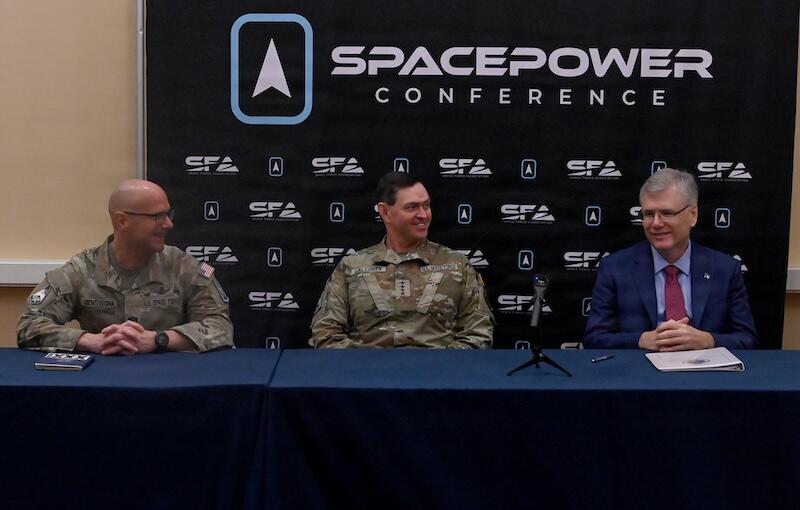
From left to right, Chief Master Sgt. of the Space Force John Bentivegna, Chief of Space Operations Gen. Chance Saltzman and Secretary of the Air Force Troy Meink answer questions from media at the Spacepower Conference in Florida.

Credit: U.S. Air Force
ORLANDO, Florida—The Department of the Air Force is moving quickly to award multiple competitive contracts for space-based moving target indication assets, first for ground moving target indication (GMTI) and then for air moving target indication (AMTI), service officials said Dec. 11.
 
The U.S. Space Force began partnering with the National Reconnaissance Office (NRO) earlier on GMTI. The service is now “further down the road in pulling those systems together,” said Gen. Chance Saltzman, chief of space operations, during a media roundtable at the Space Force Association’s Spacepower Conference here.
 
“We're developing tools to make sure that we understand exactly what the tracks are and how they're disseminated,” he said. As targets move more slowly on the ground as opposed to airborne targets, “we’re just ahead of the game on GMTI.”
 
Saltzman emphasized that both missions are priority areas for the service to accomplish “in the near-to midterm,” and that AMTI will catch up “quickly” behind GMTI.
 
While the department is focused on delivering an AMTI capability “very quickly,” it must also develop a long-term strategy to provide it, Air Force Secretary Troy Meink said at the roundtable. “We’re in the process of structuring exactly what that looks like,” he said
 
Meink—who served as NRO principal deputy director before becoming the 27th Air Force secretary in May—confirmed that the service is expected to award multiple awards to different contractors to ensure a “long-term, competitive user base.”
 
He referenced budget challenges. Money for both GMTI and AMTI is mixed between different authorization and appropriations packages. The fiscal 2026 budget request and the congressionally passed reconciliation bill included a collective $8.8 billion for space-based MTI programs, according to data compiled by The Aerospace Corp.
 
The department is “working our way through” such budget hoops to deliver those space-based MTI assets “as quickly as possible,” Meink said.
 
Since the Pentagon has more deliberately planned to shift the MTI missions from airborne assets to space-based assets, congressional defense committees have had mixed reactions. Of concern has been the adjacent plan for the Air Force to cancel the Boeing E-7 Wedgetail program.
 
The compromise fiscal 2026 National Defense Authorization Act, passed by the House on Dec. 10, prohibits the Defense Department from canceling the mid-tier acquisition rapid prototype contract for the Wedgetail, or from terminating the operations of a production line for the aircraft.
 
Meink confirmed that the Air Force will complete the two rapid prototype jets, as directed by Congress. The service is also working with allies and partners who are already flying E-7As, “to see how they fit into the production line going forward,” he said.
 
At a high level, the GMTI and AMTI missions require a combination of space, air, ground and, in some cases, cyber systems, Meink said. “The Department is really looking at a multi-phenomenology approach to do that—space, air, ground—and multiple space assets.”
Vivienne Machi

Vivienne Machi is the military space editor for Aviation Week based in Los Angeles.