This article is published in Aerospace Daily & Defense Report part of Aviation Week Intelligence Network (AWIN), and is complimentary through Aug 24, 2026. For information on becoming an AWIN Member to access more content like this, click here.

GCAP Sensor, Engine Partners Set Eyes On Tech Maturation

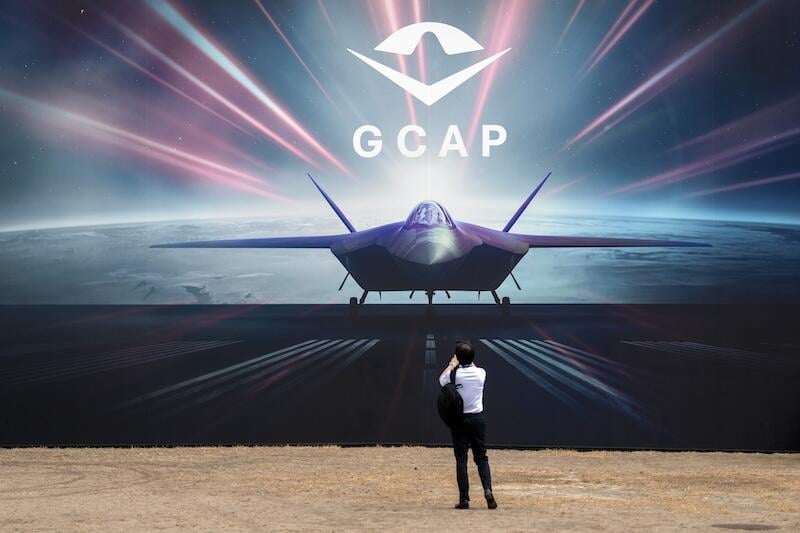
gcap model at farnborough

GCAP imagery at Farnborough Airshow.

Credit: Carl Court/Getty Images

FARNBOROUGH, England—The sensor and power providers for the Edgewing Global Combat Air Program (GCAP) fighter will spend the recently launched project phase turning concepts explored over recent months into technology demonstrations to mature capabilities for the detailed design phase.

“We're taking individual sensor solutions [and] maturing them in technology terms,” says Andrew Howard, general manager for the GCAP Electronics Evolution team. The current period should yield “a relatively mature concept that has a high level of fidelity in the cost impact, the timing impact, the deliverability impact of the sensor and communicating solution on the aircraft, and a real positive confirmation that we can deliver the warfighter capability to the requirements that's been asked of us,” he told reporters during the Farnborough Airshow.

The engine consortium of Avio Aero, IHI and Rolls-Royce is working along a similar path. “Task one is about maturation from a technological standpoint, going through all the demos,” says Edoardo Curti, who runs Avio Aero’s defense business. The engine partners are each working on national demonstrations in preparation for a tri-national engine demonstrator, though Curti would not say when that engine is due to run for the first time.

Earlier this month Edgewing secured a £4.6 billion ($6.2 billion), 18-month contract to push forward the development of the aircraft and complete the concept and assessment phase, to be followed by the detailed design phase.

One of the issues the teams are working through is the size of GCAP, which is evolving to a large combat aircraft that puts a premium on the electronic warfare system to protect it. “The size, of course, presents challenges,” Howard acknowledges.

He adds, though, that it provides a lot of real estate for the system. “We can choose better where to place things to maximize their benefit, and with more space to work with on the top and the bottom, and the front and the back, there's a lot more choice to exercise in the location of what we're trying to achieve,” Howard tells reporters.

“Ultimately, we see the larger aircraft is probably a positive,” he says.

The sensor team also is trying to design the ability to evolve its capabilities easily throughout the program’s life, Howard says. “The depth of the hardware design needs to be future-proof to enable the software and firmware to tolerate change,” he says. “We don't anticipate, from a sensing and communicating perspective, a midlife upgrade because the midlife upgrade will be daily, weekly, monthly, yearly in that software change piece,” he says.

The ambitious sensor system brings its own problem—namely, ample demand for power. Howard says, though, he is “confident” the propulsion system will deliver enough surplus energy to meet his needs.

Robert Wall

Robert Wall is Executive Editor for Defense and Space. Based in London, he directs a team of military and space journalists across the U.S., Europe and Asia-Pacific.