https://aviationweek.com/themes/custom/particle/dist/app-drupal/assets/awn-logo.svg
Skip to main content
  • Market Sector
    • Aerospace
    • Air Transport
    • MRO
    • Defense
    • Space
    • Business Aviation
  • Markets
    • Aerospace
      • Aircraft & Propulsion
      • Connected Aerospace
      • Emerging Technologies
      • Manufacturing & Supply Chain
      • Advanced Air Mobility
      • Sustainability
    • Air Transport
      • Aircraft & Propulsion
      • Interiors & Connectivity
      • Airports & Networks
      • Airlines & Lessors
      • Safety, Ops & Regulation
      • Maintenance & Training
      • Sustainability
    • MRO
      • Aircraft & Propulsion
      • Interiors & Connectivity
      • Emerging Technologies
      • Supply Chain
      • Safety, Ops & Regulation
      • Workforce & Training
      • Sustainability
    • Defense
      • Aircraft & Propulsion
      • Sensors & Electronic Warfare
      • Missile Defense & Weapons
      • Supply Chain
      • Budget, Policy & Operations
      • Sustainability
    • Space
      • Launch Vehicles & Propulsion
      • Commercial Space
      • Space Exploration
      • Satellites
      • Budget, Policy & Regulation
      • Operations & Safety
    • Business Aviation
      • Aircraft & Propulsion
      • Interiors & Connectivity
      • Airports, FBOs & Suppliers
      • Flight Deck
      • Safety, Ops & Regulation
      • Maintenance & Training
      • Sustainability
    • In Focus
      • Middle East & Africa
  • Marketplace
  • Services
    • Services
      • Advertising
      • Marketing Services
      • Fleet, Data & APIs
      • Research & Consulting
      • Network and Route Planning
      • Marketplace
  • Store
    • Market Sector

      • Aerospace
      • Air Transport
      • MRO
      • Defense
      • Space
      • Business Aviation
    • Type View All Products
      • Intelligence Bundles
        • AWIN - Premium
        • AWIN - Aerospace and Defense
        • AWIN - Business Aviation
        • AWIN - Commercial Aviation
      • Market Briefings
        • Advanced Air Mobility Report
        • Aerospace Daily & Defense Report
        • Aviation Daily
        • SpeedNews
        • The Weekly of Business Aviation
      • Directories
        • Air Charter Guide
        • Aviation Week Marketplace
        • Route Exchange
        • The Engine Yearbook
      • Data Services
        • AC-U-KWIK
        • Aircraft Bluebook
        • Airportdata.com
        • ASM Global Route Development
        • CAPA – Centre for Aviation
        • Catchment Analyzer
        • Defense Market Analyzer
        • Fleet Discovery Civil
        • Fleet Discovery Military
        • Fleet & MRO Forecast
        • MRO Prospector
        • Tracked Aircraft Utilization
      • Publications
        • African Aerospace
        • Air Transport World
        • Arabian Aerospace
        • Aviation Week & Space Technology
        • Aviation Week & Space Technology - Inside MRO
        • Business & Commercial Aviation
        • CAPA - Airline Leader
        • Routes magazine
        • Show Business
  • Events
    • Recent webinars
    • Events View All Events
      • MRO
        • MRO Americas
        • MRO Asia
        • MRO Australasia
        • MRO Baltics & Eastern Europe Region
        • MRO Europe
        • MRO Greater China
        • MRO Latin America
        • MRO Middle East
        • MRO Southeast Asia
        • Military Aviation Logistics and Maintenance Symposium (MALMS)
      • Commercial Aviation/A&D
        • Aero-Engines Americas
        • Aero-Engines Europe
        • Aero-Engines Asia-Pacific
        • Engine Leasing Trading & Finance Europe
        • Engine Leasing, Trading & Finance Americas
      • Air Transport
        • Routes Americas
        • Routes Europe
        • Routes World
        • CAPA Airline Leader Summit - Airlines in Transition
        • CAPA Airline Leader Summit - Americas
        • CAPA Airline Leader Summit - Latin America & Caribbean
        • CAPA Airline Leader Summit - Australia Pacific
        • CAPA Airline Leader Summit - Asia & Sustainability Awards
        • CAPA Airline Leader Summit - World & Awards for Excellence
        • GAD Americas
        • GAD World
      • Aerospace and Defense
        • Defense Conference
      • Awards
        • Aviation Week 20 Twenties
        • Aviation Week Laureate Awards
        • ATW Airline Awards
        • Program Excellence Awards and Banquet
        • CAPA Asia Aviation Summit & Awards for Excellence
        • Space Tech Challenge Awards
  • About
    • About Aviation Week Network
      • Our Story
      • Content and Data Team
      • Aviation Week & Space Technology 100-Year
    • Contact Us
      • Subscriber Services
      • Advertising, Marketing Services & List Rentals
      • Content Sales
      • Events
      • PR & Communications
      • Content Licensing and Reprints
      • FAQ
  • Log In
  • Register
  • My Account
    • Profile
    • Sign Out
  • AWIN Access
  • My cart
    Back to
  1. Defense

Share

NATO Defense Spending: Who's Up, Who's Down?

Tony Osborne May 29, 2015
Credit: Belgian Defense Ministry

In 2015, Belgium will spend only €2.5 billion ($2.8 billion), 0.6% of its GDP on defense. That will slide to just 0.5% of its GDP in 2019. The defense budget will be reduced €1.5 billion ($1.68 billion) over the next three years and reach €2.2 billion in 2019. The coalition government decided in March to slow the budget reduction, but the future of the Belgian armed forces looks decidedly grim.

Credit: U.S. Defense Department

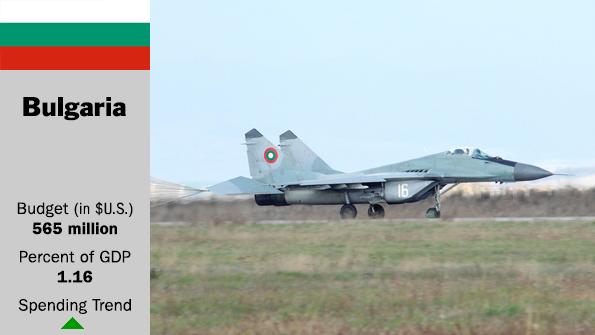
Bulgaria wants to meet the 2% target by 2024, having last met it in 2009. It plans to rebuild army capabilities and improve interoperability with NATO forces by narrowing any technological gaps with its allies.

Credit: Tony Osborne/AW&ST

Danish defense spending is set to fall further before the end of the decade. However, Denmark looks set to strengthen its military capabilities with a new fighter aircraft to replace its current fleet of F-16s, a choice that could emerge during the early summer.

Credit: NATO

On the front line from potential aggression from Russia, which it borders, Estonia has been strengthening its small armed forces. The tiny nation along the Baltic Sea recently purchased armored fighting vehicles from the Netherlands and light transport aircraft from the U.S. It is just one of a handful of countries that meets NATO’s 2% defense spending requirement, and it plans to continue to do so.

Credit: NATO

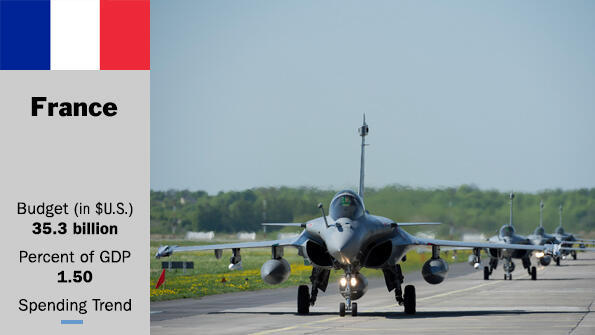
In April, French President Francois Hollande decided to slightly boost the defense budget. It will increase by €3.8 billion from 2017 to 2019. However, Hollande’s announcement is not set in stone. It remains contingent on the results of the next presidential election in 2017 and does not cover the actual cost of current operations.

Credit: Bundeswehr Bicker

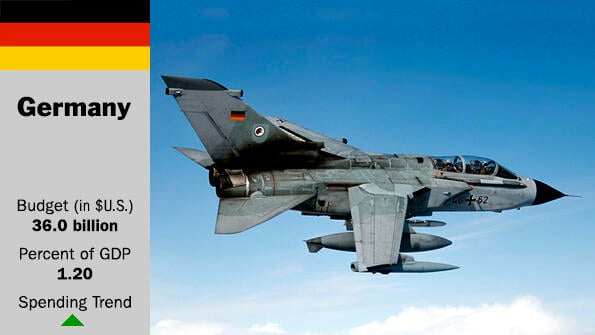
Germany announced in March 2015 that it will increase its spending 6.2% over the next five years, by €2 billion ($2.24 billion) a year from 2016. Reaching NATO’s goal of 2% is still out of reach. To meet it, Germany would need to raise its defense budget by €20 billion a year.

Credit: Tony Osborne/AW&ST

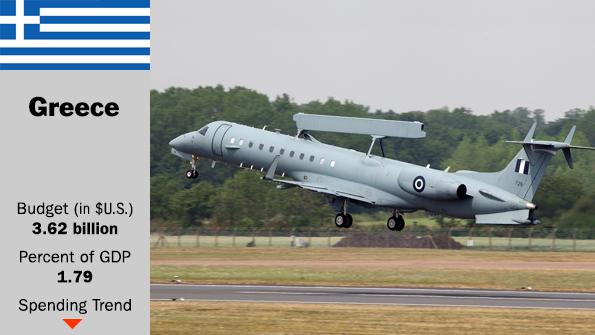
Greece’s unrelenting austerity is beginning to pinch its armed forces, following the election of the radical left Syriza government in January. For many years, Greece spent well over NATO’s 2% of GDP target, citing the need to defend itself against its old foe, Turkey. But Greece’s economic output has fallen dramatically, and military equipment spending is now being eroded as the government works out how to pay off European bailouts and interest repayments.

Credit: Tony Osborne/AW&ST

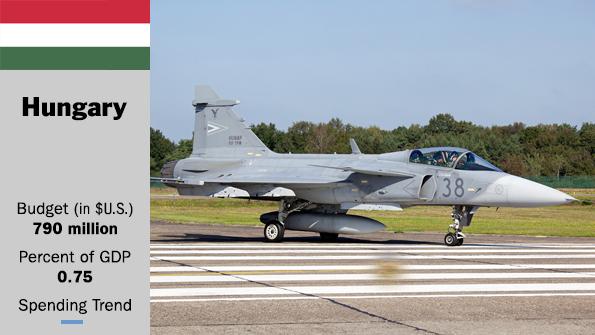
Hungary has never met the NATO target of 2% of GDP and is struggling to meet even half the target, as the country’s government spending is put toward improving the country’s economic output. Defense has received a recent 8.2% spending increase, although analysts have suggested this will achieve little.

Credit: Aeronautica Militare

Further belt-tightening related to Italy’s long-running economic crisis has led to continuing reductions in defense spending, and in particular on programs such as the F-35. However, locally produced capabilities, such as the Eurofighter Typhoon, Hammerhead UAV and FREMM Frigates are being purchased because of their perceived impact on economic output. 

Credit: Royal Netherlands Air Force

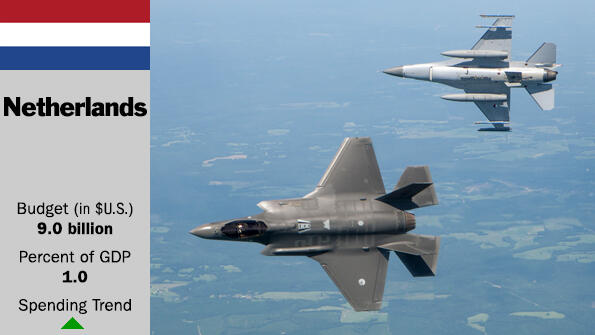
For the first time in over a decade, the Dutch government has pledged an annual structural increase in defense spending, resulting from tensions in Ukraine and the death of 193 Dutch citizens in the shoot down of MH17 over Ukraine in 2014.

Credit: Morten Hanche/Forsvaret

Norway’s government made a decision to increase defense spending by 3.5% in light of increased aggression from Russian and the Ukraine crisis. The money is focused on modernization programs including the purchase of the F-35 Joint Strike Fighter, the purchase of which Norway has accelerated over concerns about the viability of its F-16s during the 2020s. 

Credit: Tony Osborne/AW&ST

Poland is planning a major modernization of its armed forces. The conflict in Ukraine has only accelerated this process, providing additional motivation for its recent purchase of cruise missiles for the country’s F-16s and the selection of the Patriot missile defense system. Spending for new equipment now makes up more than one-third of the defense budget. Poland's finance ministry estimates the country will spend around $40 billion on new equipment in 2013-22.

Credit: Tony Osborne/AW&ST

Portuguese defense spending suffered after the economic downturn. In fact the Euro-zone crisis hit equipment modernization plans there particularly hard. Portugal canceled its plan to buy NH90 helicopters and armored vehicles. The armed forces are now considering life-extension programs for some platforms.

Credit: Romanian Air Force

Romania increased its defense spending by 0.2% of GDP in 2014 and is aiming for the NATO 2% target by 2017 in light of the situation in Ukraine. The country has been strengthening its air force with new transport aircraft and in 2016 will start taking delivery of second-hand F-16s purchased from Portugal.

Credit: Ministerio De Defensa

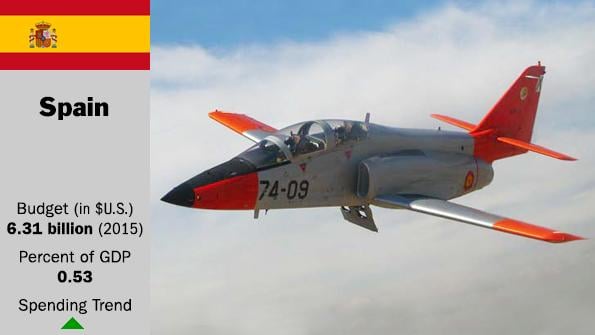
Spain is finally emerging from the economic crisis that forced the government there to significantly cut back new equipment and modernization programs. Now faced with reduced pilot readiness and a dwindling inventory, Spain is looking to increase its defense budget in 2016 and planning for a new fleet of tanker aircraft, UAVs, submarines and frigates.

Credit: Tony Osborne/AW&ST

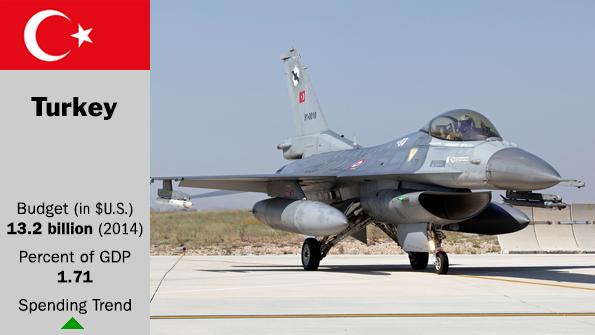
Turkey has one of the largest armed forces in NATO, and Ankara plans to spend as much as $70 billion on new military equipment through 2023. It is pushing toward the NATO target of 2% by 2018. Key spending programs include the purchase of the F-35 Joint Strike Fighter, new helicopters, new surface-to-air missile systems and the development of an indigenous fighter aircraft. 

Credit: Tony Osborne/AW&ST

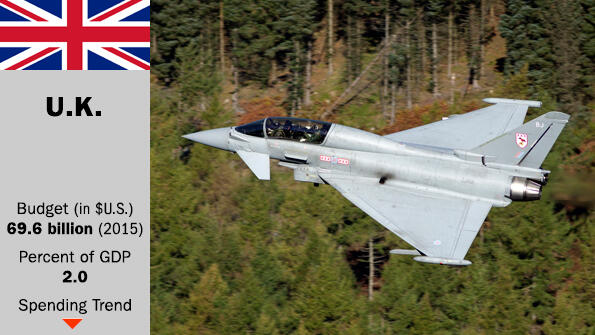
Britain has one of Europe’s largest defense budgets, and the U.K. has long aimed to keep spending above the 2% NATO target, but experts say the proportion dedicated to defense is falling. It could drop below 2% in the next few years unless additional funding comes through. The future shape of the U.K.’s defenses will be outlined in a Strategic Defense and Security Review expected in the coming months.

Previous
Next

European NATO member countries are beginning to respond to the multinational alliance’s pledge to increase defense spending to 2% of Gross Domestic Product. Reversing years of disinvestment in the military is uneven, however. Here we look at where the increases are taking hold and where budgets remain tight.

Tony Osborne

Based in London, Tony covers European defense programs. Prior to joining Aviation Week in November 2012, Tony was at Shephard Media Group where he was deputy editor for Rotorhub and Defence Helicopter magazines.

Follow us on

Markets

  • Aerospace
  • Air Transport
  • MRO
  • Defense
  • Space
  • Business Aviation

Products

  • AWIN Intelligence Bundles
  • Market Briefings
  • Publications
  • Data Services
  • Directories
  • Resources

Contact Us

  • Subscriber Services
  • Advertising, Marketing Services & List Rentals
  • Content Sales
  • Events
  • PR & Communications
  • Content Licensing and Reprints
  • FAQ

Other Resources

  • Aviation Week Marketplace
  • Knowledge Center
  • Newsletters
  • ShowNews
  • Advertising - Media Kits
  • Japanese 日本語
  • Korean 한국인
Copyright © 2026. All rights reserved. Informa Markets, a trading division of Informa PLC.
  • Accessibility
  • Privacy Policy
  • Cookie Policy
  • Terms of Use