This article is published in Aerospace Daily & Defense Report part of Aviation Week Intelligence Network (AWIN), and is complimentary through Sep 13, 2026. For information on becoming an AWIN Member to access more content like this, click here.

Pentagon Wants Lighter Directed-Energy Weapons For Airborne Use

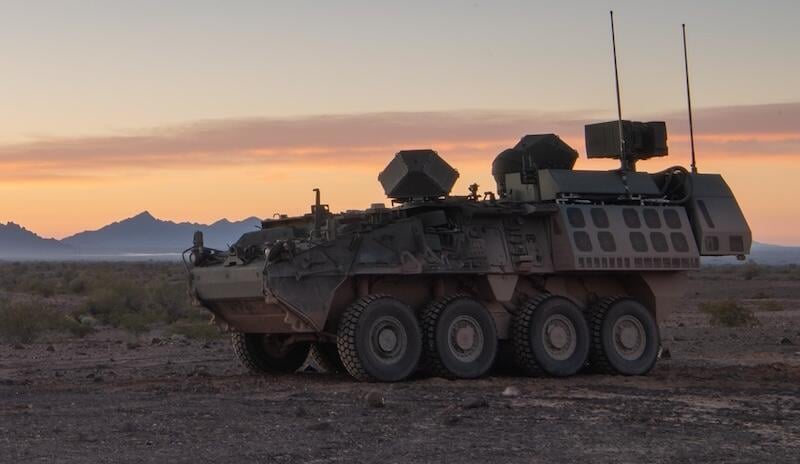
armored military vehicle in desert landscape

The 50kW-class Directed-Energy Maneuver-Short-Range Air Defense system.

Credit: U.S. Army

The Pentagon is looking for more compact directed-energy systems to apply the technology more widely, including in airborne applications.

“Smaller. Lighter. More efficient,” said Mike Dodd, the Pentagon’s assistant secretary for critical technologies, in a social media post. “We want tech on aircraft and high-altitude platforms for counter-drone, expeditionary and special operations missions, and disrupting adversary C2,” he said in reference to command and control targets.

In addition to the size and power challenge, Dodd said the military faces two other directed-energy-related hurdles to help transition directed-energy technology from the laboratory to be operationally ready: testing and targeting.

“We need to shoot more, and shoot sooner,” Dodd said in his appeal for more robust testing.

He called not just for more trials, but also more realistic ones. “Live fire, in the field, with the units who will actually use these systems—air, land, sea, space. Testing can't be a once-a-year event on a range. It has to be routine,” he said.

Bringing together more sensor information to help use directed-energy weapons to deal with targets is another area that needs more work to ensure these weapons work well in conjunction with kinetic and non-kinetic options, Dodd said.

Dodd asked industry to bring forward more than ideas, or “slideware,” but instead hardware that can be stress-tested on ranges. “Whole system, subsystem, or component. If it solves one of these three, we want to see it,” he urged.

Robert Wall

Robert Wall is Executive Editor for Defense and Space. Based in London, he directs a team of military and space journalists across the U.S., Europe and Asia-Pacific.