This article is published in Aerospace Daily & Defense Report part of Aviation Week Intelligence Network (AWIN), and is complimentary through Mar 16, 2026. For information on becoming an AWIN Member to access more content like this, click here.
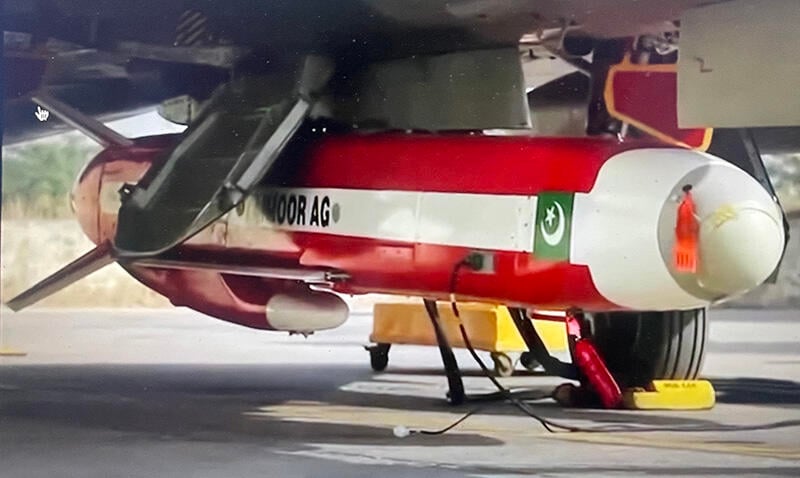
RIYADH—Pakistan’s GIDS (Global Industrial and Defense Solutions) started 2026 off with a bang, literally, when on Jan. 3 the first test-firing of the Taimoor air-launched cruise missile (ALCM) was conducted.
Dropped by a Pakistan Air Force (PAF) Dassault Mirage IIEA, the export version of the Taimoor can engage both land and sea targets at a range of up to 295 km (183 mi.) carrying a conventional warhead.
The Inertial Navigation System (INS)/Global Navigation Satellite System (GNSS)-capable cruise missile is designed to fly at very low altitudes, which is intended to enable it to effectively evade hostile air and missile defense systems. The weapon is based on the indigenous Ra’ad ALCM used by the PAF since 2011.
At the World Defense Show in 2024, GIDS boasted its biggest-ever stand at an international event with the Fatah II multi-barrel multi-launched rocket system, also with a reported export range of 290 km, taking center stage. That system is present again here this year alongside the Taimoor ALCM, Shahpar II and Shahpar III combat drones and Harba NG ship-launched cruise missile.
The company reports that the Shahpar medium-altitude long-endurance (MALE) drones have attracted a lot of international interest and today serve the Pakistan military.
Shahpar II commenced flight trials in late 2021, equipped with two Burraq 45 laser-guided munitions, a maximum takeoff weight of more than 1,100 kg (1.2 tons), and capable of flying at up to 25,000 ft., but it is unclear when it became operational. While the SATCOM-equipped Shahpar III can climb up to 35,000 ft. and has a maximum takeoff weight of 400 kg, it can be accommodated by six underwing hard points. They are among seven unmanned aerial vehicles GIDS will have on show.
Speaking at World Defense Show, GIDS CEO Asad Kamal, who has been heading up the company since 2020 and is credited for the major upturn in the company’s fortunes, says: “We want to showcase what Pakistan has developed indigenously, and we are willing to transfer technologies or transfer production to fulfill the aims of Saudi Vision 2030. The Middle East market is a natural ally market for Pakistan.”
Being displayed for the first time is the Safrah-III handheld drone jammer, which boasts a range of about 1,500 m (0.9 mi.).
Three more relatively new products in the GIDS portfolio are two long-range loitering munitions—Blaze 200 and Blaze 400—plus the Sarkash kamikaze drone.
Following the evolution of warfare in Ukraine, demand for these weapon types has risen. The Blaze systems are air-launched, weighing 25 kg and 75 kg respectively, and were seen publicly for the first time at Karachi’s International Defense Exhibition & Seminar (IDEAS) exhibition in December 2024.
They made their international debuts last December at the Egypt Defense Exhibition (EDEX). The electric Blaze 200 is primarily an anti-tank weapon with a range of up to 200 km, while the gasoline-powered Blaze 400 has a range of 400 km using GNSS guidance.
The turbojet-driven 175-kg Sarkash long-range kamikaze munition, equipped with canister-launch technology, has a 1,000-km range and is used predominantly to target high-value assets like radars, through what the company would only say are “precision-targeting capabilities.”
GIDS also offers a diverse portfolio of air-launched munitions and smart bomb kits, designed for integration on platforms like the CAC/PAC JF-17 Thunder. On show at World Defense Show is the AZB, often referred to as the Indigenous Range Extension Kit (IREK), fitted to Mk. 83 and Mk. 84 bombs, with ranges of up to 100 km, plus Al Battaar—a laser-guided bomb kit on Mk. 82 bombs (with a range of eight km).
All of these were on display alongside the JF-17C Block III at Dubai Airshow last November. “For us, Saudi is the biggest market,” CEO Kamal says. “There are a lot of companies interested in the localization of our products—that is why there is such a lot of variety at the stand.”