This article is published in Aerospace Daily & Defense Report part of Aviation Week Intelligence Network (AWIN), and is complimentary through Jul 12, 2026. For information on becoming an AWIN Member to access more content like this, click here.
BERLIN—An MBDA-led European effort to create a hypersonic glide vehicle (HGV) to inform the development of a hypersonic interceptor will also support research on hypersonic deep strike capabilities.
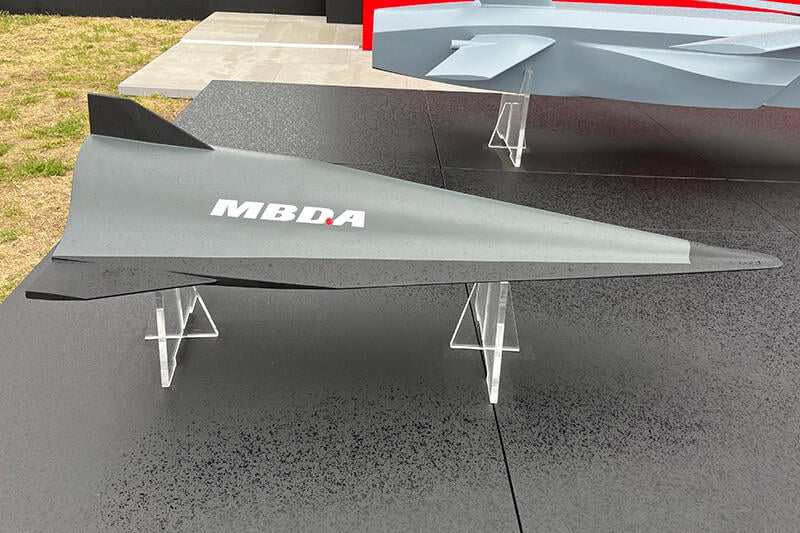
The German business of MBDA hopes to perform initial trials of the €110 million ($127.7 million) Hypersonic Radar and Optical signature collecting GLIde Vehicle (Hyroglive) hypersonic target demonstrator as soon as 2027. Scaled versions potentially likely would make their first flights using Bayern-Chemie’s Red Kite solid-fuel motor, which MBDA has identified as the potential propulsion for a sounding rocket during initial test flights. The missile company presented a model of a potential HGV at the Berlin ILA Air Show here.
The trials will be dual-hatted, company officials say, with data supporting both the development of the Twister hypersonic defense system and future developments of the Hydef and Hydis2 interceptor concepts that are being developed by different factions of the European missile industry. But it will also support wider European efforts to develop a long-range deterrent capability. Hyroglive, Hydef, and Hydis2 are all funded by the European Defense Fund (EDF). Hyroglive is receiving around €78 million of EU funding.
MBDA Germany is exploring the use of a hypersonic missile capable of penetrating an adversary’s defenses and holding strategic sites at risk, a capability that European nations currently lack.
This could eventually form part of a conventional deterrent fielded through the European Long-range Strike Approach (ELSA) initiative.
Hydef and Hydis2 will compete against each other for a future EDF-supported project called the High-End Endo-Atmospheric Interception initiative.
Development of the HGV target demonstrator is being coordinated by MBDA and supported by a range of European defense companies including Avio, Diehl, Kongsberg, Hensoldt, Indra, Spanish Missile Systems, and Thales.
The project calls for the partners to build, test and fly a basic full-scale HGV demonstrator that should be stable in flight and have the structural endurance for a “realistic trajectory with speed in the hypersonic regime,” the EU says.