This article is published in Aerospace Daily & Defense Report part of Aviation Week Intelligence Network (AWIN), and is complimentary through Aug 24, 2026. For information on becoming an AWIN Member to access more content like this, click here.

Compressed Engineering Effort Got Typhoon, APKWS To Front Line

eurofighter
Credit: BAE Systems

FARNBOROUGH, England—BAE Systems compressed 18 months of work to develop a low-cost anti-drone capability for the Royal Air Force’s (RAF) Eurofighter Typhoon into just 42 days, the company has revealed.

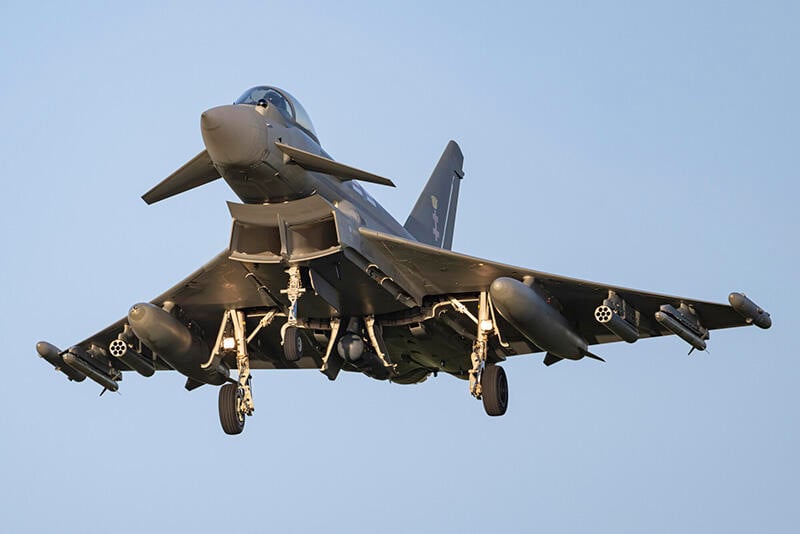
A normally lengthy weapon integration process on the fighter was bypassed to enable the Advanced Precision Kill Weapon System (APKWS) guided rockets to be installed to provide a low-cost effector to the aircraft and give it an alternative means to down Iranian Shahed one-way attack drones being used to target Middle Eastern allies at the height of the Israeli and U.S. attacks against Iran earlier this year.

Until now, the RAF had to use the MBDA Advanced Short-Range Air-to-Air Missile (Asraam) against the threat, a missile costing several times the price of a Shahed.

RAF commander Air Chief Marshal Harv Smyth had called on industry to urgently develop a low-cost means of downing the Shaheds. He told the Global Air and Space Chief’s Conference in London earlier this month that he had originally been informed it could take up to two years to get the weapon onto the aircraft. 

BAE had been studying the potential of using the APKWS on the Eurofighter since the end of 2025 and demonstrated an air-to-surface shot on the third day of the war.

The transition to establishing an air-to-air capability with the system was challenging, says BAE’s Typhoon Operational Requirements manager, Andrew Mallery-Blythe, speaking on the second day of the Farnborough Airshow.

“Intercepts inside of five miles are very dynamic,” he says. “Geometry changes very quickly, and if your attention is in the wrong place for a few seconds, you can find yourself 10 mi. behind your target instead of two or three, where you want to be.” Because the Shaheds are small, they are difficult to track, requiring the pilots to work the radar and targeting pod which provides the tracking laser for the APKWS’ guidance. Mallery-Blythe said engineers had suggested using button pushes to operate the system, but to reduce pilot workload, they elected to use controls on the Hands-On Throttle and Stick.

The air-to-air capability was demonstrated by the Royal Air Force’s 41 Test and Evaluation squadron in May, and the capability was deployed to the Middle East shortly afterward.

The “austere” capability allows pilots to make one shot at a time, with the aircraft configured to carry up to 14 rockets in two seven-shot pods fitted to the second outermost pylon on the aircraft.

Development of the APKWS capability has attracted the interest of regional Eurofighter customers who have also been using their Eurofighters for air defense against the Shaheds. 

Mallery Blythe said the said the work had been a “collaborative effort” between industry and the RAF and required some innovative engineering.

“We now have a sort of new template to do things rapidly,” he said. “It has been a long time since industry has been really tested and asked to deliver and respond to an urgent operational requirement … and this really is a life-saving capability,” he added.

Tony Osborne

Based in London, Tony covers European defense programs. Prior to joining Aviation Week in November 2012, Tony was at Shephard Media Group where he was deputy editor for Rotorhub and Defence Helicopter magazines.