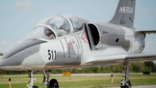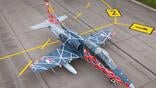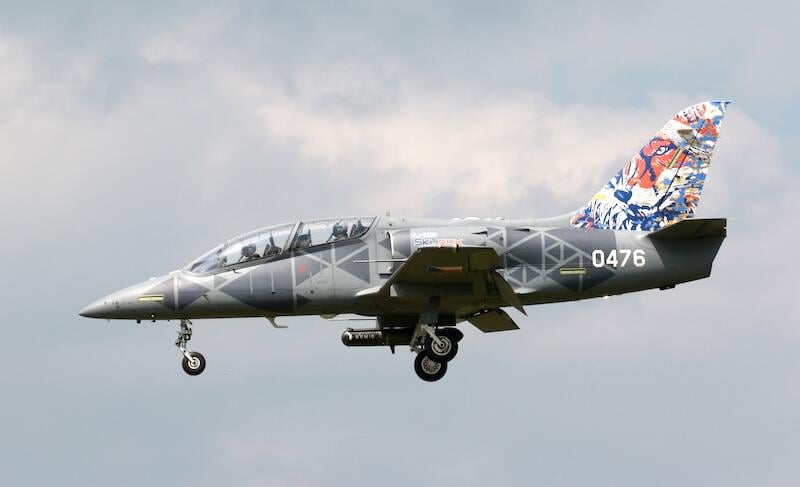
The prototype L-39NG 7001/0475 seen here with a new colour scheme specially adopted for the Dubai Airshow.
DUBAI—Aero Vodochody continues to look at new roles for the L-39NG Skyfox, offering a new counter-UAS option to prospective customers here the Dubai Airshow.
The Prague-based company has been busy continuing the development of both the L-39NG Skyfox's integrated training system and a light-attack version of the jet trainer. The Czech company is working with Israel Aerospace Industries (IAI) to hone the jet's live virtual constructive (LVC) attributes, focusing more on the ground-to-air communications.
The training configuration is finished, and the L-39NG Skyfox production line is now focused on delivering more orders. The Czech Air Force's training partner (LOM Praha's Flight Training Centre – CLV) has taken delivery of four Skyfoxes this year, but LOM exercised an option for four more of the jets on Sept. 20.
In addition, the Hungarian Air Force received five with the next three expected by the end of the year. The last four of the 12 aircraft order will be optimized for the reconnaissance role and could see the lightweight SiNAB Phoenix as one tool to fulfill that role.
Trials were being carried out on the SiNAB tactical pod in early June, but there has been no decision on a purchase because delivery of the four reconnaissance-configured aircraft is not expected until 2028.
The SiNAB pod could provide the Skyfox with a very cost-efficient counter-UAS capability when paired with laser-guided rockets, like the BAE Systems AGR-20 APKWS or Thales FZ-275RR.
One of the unique aspects of the light attack version of the L-39NG is that it can work with both Western and Eastern weapons. Jaromir Lang, the Aero L-39NG aircraft designer, says: “This is because of modifications we made to the computer system. The Vietnamese aircraft can use the Wastern weapons like rocket launchers and UB16 rockets, and OFAB bombs. We can even offer a mixture, as some potential customers have asked, like Eastern weapons and Western gun pod.”
The Vietnamese Air Force took delivery of 12 L-39NGs, designated as the L-39NG.A1s. They are light-attack versions with two pylons and a maximum takeoff weight (MTOW) of 5,370 kg (11,800 lb.), including the 350 kg fuel tanks. For fully weaponized versions, Aero plans to increase the MTOW to 5,600 kg with five pylons.
At the moment, Lang is devoting much of his time on developing the Western light-attack version, utilizing all five weapons pylons. “That means building the stores management system and negotiating with weapons suppliers for the integration of the digital munitions and gun pods,” Lang says. “Ground testing of the gun pod should commence this autumn, next year we should finish the development and fly the fully-flyable prototype and at the start of 2027 start the test-firing. We will use prototype 7001 for this work."
While Hungary is not expected to receive its last four reconnaissance-configured L-39NGs—to be designated L-39NG.R1—until 2027-28, the last L-39NG of the current order book should come off the production line soon.
It is important for the airframer that more orders come. In the latest set of Aero Vodochody's financial accounts there was a reference to two new customers, but no one at Aero Vodochody was willing to say who they are.
In September 2024, Aero Vodochody flew an L-39NG prototype to the Egyptian Airshow, where it participated in the flying day on most days. The Egyptian Air Force had the opportunity to look at the jet and fly in it as a possible Alphajet replacement.
Nigeria is also considering the Skyfox as a future L-39ZA Aero Albatros replacement when funds become available, which will not be imminent due to the upgrade and overhaul of three in 2022 and work on another three on the cards.
Ghana is also keen, but the deal for six aircraft that was signed in 2021 was humbled by the finance system. Regardless, the interest from Accra remains to replace the grounded Hongdu K-8 Korakorams.

Related Content