This article is published in Aerospace Daily & Defense Report part of Aviation Week Intelligence Network (AWIN), and is complimentary through Oct 16, 2026. For information on becoming an AWIN Member to access more content like this, click here.
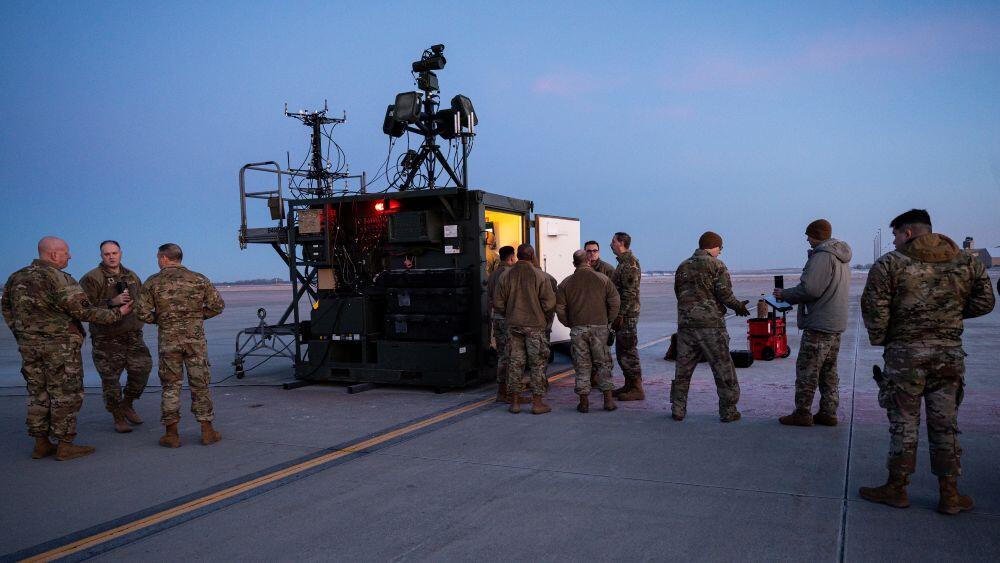
USAF personnel conduct a “Point Defense Battle Lab” exercise at Grand Forks AFB, North Dakota, in February.
NATIONAL HARBOR, Maryland—In the early days of the war against Iran, an Iranian missile attack came down on a base in the Middle East housing Americans and fighter jets—including a hit inside a hangar containing a single aircraft.
The missile strike caused the aircraft to burst into flames, and though a bunker withstood the explosions, the doors were damaged to the point where they could not open and airmen were trapped inside.
“Picture the scene: fire was spreading, an aircraft was burning only feet away,” Air Force Chief of Staff Gen. Kenneth Wilsbach recounted during a Sept. 14 speech. “Their teammates were trapped inside and they had no way out.”
As another airman was able to pry open the door, the ejection seat on the burning aircraft ignited and blew glass and metal fragments through the air as the airmen were able to escape.
The incident, which appears to have not been previously disclosed, was recounted by Wilsbach at the Air & Space Forces Association’s Air, Space and Cyber Conference here as service leadership emphasized a broader point. The current structure for air base defense is simply not enough to protect U.S. Air Force bases and aircraft. So the service announced it is taking multiple steps to address it.
First, Air Force Secretary Troy Meink announced Sept. 14 that the service was planning to create a new acquisition leader—a portfolio acquisition executive (PAE) in new Pentagon parlance—to oversee air base defense. This seemingly encroaches on the U.S. Army’s own PAE office that oversees the base defense mission as assigned to that service.
Air Force leaders have long said the Army has underinvested on base defense, and creating a new acquisition office will look to address that by bringing on new systems.
“It’s quite obvious that the challenges are out there, given the proliferation of one-way attack and other threats that we have,” Meink says. “There’s the kit side of it: How do you make sure that they have the kit they need to do the job? And that is a rapidly changing environment as well, both the threat as well as the development of the kit that the defenders are going to use.”
The Air Force is also creating a new career field for personnel specifically charged with what it calls point defense. Wilsbach says the service needs to deploy the personnel with the equipment at every base in the future to address this growing threat.
“If every base is going to be threatened, we have to have somebody who knows how to defend it. That’s a long-term objective,” Wilsbach says. “But what I’ll tell you for right now is we’re going to develop a career field and push it forward to the critical bases that need protecting most, and then we’ll expand it beyond.”
Also on Sept. 14, the Pentagon’s inspector general released a report detailing the extent that U.S. bases and other facilities have been damaged by Iran. Strikes have damaged and destroyed hundreds of buildings and other structures at bases in Kuwait, Bahran, Qatar, the United Arab Emirates, Saudi Arabia, Iraq, Oman and Jordan.