This article is published in Aerospace Daily & Defense Report part of Aviation Week Intelligence Network (AWIN), and is complimentary through Aug 24, 2026. For information on becoming an AWIN Member to access more content like this, click here.
LONDON—The Swedish Air Force wants to cut fighter turnaround times below 10 min. as it evolves its renowned dispersed operations concept to survive increasingly sophisticated Russian targeting.
A ground crew consisting of one officer and five conscripts currently takes 15-20 min. to rearm and refuel a Saab Gripen for an air-to-air sortie, but the service aims to cut that to less than 10 min., Swedish Air Force Chief Maj. Gen. Jonas Wikman told the Swedish Air Force Fan Club on the eve of the Farnborough Airshow.
Currently, such turnarounds are performed with the engine shut down, but the service is currently trialing engine-running refueling and arming.
“It might be argued that we cannot move, we cannot hide at such a pace, and that we are in the [adversary’s] targeting cycle,” Wikman said.
“But we are sticking to the [dispersed basing] concept and continue to develop concept…going towards a lighter footprint in order to keep at a higher pace.”
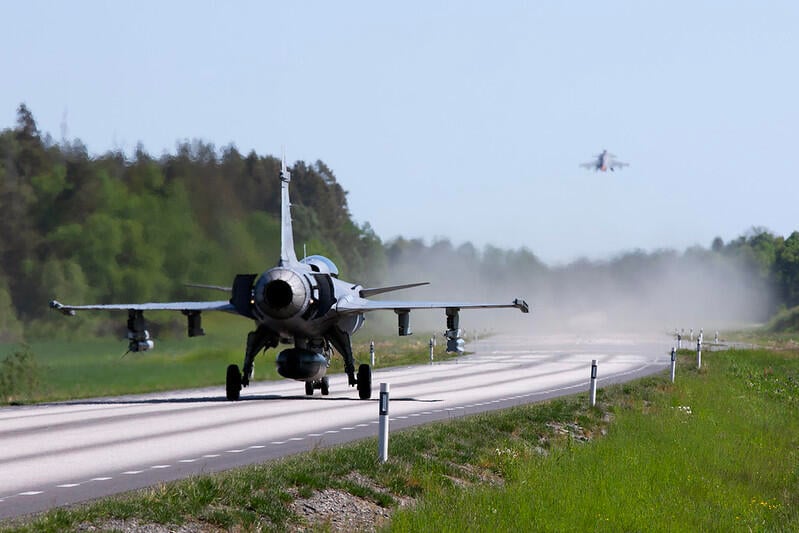
Dispersed basing has been used by the Swedish Air Force since the 1960s—a lesson learned in part from the 1967 Six-Day War when Israel destroyed the Egyptian Air Force on the ground. The concept has been constantly adapted and every fighter type developed by Sweden has been designed to be maintained in austere conditions and operate from short airstrips and road runways. The aim is to make tracking the movements of Swedish Air Force aircraft more difficult for the adversary, forcing them to expend more effort in trying to locate them.
Today, Sweden is regarded as one of NATO's leading practitioners of dispersed air operations, and alliance air forces are working on similar concepts, coined Agile Combat Employment or ACE.
Ukraine has adopted a similar operational concept, but Russia is working hard to identify potential operating sites and is actively sending loitering munitions to monitor those it has identified. Those munitions then dive on targets if aircraft are spotted moving out of shelters.
Sweden has access to hundreds of airfields, airstrips and road bases that could be used during a conflict. But the concept has limitations, particularly as the air force expands its offensive counter-air (OCA) mission alongside its traditional defensive counter-air (DCA) role.
Long-range strike weapons such as the KEPD 350 Taurus air-launched cruise missile—being integrated on both Gripen C/D and Gripen E aircraft—cannot be dispersed as easily because of their size, limited numbers and the specialist mission-planning and loading equipment they require.
Supporting this push to DCA operations are new space-based capabilities including optical and synthetic aperture radar satellites for intelligence gathering as well as the upcoming delivery of the new GlobalEye airborne early warning platform.
These changes reflect the Swedish Armed Forces' preparations for what Wikman described as a more prolonged conflict, rather than the Cold War scenario of repelling an invasion of Sweden.
“Our sense of urgency is on quite a high level…we are preparing to defend ourselves against a much larger enemy,” said Wikman.
“The atmosphere in the armed forces…is that it is time to prepare—to prepare to be able to use your capabilities if needed.”
That sense of urgency was also driving the introduction of new platforms with the new Gripen E arriving in growing numbers.
The introduction of the larger, more powerful Gripen E has been "going very successfully," Wikman says, with availability exceeding that of the proven Gripen C/D fleet.
“We know we will run into problems…probably some we have never seen before because the airframe is completely new, but the pace is going good right now,” he added.
The air force is currently working to understand the strengths of the three versions of the Gripen now on charge and how they can work together best, with the Gripen E’s sensor suite and electronic warfare showing promise. The order by Ukraine of the Gripen E and the transfer of Gripen C/Ds to Kyiv looks also set to strengthen the Swedish Air Force.
Under current plans, the Swedish Air Force is planning to purchase 60 Gripen Es to operate alongside 60 Gripen C/Ds for a total of around 120 aircraft, up from around 100 Gripen C/Ds in service now. With the transfer of Gripen C/Ds to Ukraine, the Swedish government plans to purchase another 12 Gripen Es, expanding that fleet to 72. The 16 Gripens C/Ds being donated to Kyiv will come from the surplus 40 aircraft being withdrawn from service, leaving Sweden's overall fighter fleet to grow to around 130 aircraft.
“That is quite a good exchange rate for me,” Wikman said.