This article is published in Aerospace Daily & Defense Report part of Aviation Week Intelligence Network (AWIN), and is complimentary through Mar 20, 2026. For information on becoming an AWIN Member to access more content like this, click here.
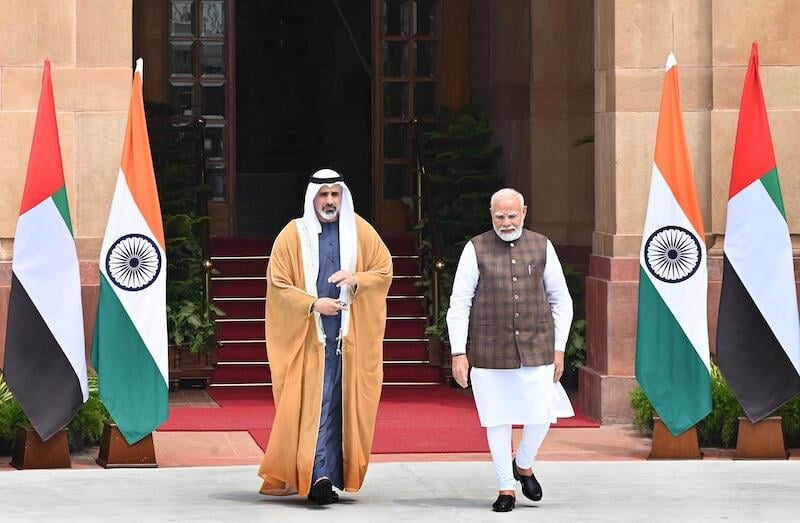
Credit: Arvind Yadav/Hindustan Times/Sipa/Alamy
India and the United Arab Emirates (UAE) are working toward a strategic defense partnership following meetings between the leaders of the two countries.
During a brief visit to New Delhi on Jan. 19, UAE President Mohamed bin Zayed Al Nahyan and Prime Minister Narendra Modi signed a letter of intent to work on the framework agreement for a defense partnership.
Precise details of the agreement have not been released, but the likely aim is to form a pact similar to that agreed by Pakistan and Saudi Arabia at the end of 2025. It follows a breakdown in the diplomatic relationship between Riyadh and Abu Dhabi over support for different factions in Yemen.
The letter of intent follows an exchange of visits by the respective service chiefs and commanders of the armies, navies and air forces of both countries and the successful conduct of bilateral military exercises, a joint statement from the two countries reads.
In response to questions from journalists about the planned partnership, Shri Vikram Misri, India’s foreign secretary, said the partnership would explore defense industrial cooperation, defense innovation, linkages on training, education and potentially special forces operations.
Misri said the creation of a partnership is not necessarily a response to any specific event in the Middle East region.
It is unclear whether the partnership might extend to protection under India’s nuclear umbrella, for example, as has been suggested for the Saudi-Pakistan agreement.
As well as agreements on defense, the two leaders also signed a letter of intent for closer cooperation between the Indian National Space Promotion and Authorization Center and the Space Agency of the United Arab Emirates that could lead to the development of joint infrastructure for space, including launch complexes, manufacturing and technology zones, an incubation center and accelerator for space startups, as well as a training institute and exchange programs.
The two countries will also create a special investment region in Dholera, Gujarat, which will see the development of infrastructure including a new airport, pilot training school and a maintenance, repair and overhaul facility.