This article is published in Aerospace Daily & Defense Report part of Aviation Week Intelligence Network (AWIN), and is complimentary through Jul 12, 2026. For information on becoming an AWIN Member to access more content like this, click here.
MQ-9B
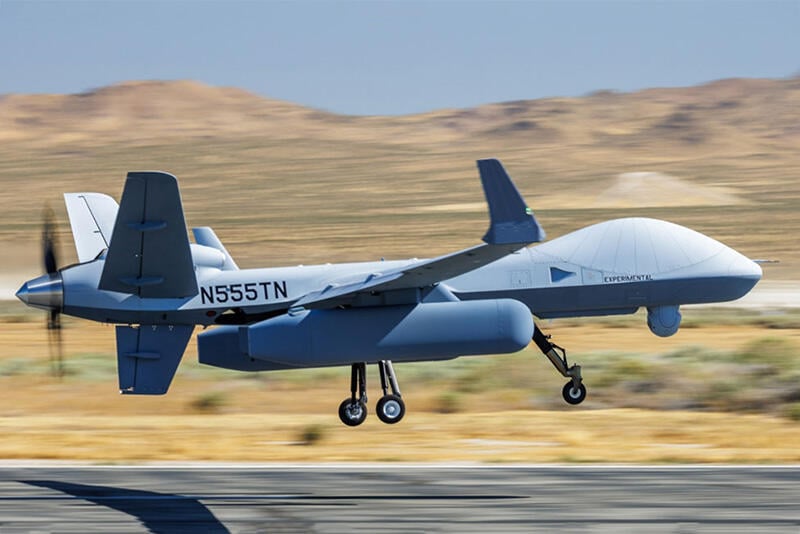
BERLIN—In response to U.S. Air Force leaders saying they want to backfill a critical shortage of MQ-9A Reapers in the short term and switch to a significantly cheaper aircraft for the same mission in the long term, the manufacturer plans to offer the same solution: a proposal for the larger MQ-9B SeaGuardian.
The proposal by General Atomics Aeronautical Systems Inc. (GA-ASI) President Dave Alexander during a June 10 interview on the sidelines of the ILA Berlin airshow here faces an uphill struggle. It would require the Air Force to operate a mixed fleet of MQ-9A and MQ-9Bs in the short term and runs against a U.S. military trend favoring lower-cost proposals from startups and nontraditional defense contractors.
But Alexander insists the MQ-9B offers the only viable solution to a problem exposed by the U.S. and Israeli air campaign against Iran since Feb. 28, which has proven costly to a dwindling fleet of MQ-9As. Citing public reporting, the Congressional Research Service informed lawmakers last month that 42 Reapers could have been shot down.
But Alexander pushes back against questions about whether the losses bring the operational viability of the MQ-9 into question.
Air war planners deliberately charged the MQ-9A, which lacks onboard self-protection systems, with the dangerous task of hunting mobile Iranian targets, including surface-to-air missile launchers, Alexander said.
“They will not put a manned [aircraft] into these dangerous areas, where they have all these mobile targets that come out of a cave, go back in the cave,” Alexander said.
As evidence, Alexander cited congressional testimony by Air Force Chief of Staff Gen. Kenneth Wilsbach, who told lawmakers that the MQ-9A ranked as the “most valuable” aircraft in the U.S. inventory during the conflict.
“Without the MQ-9, you’re not hitting those mobile targets, so MQ-9 is just saving the day,” Alexander said.
But the rate of losses has forced the Air Force to consider near-term and long-term options for replacing a fleet of MQ-9s that stood at less than 140 in early May.
Ordering a new batch of 12,500-lb. MQ-9As is no longer possible. Due to an absence of U.S. orders, GA-ASI closed the only assembly line nearly two years ago, Alexander said. GA-ASI continues producing the nearly 14,000-lb. MQ-9Bs for the foreign market, with more than 10 orders for more than 100 aircraft on contract so far.
“Why would we activate a [MQ]-9A line unless somebody said, ‘I want to buy a gazillion of them,’” Alexander said. “Then ... we’ll consider it. But they don’t [want to order that many]. They just want to backfill bits and pieces here and there.”
That means GA-ASI is responding to the Air Force for the short-term replacement need with deliveries of the MQ-9B and shifting the domestic inventory to a mixed fleet.
“They’re still considering that, and we’re here to help,” Alexander said.
But Air Force leaders also have been clear that they do not view any version of the MQ-9 as a long-term solution for the medium-altitude, long-endurance, hunter-killer role. Instead, Air Force officials released a request for information (RFI) in April for an uncrewed aircraft that could perform the intelligence, surveillance and reconnaissance (ISR) mission at a much lower cost than the Reaper. Several startups have responded to the Air Force’s market survey.
“What they want, is [an] MQ-9 at one-third of the cost,” Alexander said.
“There’s a lot of private equity, [venture capital]-backed companies that have never built a thing in their life, touting production [cost] numbers, and buyer beware. That’s all I got to say,” Alexander added.
Instead, GA-ASI will respond to the Air Force’s long-term need for an attritable ISR aircraft with the SeaGuardian, too.
“You’ll see this next-generation RFI come out, and we will be all over that, like you can’t believe,” Alexander said. “We will be on that with a hot production line. It will be an MQ-9.”