This article is published in Aerospace Daily & Defense Report part of Aviation Week Intelligence Network (AWIN), and is complimentary through Oct 21, 2026. For information on becoming an AWIN Member to access more content like this, click here.
Army Interest Ballooning For Stratospheric Operations
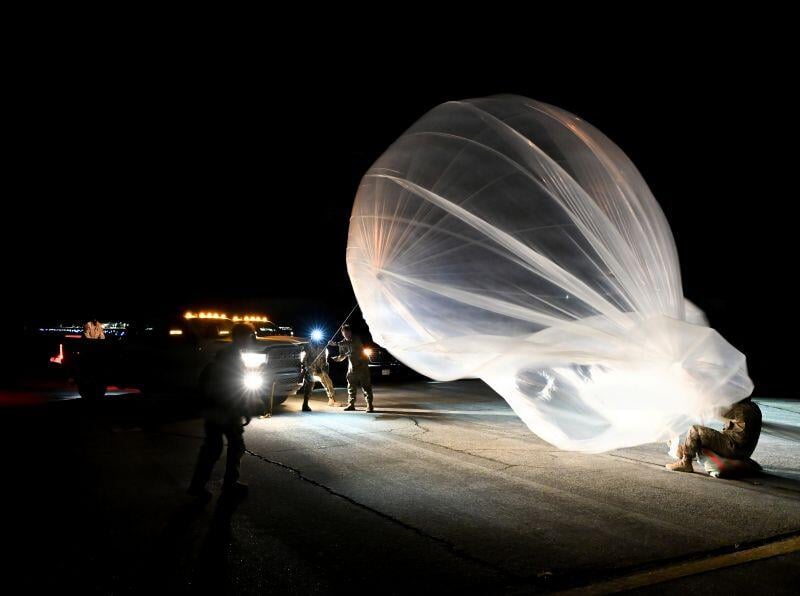
U.S. Army Soldiers from Multi-Domain Command–Europe deploy high-altitude balloons on April 22.
The U.S. Army wants to expand its space portfolio into stratospheric operations with multiple experiments on the horizon, officials said this week at the Association of the U.S. Army’s annual convention in Washington.
As the service has redefined its space expertise and created a new operations branch for the domain, leaders see an opportunity to use balloons and other technology that operate between 60,000-100,000 ft. above the ground to interdict adversary capabilities from space. New pilot programs are in the works to perform such experiments next year, Lt. Gen. John Rafferty, commander of the Army’s Space and Missile Defense Center (SMDC), said in an Oct. 14 media roundtable.
Rafferty said he has come around in the last several years to the utility of high-altitude balloons after witnessing a training event in Morocco. “After I understood better how they work, their ability to station-keep, and then their ability to sense and even deliver effects from high altitude . . . I went from nowhere to a huge believer very quickly once I saw them in action,” he said.
Those experiments will take place over the next couple of years, Col. Joseph Mroszczyk, director of SMDC’s Transformation Integration Directorate for Space Superiority, told reporters.
The Army has experimented with high-altitude balloons in the Pacific theater, he noted. Mroszczyk said that in his current role he is advocating for a family of stratospheric systems of varying sizes so that the Army can exploit a “transition point” between the traditional bounds of the air and space domains.
“Being able to go and take advantage of winds that are pushing you where you want to go already, to be able to get either launched effects or other types of payloads for sensing and communications and extension of your launched effects portfolio is a way that we can help exploit the stratosphere,” he said.
The experiments will explore a variety of payload options, Mroszczyk said. “I wouldn’t say that we’re going to hold back from opportunities and options that would include something that could be kinetic in nature,” he said.
The Army is exploring a broad spectrum of platforms for stratospheric operations and plans to issue a report to determine which pathway to take, Andrew Evans, director of the Strategy and Transformation Office of the Army Deputy Chief of Staff for Intelligence, told Aviation Week Oct. 12.
The entire Joint Force is interested in the promise of high-altitude balloons, in part due to their low cost, Evans said. But recent tests with foreign allies and partners experimenting with “swarms” of balloons have reinforced long-standing challenges to control and sustain the platforms, he noted.


Related Content