This article is published in Aerospace Daily & Defense Report part of Aviation Week Intelligence Network (AWIN), and is complimentary through Jun 24, 2026. For information on becoming an AWIN Member to access more content like this, click here.
The U.S. Air Force will move forward with fielding the Collaborative Combat Aircraft in development from Anduril and General Atomics Aeronautical Systems Inc., while continuing a competition to select the autonomy to control the systems.
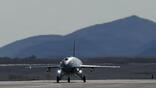
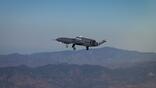
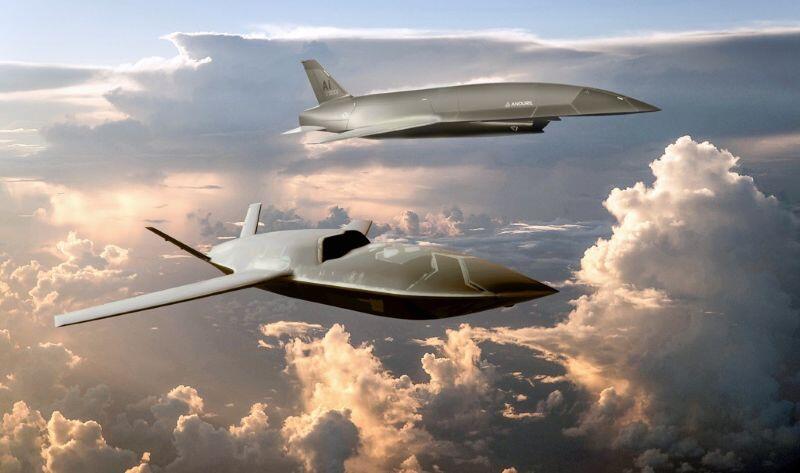
The service on June 17 announced it awarded engineering and manufacturing development and production contracts to the two companies, which had been developing their prototypes under a previous award in April 2024. This means the Anduril YFQ-44A and General Atomics YFQ-42A will drop the prototype “Y” designation and be fielded as FQ-44A and FQ-42A, respectively.
Col. Timothy Helfrich, the Air Force’s program acquisition executive for fighters and advanced aircraft, said as part of the CCA Increment 1 down selection process: the three other companies originally considered—Boeing, Lockheed Martin and Northrop Grumman—were also considered as part of a “resolicitation” and the two incumbents were selected because they demonstrated the ability to meet the service’s cost requirements and schedule.
“At the core, these are the same aircraft designs, however they have evolved to ensure that they will meet the operational needs … They are the same [designation] because … at their core, they are fundamentally the same aircraft,” Helfrich told reporters.
Anduril in an announcement said it will deliver an initial set of semi-autonomous FQ-44s for continued testing, validation and ultimately operational fielding. Anduril says it is the first time a new company has won a fighter aircraft program since the 1970s.
“In its current configuration, FQ-44 has the ferry range necessary to deploy anywhere in the world. It can take off and land on a short field. It has a combat radius that significantly exceeds the combat radius for current crewed fighters, and the speed to keep up. It has the payload capacity required to make a real impact on the battlefield,” says Mark Shushnar, Anduril’s vice president for autonomous airpower. “And, across hundreds of hours with Air Force experts and thousands of simulations, we have demonstrated that FQ-44 will do more than just survive the high-end fight: it will excel.”
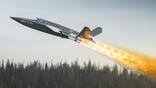
General Atomics ASI in a statement said the order is a significant milestone to begin delivery of production aircraft. The company moved from contract award to first flight in 15 months, “one of the fastest rollouts of a new fighter in history.” The YFQ42A Dark Merlin is heavily based on the XQ-67A, which served as a flying prototype for its concept. It is the basis for what the company calls its Gambit series, which includes variants for other roles such as long-endurance surveillance and air-to-ground strike.
“Moving to production on FQ-42A is the result of an extraordinary partnership and many years of investments between General Atomics and the U.S. Air Force,” GA-ASI President David Alexander said in a statement. We’ve been preparing for this order, and manufacturing is already well underway.”
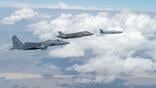
The costs, for now, are classified, though Helfrich says the Air Force is beating the goal of having one CCA cost less than a third of an F-35. The service expects to award production in fiscal 2027 once the budget is enacted. The service plans to field approximately 150 CCAs by the end of the decade, with follow-on increments coming. The Air Force plans for 1,000 overall. Helfrich says the service wants to move quickly on the program, with the production awards coming four months earlier than expected.
Also on June 17 the Air Force announced that Anduril, RTX-Collins and Shield AI have been down selected to continue developing autonomy systems for the first increment. The other companies considered were General Atomics, Lockheed Martin and Northrop Grumman.
The six-month contract announced June 17 will cover a period of performance to advance mission autonomy to meet the service’s initial operational capability criteria as best they can. Then, there will be an assessment of their status for another down select for another six-month option, Helfrich says. At the end of this phase in the summer of 2027, the Air Force will select one vendor.
The Air Force is part of an agreement with the Marine Corps, Navy and U.S. Special Operations Command on a common baseline for key components of CCAs, to include autonomy along with the government reference architecture and datalink. This was part of the requirements for the contracts to ensure the autonomy is being developed in line with the needs of the services, Helfrich says.
In addition to the mission autonomy, which was awarded, the Air Force is also competing a separate command and control effort with all vendors still able to propose for that, he says.