This article is published in Aerospace Daily & Defense Report part of Aviation Week Intelligence Network (AWIN), and is complimentary through Oct 31, 2026. For information on becoming an AWIN Member to access more content like this, click here.
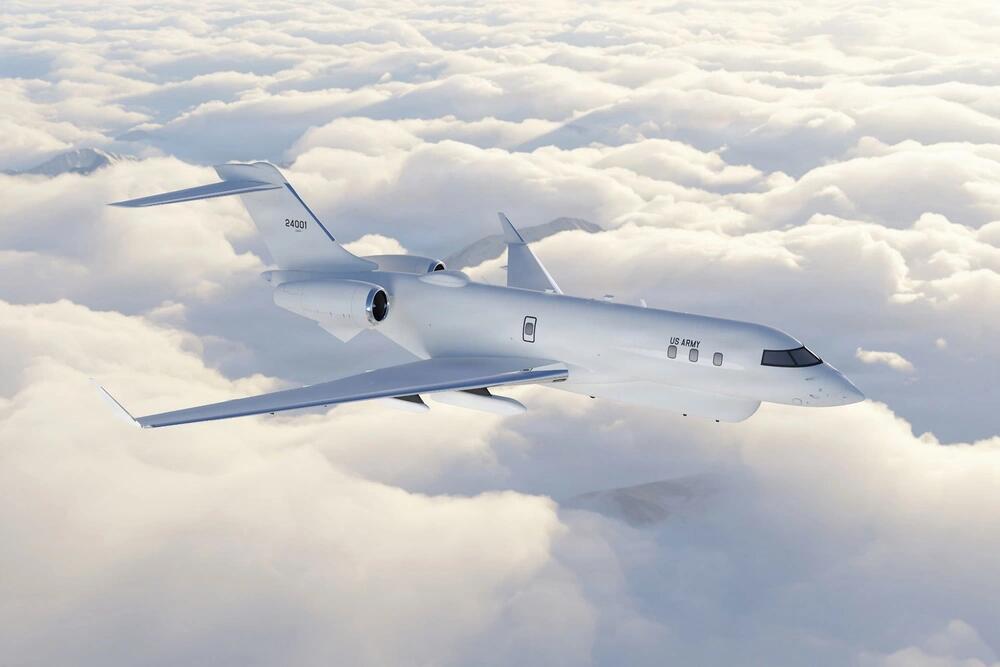
ME-11B rendering.
The U.S. Army is reassessing how it will continue to operate a fleet of privately owned and operated prototypes as it both stands up its own program of reconnaissance jets and reassesses how it collects intelligence from the ground to the stratosphere.
The Army earlier this month posted a notice that said it intended to bring the contractor-owned, contractor-operated fleet of intelligence, surveillance and reconnaissance (ISR) business jets into its own fleet, Aviation Week first reported. The notice said the Army intended to award fixed-price contracts to L3Harris Technologies, MAG Aerospace and SNC for the aircraft.
But the notice was quickly deleted after it created confusion among the companies and within the service.
“There is no, and I’ll be very clear about this, there is no plan for the Army to procure the contracted assets that we have today,” says Andrew Evans, director of the Strategy and Transformation Office of the Army Deputy Chief of Staff for Intelligence. “Those are delivered as a service-based contract to the Army; they’re doing great work.”
Evans explains that the Army’s Contracting Command is “trying to help us achieve the vision of being more efficient with every dollar that we spend, and that’s really important for me to relay.” The solicitation will be reposted with different language clarifying that the aircraft will continue as contractor-owned, but the service is exploring other ways to keep them flying at a lower cost. The previous notice created “a bit of confusion” for industry, Evans said, a sentiment shared among industry officials.
L3Harris is operating the Airborne Reconnaissance and Electronic Warfare System (ARES), a Bombardier Global 6000/6500 series jet with sensors for intelligence gathering. MAG and SNC each operate two 6500s as Army Theater Level High Altitude Expeditionary Next ISR (ATHENA) prototypes.
Evans tells Aviation Week these prototypes, along with a similar aircraft built and operated by Leidos, had the mission of continuing to provide Army intelligence after the retirement of the RC-12 Guardrail and MC-12 Enhanced Medium Altitude Reconnaissance and Surveillance System fleet. They are also guiding the requirements for what is becoming the ME-11B High Accuracy Detection and Exploitation System. SNC is the prime contractor for the new fleet, with the first prototype expected to be completed by year's end. A second will follow in 2027 and the third more advanced version will be modified over the next two years. This schedule is dependent on timely funding and could be impacted by an extended continuing resolution.
The new contract plan will keep the prototypes operating as ME-11Bs come online, though the specific timeline is not set, Evans said in an interview at the Association of the United States Army’s annual convention Oct. 12-14.
“I don’t think it’s quite clear how that transition will occur, in time and space, because a lot of that depends on the delivery timeline of the HADES aircraft themselves,” he says. “But as they come online and they’re available for us to use ... then we’ll start the transition.”
The Army is still working toward the plan of six ME-11Bs, as directed by last year’s Army Transition Initiative (ATI). This is down from as many as 14 that were originally planned.
Under ATI, and current Acting Army Chief of Staff Gen. Christopher LaNeve’s new guidance, the Army’s intelligence community is looking broadly at how it will provide the service intelligence.
“This is a super sensor-saturated environment that we’re now in, and so we used to have the benefit of what we would describe just loosely as a sanctuary,” Evans says. “This ability to hide, maybe reconstitute forces, be able to protect forces from a place of relative safety. And, I think as you look at the world and you look at the threat, that might be something that’s a relic of a bygone era.
“Our formations can now be seen almost anywhere in the world ... If you can be seen, you can be targeted. If you can be targeted, you can be killed.”
While the Army is developing the current systems, Evans says there are emerging plans to add “a lot of additional, complementary capability” to fight in a more distributed way. This includes autonomous systems with both surveillance and kinetic capabilities, and a large need for the ability to analyze vast amounts of data collected by different systems.
“When you start talking about mass attritable and highly scalable swarms of systems, synchronizing that type of data is a different value proposition,” Evans says. “It’s much more complicated.”
The Army has also been experimenting with high-altitude balloons, including a recent demonstration that focused both on the effectiveness of collecting data from different sensors and the simple physics of operating the balloons.
“We’re all trying to figure out how do you employ this type of capability, if you also have to contend with the fact that you cannot directly control, necessarily, where they go all the time,” he says.
The recent exercise validated a lot of assumptions, with a final report expected soon. This in turn will inform whether the Army decides to create a program of record for high-altitude balloons or other high-altitude platforms, he says.

Related Content