This article is published in Aerospace Daily & Defense Report part of Aviation Week Intelligence Network (AWIN), and is complimentary through Jul 12, 2026. For information on becoming an AWIN Member to access more content like this, click here.
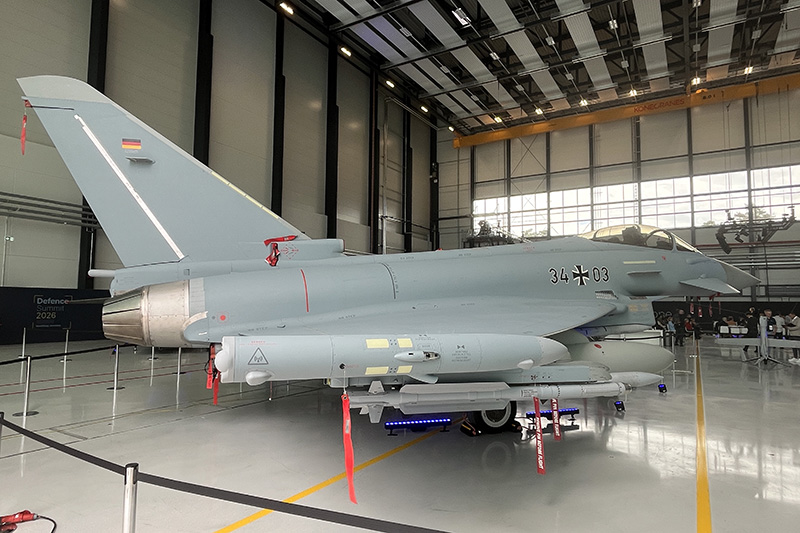
Germany’s first Tranche 4 Eurofighter was displayed at the Airbus Summit in Manching in May.
BERLIN—With Germany taking the lion’s share of new-production Eurofighters amid the combat aircraft’s renaissance, Airbus Defense and Space’s final assembly line in the Bavarian city of Manching has not been this busy since the mid-2010s.
Almost 150 Eurofighters are currently on order, with partner nations Germany, Italy and Spain all placing follow-on purchases. Turkey has become the latest export customer, with an order for 20 new-build aircraft.
Of that 150, Germany is set to take around one-third. It has ordered 58 Eurofighters across Tranche 4 and Tranche 5 for delivery into the 2030s. Thirty-eight Tranche 4 aircraft ordered through the Quadriga program will replace Germany’s current, difficult-to-upgrade fleet of Tranche 1 aircraft. Twenty Tranche 5 models contracted last October will help to replace the Panavia Tornado, which is due to leave German service at the end of the decade.
Manching will assemble all these aircraft—and potentially others for export opportunities where Germany is the lead nation.
There is also a renewed development and testing effort to bring new capabilities onto the aircraft to support emerging missions and to further future-proof the four-nation fighter.
It all adds up to a busy time for the German Eurofighter program.
“There is a big momentum,” Andreas Hammer, head of combat air systems at Airbus Defense and Space, tells Aviation Week ahead of the ILA Berlin air show.
“Everybody who is involved in creating this momentum for the Eurofighter, they are all convinced that the Eurofighter is indeed the backbone of the air forces right now,” he says.
As well as Eurofighter production in Germany, Hammer also manages Spanish final assembly of Eurofighters in Getafe near Madrid.
Spain has ordered 45 aircraft across two programs: Halcon I and Halcon II. Getafe formally rolled out its first Tranche 4 aircraft on June 1. Manching’s first Tranche 4 appeared outside in April and made a public debut at Airbus’ Defense Summit in May.
Hammer says Manching’s Tranche 4 will fly first, however. Engine ground runs on the first two Quadriga aircraft are already underway, and electrical system tests have advanced, with a first flight expected in July.
The most significant change in the Tranche 4 aircraft is the introduction of an active electronically scanned array (AESA) radar. Germany and Spain will be the first of the Eurofighter partner nations to receive an AESA-equipped aircraft.
Until now, AESA-equipped Eurofighters have been exported to Kuwait and Qatar. Germany and Spain are currently slated to receive the European Common Radar System (ECRS) Mk.1, developed by Hensoldt and Indra, but the complete radar is not yet ready.
In the interim, German and Spanish aircraft will receive the Radar 1 Step 0 configuration, like that already fielded on Kuwaiti and Qatari Eurofighters. A phased approach will follow to bring the production-standard Radar 1 to front-line Eurofighters in 2027.
“We are well advanced with the development of the Mk. 1 radar,” Hammer says. “We have installed it in our roof labs in Manching, and it is monitoring the Munich skies, where it is seeing a lot of flying objects,” he says.
The next step will be to get the radar installed on a new flying testbed. Airbus has modified German aerospace center DLR's Advanced Technology Research Aircraft A320 with a Eurofighter nose, and it will take its first flight with a prototype Radar 1 after the summer break, Hammer says.
As part of the testbed’s development effort, engineers have installed a mock-up Eurofighter cockpit in the A320 that will be linked to the radar, allowing engineers to see how the aircraft’s avionics works with the radar.
“This way we will be able to trigger a lot of short iteration cycles in order to improve it [the radar] as quickly as possible,” Hammer says. “I think [the flying testbed] is a real game changer.”
Work is also progressing with Saab on the development of a suppression and destruction of enemy air defense (SEAD/DEAD) capability for the German Air Force’s Eurofighters, allowing the aircraft to take on that mission from the Tornado Electronic Combat Reconnaissance (ECR) version.
Integration of Saab’s Arexis emitter locator system—to track down adversary radars—is well advanced, as is work on the integration of what Hammer calls the “effector,” the Northrop Grumman Advanced Anti-Radiation Guided Missile.
Just as the latest Eurofighter tranches introduce AESA radar technology, the SEAD/DEAD mission will also see the aircraft “enter the [artificial intelligence] era,” Hammer says. European defense artificial intelligence specialist Helsing is partnering with Saab on using the technology as an electronic warfare support tool.
“The aircraft ordered by Germany, Italy and Spain and due to be delivered through the 2030s are going to fly until at least the 2060s, so there is still a long path ahead for adding new capabilities," Hammer said.