This article is published in Aerospace Daily & Defense Report part of Aviation Week Intelligence Network (AWIN), and is complimentary through Aug 24, 2026. For information on becoming an AWIN Member to access more content like this, click here.
FARNBOROUGH, England—Tekever has unveiled a new rotary wing uncrewed air system that it hopes will help the company secure a chunk of the growing uncrewed heavy-lift multi-copter market.
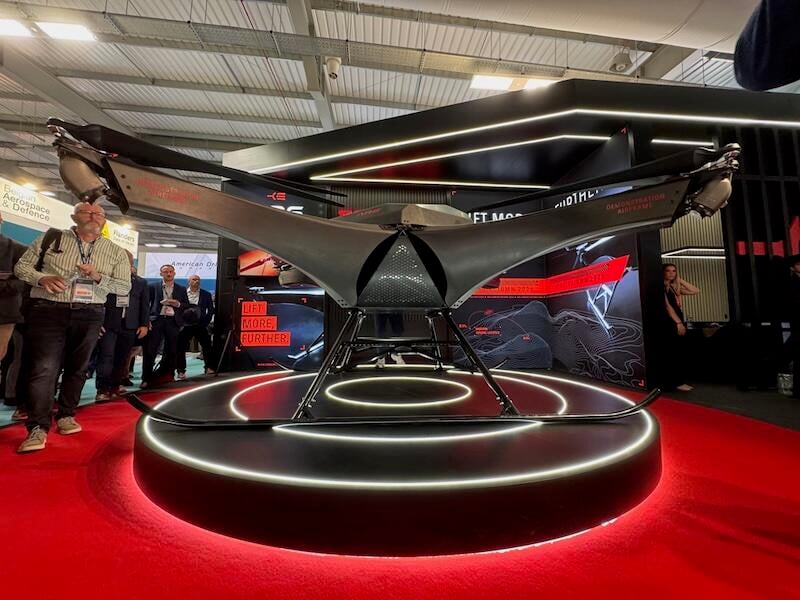
The company unveiled its new AR6 platform, the first of what it describes as a family of scalable heavy-lift autonomous systems, on the second day of the Farnborough Airshow.
Tekever says its combustion-engined AR6 will deliver significant range and payload performance improvements over electric vertical-takeoff-and-landing systems. Tekever claims the “entry-point” AR6 with its maximum takeoff weight of 700 kg (1,540 lb.) will be able to deliver payloads of 200 kg over distances of around 500 km (310 mi.).
The airframer claims its approach solves what it says is a fundamental design problem with electric-powered air systems: As the systems scale up, they require increasingly heavier batteries and electric motors, as well as complex rare earth materials in both of those components.
Tekever says it turned to digitally controlled hydraulics pumps and motors, a technology developed by Scottish company Flowcopter, to boost the performance of the AR6. These digitally controlled hydraulics control the pressure out to each arm and connect with a hydraulic motor that delivers thrust.
“If you try to use conventional hydraulics, you do not have enough control and you lose a lot of energy,” Karl Brew, Tekever UK’s managing director, tells Aviation Week.
“When you digitize that pump, the valves are opening and closing, you can create enough control to run a quadcopter and maneuver, and you save all your energy because you're not losing it in the system.”
That core technology has been flight-tested by Flowcopter for several years but has now been drawn into the AR6 program, Brew says.
Flowcopter has previously test flown a platform called FC100, which that company has demonstrated to the U.S. Army and the UK military.
Tekever says the AR6 technology has commercial and civil applications, including logistics, medical support and humanitarian relief. The AR6 tech also forms part of the company’s offering for Project Nyx, a UK program to develop an autonomous adjunct to support the British Army’s Apache attack helicopter fleet. Tekever was one of four companies shortlisted for the program in May alongside Anduril, BAE Systems and Thales. The military variant of AR6 will also be able to fully operate without any reliance on global navigation satellite services and includes features for swarming, crewed teaming and survivability.
Platform development had also taken lessons from Tekever systems deployed in Ukraine.
Tekever plans to do what Brew describes as “core production” for the AR6 for both civil and military markets at its newly opened facility in Swindon, England, but the company will propose localized customization for different markets where appropriate. Production is set to begin in Swindon from the end of 2026.
“AR6 represents the next evolution of our autonomous capability,” said Tekever CEO Ricardo Mendes.