This article is published in Aerospace Daily & Defense Report part of Aviation Week Intelligence Network (AWIN), and is complimentary through Oct 16, 2026. For information on becoming an AWIN Member to access more content like this, click here.
NATIONAL HARBOR, Maryland—New defense industry player Swarm Aero unveiled the Gamera uncrewed aircraft system (UAS) on the opening day of the Air, Space and Cyber conference, revealing the product of a nearly five-year, largely secret effort to offer the U.S. Air Force a replacement for the MQ-9A Reaper with a similarly-sized aircraft capable of swarming.
The unveiling by the Oxnard, California-based startup reveals the Gamera as a new twist on several familiar design concepts in the large UAS market.
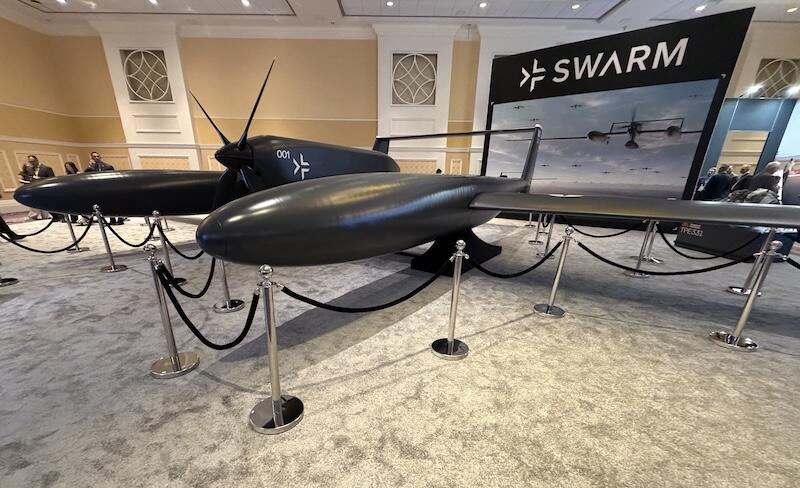
Swarm Aero’s Gamera is powered by the MQ-9 family’s identical Honeywell TPE731 turboprop engine, and adopts the twin-boomed design of the Reaper’s international competitor—the Israel Aerospace Industries Heron TP UAS. It also features the latter’s boom-connecting horizontal stabilizer, evoking the layout of the North American Rockwell OV-10 Bronco.
A key difference on the Gamera is the distinctive engine placement in a nacelle mounted atop the wings between the twin booms. The turboprop propeller is placed forward of the wing, creating a tractor-pull configuration and avoiding the pusher approach of the Reaper and Heron TP. The model includes a munition resembling the Lockheed Martin AGM-158C Long-Range Anti-Ship Missile loaded beneath the engine nacelle. Because the payload store would interfere with the nose wheel of a retractable, tricycle landing gear, the Gamera is fitted in a rare quad-gear layout, with two sets of struts and wheels positioned inside each boom.
Besides the Gamera’s distinctive looks, the key design choice for operating the proposed UAS is revealed in the company’s name. Instead of the two- or four-person crews required to operate a single Reaper or Heron TP, Swarm Aero designed its control system to allow a single operator to manage up to 35 Gamera UAS in flight at the same time.
To make the economics of operating swarms of large UAS possible, Swarm Aero adopted an automated manufacturing system for the composite airframes and a modular avionics system, seeking to lower the unit price by at least one-third compared to the roughly $30 million pricetag of a General Atomics Aeronautical System Inc. (GA-ASI) MQ-9B.
The Gamera project reflects a nearly five-year effort by Swarm Aero co-founders Danny Goodman, Peter Kalogiannis and Oliver Palmer. By 2022, the trio had raised $59 million in seed money to hire 75 people and launch Swarm Aero, with the goal of building the largest swarming UAS in the market.
At the time, the Air Force was still thinking through its strategy to replace the Reaper, the 12,000-lb. UAS that defined the long-endurance, hunter-killer mission. In June 2020, the Air Force published a request for information for a “future medium altitude UAS ISR [intelligence, surveillance and reconnaissance]/strike” system, but provided little follow-up in the public domain.
In the meantime, the Swarm Aero founders busily honed their concept for a new aircraft. Under the company’s original name, “Autonomous Defense Technologies Corp.,” Swarm Aero received a string of small contracts from the Air Force Research Laboratory, which helped them develop their approach to low-cost and high-volume manufacturing, plus designing a large, swarming UAS for contested logistics, electronic warfare and ISR. The company received a design patent in August from the U.S. government for an early version of the Gamera concept.
Also earlier this year, the AFRL followed-up with a $10 million award to Swarm Aero focused on helping set the company up for mass manufacturing a large UAS.
By that time, a panel of new Air Force leaders had decided what they wanted in a Reaper replacement. In May, the Defense Innovation Unit, an acquisition agency, published requirements for a new fleet of Massed Modular Aircraft (MMA), seeking a long-range UAS that could carry at least one of the 2,800-lb. LRASMs, along with a payload capable of detecting and tracking targets for such a weapon.
Anticipating a new threat to the company’s grip on the hunter-killer UAS mission, GA-ASI has already revealed the proposed Wildfire UAS with a configuration capable of launching two AGM-158Cs or up to four Kongsberg Joint Strike Missiles.