This article is published in Aerospace Daily & Defense Report part of Aviation Week Intelligence Network (AWIN), and is complimentary through Aug 24, 2026. For information on becoming an AWIN Member to access more content like this, click here.
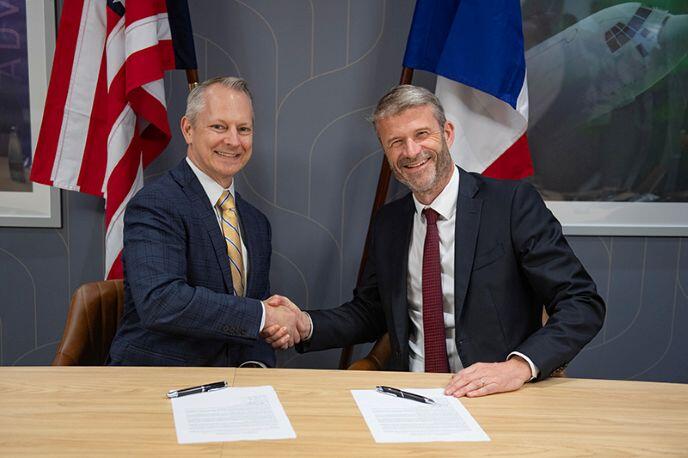
Sikorsky Vice President and General Manager Rich Benton and Safran Helicopter Engines President Cédric Goubet.
FARNBOROUGH, England—Rotorcraft manufacturer Sikorsky and Safran Helicopter Engines have agreed here to explore opportunities for cooperation on existing and future rotorcraft programs.
Sikorsky has traditionally relied on U.S.-built turboshaft engines for its helicopters, using a Safran—then Turbomeca—Arriel engine only on its S-76 family of twin-engine medium helicopters, including the S-76A and S-76C. Safran has supplied about 1,230 engines for the program, which have accumulated some 10 million flight hr.
The agreement, signed at the Farnborough Airshow, “paves the way for new collaboration on power and propulsion technologies for Sikorsky's next-generation aircraft,” the companies said. The companies said the closer relationship will “accelerate design cycles, shorten proposal turnaround times and deliver faster, higher-performance solutions to customers in both commercial and defense sectors worldwide.”
One potential opportunity is Sikorsky's effort to offer a next-generation medium helicopter for NATO's Next Generation Rotorcraft Capability initiative, for which the company is proposing production in Europe. A joint venture between MTU and Safran is developing a new high-power turboshaft that could power the platform.
U.S. rotorcraft manufacturers increasingly have turned to European engine suppliers. Bell selected the Safran Arrius turboshaft for its 505 Jet Ranger X, while Robinson has chosen the Safran Arriel 2W to power its new R88 single-engine rotorcraft, which is under development.
Rich Benton, Sikorsky general manager, said the agreement was part of parent company Lockheed Martin's commitment to working with European industry. Safran Helicopter Engines CEO Cédric Goubet said the two companies share a “strong history,” but there are still “new chapters to be written.”
Initially, the companies will focus on the collaborative process itself, with Lockheed Martin telling Aviation Week that efforts will include “identifying opportunities, assessing technology synergies and defining the most promising concepts.”