This article is published in part of Aviation Week Intelligence Network (AWIN), and is complimentary through Jun 19, 2026. For information on becoming an AWIN Member to access more content like this, click here.
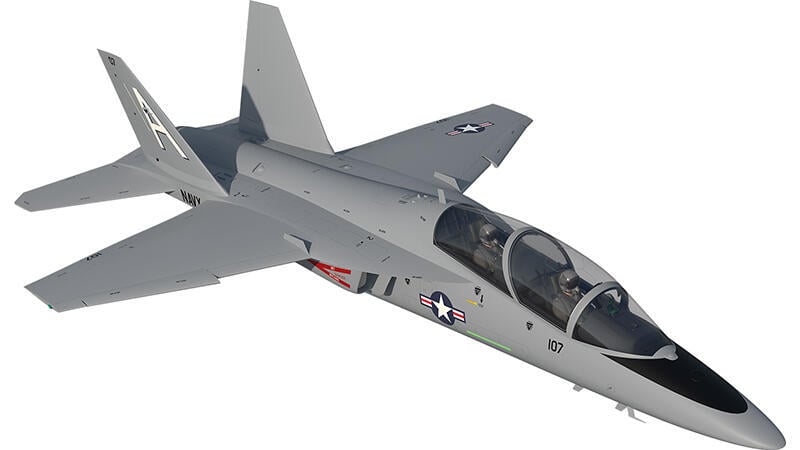
Boeing rendering of its T-7A as a U.S. Navy trainer.
Boeing has decided not to bid on the U.S. Navy’s next-generation trainer competition, a surprise move by the company that was seen as a favorite.
The decision allows Boeing to focus more heavily on sixth-generation aircraft programs. With Lockheed Martin having also dropped out of the Undergraduate Jet Training System competition, the teams that remain are Sierra Nevada Co. (SNC) with Northrop Grumman and General Atomics Aeronautical Systems Inc., and a team of Leonardo and Textron.
Boeing in a statement to Aviation Week said its offering, the T-7A Red Hawk, does not meet the Navy’s stated needs despite it already being delivered to the U.S. Air Force.
“Boeing is focused on meeting our commitments, and we bid for programs where we believe we can provide the right solution tailored to our customers’ needs and requirements,” a company spokesperson says. “After careful evaluation, we have determined the T-7A does not meet the U.S. Navy’s Undergraduate Jet Training System requirements.”
The company recently told the Navy it would not bid, but it remains committed to delivering the T-7A as a trainer for fourth-, fifth- and sixth-generation pilots “as requirements evolve.”
The T-7A recently started low-rate initial production for the Air Force and Boeing continues to offer it on the global market.
A Boeing spokesperson says the T-7A’s GE Aerospace F404 engine is proven with millions of flight hours on multiple platforms. Though it is ready to field, the engine would need long-cycle development to meet unique UJTS engine qualification requirements.
It is not clear how the in-service F404, which already powers the Navy’s F/A-18, does not meet the Navy’s needs. It is notable that the Lockheed Martin T-50 that it had offered with Korea Aerospace Industries also uses the F404.
The announcement comes about a month after the Navy raised the cost ceiling for the engineering and manufacturing development phase of the UJTS by about $1 billion based on feedback from the March request for proposals (RFP).
It also comes about two months before the Navy is expected to make its selection for its sixth-generation fighter, which is down to Boeing and Northrop Grumman. Pentagon officials have raised concerns about the industrial base’s capacity to produce multiple sixth-generation fighters.
Industry sources suggest that Boeing is positioning itself to invest heavily in the F-47 and F/A-XX simultaneously, keeping its engineering resources focused on top Pentagon priorities like sixth-generation fighters rather than reworking its existing trainer.
Lockheed Martin had dropped out of the program before the RFP was released and well before the cost ceiling was raised. A company spokesperson did not clarify specifically if that decision has changed because of the cost increase.
“We continually evaluate opportunities across our portfolio to ensure alignment with our customers' missions and our business strategy,” a company spokesperson says. “We remain committed to providing the best capabilities to our U.S. military and global partners and will continue to engage with our customers to understand their evolving requirements.”
SNC has said it designed its clean-sheet Freedom trainer to be able to conduct full carrier-representative landings, though the Navy controversially decided not to require this capability for its next trainer. The Freedom is based on a design previously offered for the Air Force trainer program but has not been built yet. In announcing the teaming agreement in February, Northrop Grumman highlighted its production capacity for the program.
The team of Textron and Leonardo is offering the Beechcraft M-346N, which is already in use as a trainer and light attack aircraft with several nations and has more on order.
Neither of the remaining competing teams uses the GE Aerospace F404. SNC’s Freedom is powered by two Williams FJ44 engines, while the M-346N uses the Honeywell F124.