This article is published in Aerospace Daily & Defense Report part of Aviation Week Intelligence Network (AWIN), and is complimentary through May 17, 2026. For information on becoming an AWIN Member to access more content like this, click here.

Bell Showcases Updated MV-75 Design

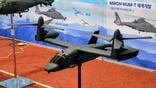
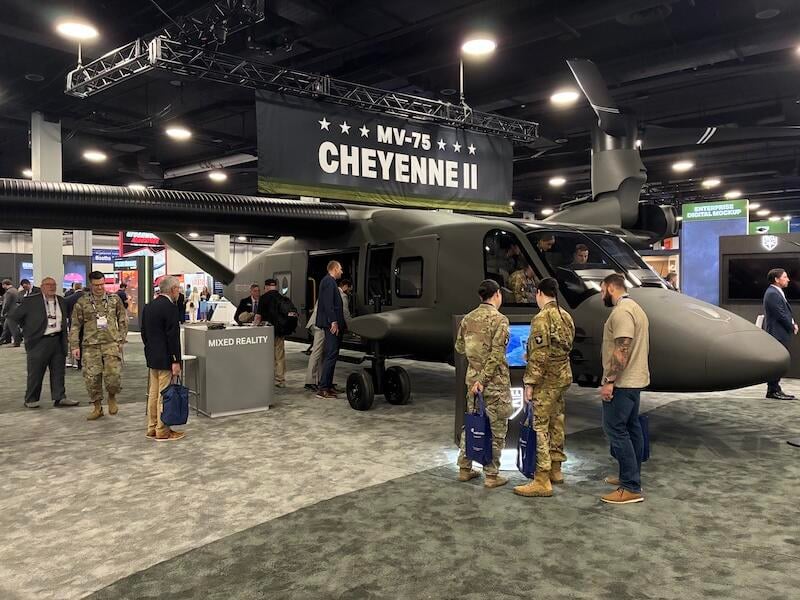
New model of Bell’s MV-75.

New model of Bell’s MV-75.

Credit: Brian Everstine/Aviation Week

NASHVILLE, Tenn.—Bell on April 15 rolled out a new model of its MV-75 Cheyenne II tiltrotor the same day the aircraft got its name, showing the design has evolved and is largely set as manufacturing begins.

This comes as U.S. Army Special Operations Aviation Command also unveiled a new rendering of a special operations variant of the tiltrotor outfitted with a refueling probe, advanced radars, and sensors, among other updates.

Ryan Ehinger, Bell’s senior vice president and Future Long Range Assault Aircraft (FLRAA) program director, told Aviation Week April 16 at the Army Aviation Association of America’s Army Aviation Mission Solutions Summit here that the design is “essentially locked.” He said more than 90% of the aircraft’s details are set. Manufacturing has started with fuselages for six test aircraft in production at Bell’s Wichita Assembly Center.

The U.S. Army showed a new rendering of a special operations variant of the MV-75.
The U.S. Army showed a new rendering of a special operations variant of the MV-75. Credit: Brian Everstine.

Ehinger pointed to some design changes that have occurred as it matures and were reflected in the new model. Most notable is a substantially strengthened landing gear that is a result of Army requirements to operate in austere locations. With the aircraft’s landing gear fully extended, a strut sticks up out of the tiltrotor’s sponson to allow for more stroke on the gear to absorb landings more effectively, he says.

The aircraft also has access panels for its hydraulic system along with its fuel system—a “one-stop shop for understanding how to get this aircraft back in the air.” Army officials have announced that the MV-75’s hydraulic system is substantially different from Bell’s V-22 tiltrotor, with a focus on addressing some of the readiness issues that had been identified.

Ehinger says the MV-75’s system has reduced pressure to allow for more tolerance, and it is triply redundant. “It’s a combination of Bell’s history and learning and understanding about fly-by-wire control systems, and then us just knowing what this aircraft is going to be used for ... how do we make the most robust, survivable platform that we can, and this is a great way to do that,” he says.

The tiltrotor’s fuselage has been refined to allow for integrating different mission systems along with a seating configuration designed and optimized for weight and ease of soldier ingress and egress. Behind the seating area is a large opening to allow for equipment such as line-replaceable units and mission systems. This, Bell says, is part of its modular open systems architecture approach to easily bring on additional systems for the aircraft as it evolves.

Bell unveiled the model as part of a naming ceremony, featuring members of Cheyenne tribes. The same day, Col. Roger Waleski, commander of U.S. Army Special Operations Aviation Command, briefly showed a slide with a rendering of a special operations variant of the MV-75. The rendering included the refueling probe, along with a nose-mounted radar that appears similar to the APQ-187 Silent Knight terrain-following radar that Bell has on the CV-22 Osprey, along with other special operations aircraft.

Army officials have said they are also looking to accelerate the special operations increment two as the broader Future Long-Range Assault Aircraft (FLRAA) program has been sped up. Ehinger deferred on specifics for the effort. The Army has solicited information from industry on what could be added to the aircraft, with the focus on once MV-75 has been delivered, then the program can shift to updating the technology, he says.

The aggressive schedule change to get the first MV-75 prototype delivered within a year and have the first unit equipped by 2030 places a lot of pressure on Bell and the Army’s program office, and officials have said there is not much flexibility or room for delays.

Ehinger says Bell is starting to see some of the first parts and assemblies, with boxes showing up every day. All sections of the initial fuselage are being assembled and will then be taken to Bell’s Amarillo, Texas, facility for final assembly. “They’ll start putting that together later this year and start to do major structural airframe tests with that airframe,” he says.

Brian Everstine

Brian Everstine is the Pentagon Editor for Aviation Week, based in Washington, D.C.