This article is published in Aerospace Daily & Defense Report part of Aviation Week Intelligence Network (AWIN), and is complimentary through May 17, 2026. For information on becoming an AWIN Member to access more content like this, click here.

Bell MV-75 Schedule Leaves No Slack, Army Officials Say

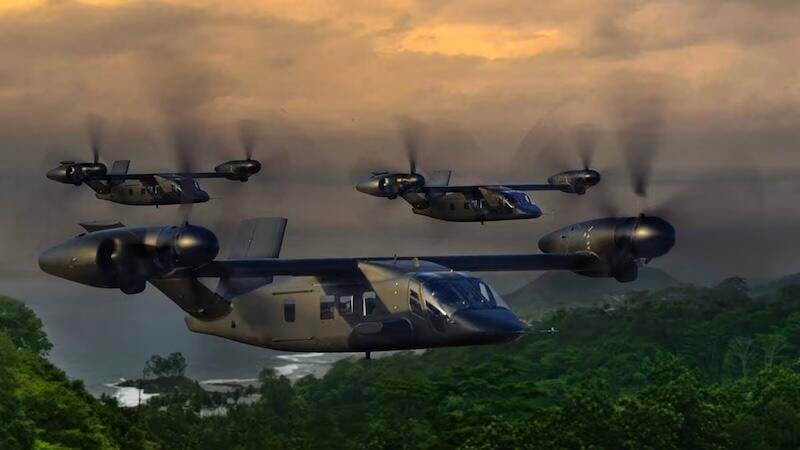
bell tiltrotor illustration

Bell has started early manufacturing as the MV-75’s design process continues.

Credit: Bell rendering

The U.S. Army has named the Bell MV-75 the Cheyenne II, a nod to the 1960s transformational Lockheed AH-56 Cheyenne, though the service is hoping for a better future for its tiltrotor compared to its namesake.

Army officials say the lineage between the two helicopters is based on how they represent a leap forward in technology. The AH-56’s unique design features, such as its pusher propeller and the four-blade rigid rotor system, were groundbreaking at the time—however, the program lasted just two years after 10 were built before being canceled.

“You can draw a lot of parallels between going from the current fleet of rotorcraft that we fly, that is really 1960s-70s era technology … to what we’re doing with the tiltrotor technology,” says Maj. Gen. Clair Gill, the commanding general of the U.S. Army Aviation Center of Excellence and program acquisition executive for Maneuver-Air. “Twice as far, twice as fast, vertical takeoff and landing, but flying at airplane speeds. You can certainly draw the metaphor there if you want between the AH-56 back in the late ’60s and the MV-75 today.”

The Army has announced a dramatic acceleration of the MV-75, looking to have a first delivery by the end of this calendar year or the beginning of next, with the first unit equipped with 24 of the tiltrotors in 2030. The service had originally planned to field the Future Long-Range Assault Aircraft in 2034.

This is a “success-oriented schedule,” with as much flexibility taken out as possible to meet the demands of top Army leaders, Gill says.

“There’s a lot we have to learn along the way, and so I would say we have some very optimistic goals about when we’re going to deliver a first aircraft and when we’re going to deliver the first formation,” Gill says.

If everything goes well, it will fly within two years, he says.

“My sense is we’ve taken as much of the slack out of the system as we possibly could, but that doesn’t allow for anything to go wrong either,” Gill says.

Bell has started building components of the aircraft as the design continues. The Army will make an early production decision ahead of the regular Milestone C, with a lot of faith being placed on models-based system engineering. At least three virtual prototypes have been delivered, and in the meantime Army pilots have been flying with U.S. Marine Corps MV-22s to get ready.

The Army is looking to learn as much from the V-22 as it can, and avoid many of the Osprey’s developmental pitfalls, says Brig. Gen. David Phillips, the program executive officer for aviation. For example, the MV-75’s engine does not rotate and already has an integrated particle separator, which is something that had to be added to the V-22. The MV-75 has a simplified straight wing, and its hydraulic system has fewer parts and a lower operating pressure. The Army’s tiltrotor has a V-tail instead of the Osprey’s H-tail, which is both better for maintenance and maneuverability, Phillips says.

The Army evaluated the top 100 sustainment issues with the Osprey and tried to design them out of the aircraft.

Much of the recent focus on the Osprey has been on its gearbox, which has seen failures in recent years linked to multiple crashes. One issue that emerged was the use of dual-melt steel, which was linked to imperfections that caused component failures. The Army is increasing the use of triple-melt steel to avoid those issues.

The V-22’s history does allow for some other ways to speed up MV-75 development. For example, the Rolls Royce AE 1107 engine is the same as the V-22 and, as such, it is well understood. Bell has established relationships with many suppliers from the Osprey, which will be brought into the MV-75.

“The supply chain risk management team that has been looking at the V-22 and the MV-75 for the past seven years now has really been digging into the details there, and fortunately we’ve got 30 years’ worth of learning there that we’ve been able to clean from the V-22 program,” Phillips says.

Brian Everstine

Brian Everstine is the Pentagon Editor for Aviation Week, based in Washington, D.C.