This article is published in Aerospace Daily & Defense Report part of Aviation Week Intelligence Network (AWIN), and is complimentary through Aug 24, 2026. For information on becoming an AWIN Member to access more content like this, click here.

Anduril Hopes To Reclaim Low Altitude With New Thunder

Anduril's Thunder

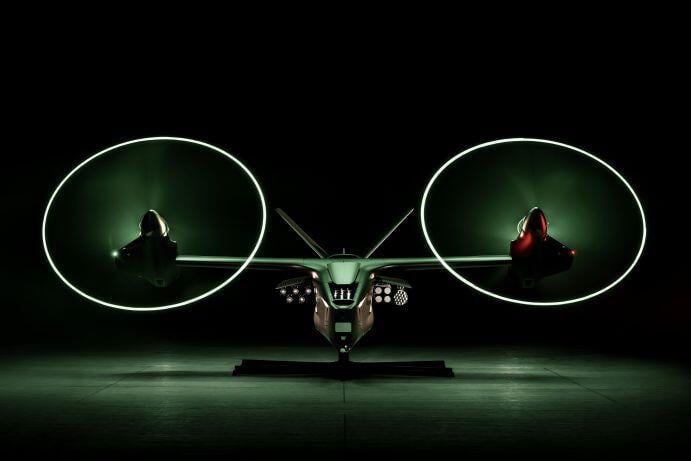
Anduril's Thunder uncrewed aircraft system (UAS).

Credit: Anduril

Anduril unveiled the hybrid-electric, vertical-takeoff-and-landing (VTOL) Thunder uncrewed aircraft system (UAS) on the opening day of the Farnborough Airshow on July 20, revealing a concept that proposes to revive the armed scout mission with autonomous flying robots.

The Thunder design, which combines the optimum-speed tiltrotor technology of Karem Aircraft, the hybrid-electric drivetrain of electric-VTOL aircraft developer Archer Aviation, and Anduril’s own autonomous control system, represents a throwback to the lost capability of the Bell OH-58D Kiowa Warrior, a human-piloted armed scout helicopter that the U.S. Army retired in 2015. The Army tried to replace it directly with the Future Attack Reconnaissance Aircraft (FARA) but canceled the program in February 2024.

Equipped with up to 10 Lockheed Martin AGM-114 Hellfire missiles, 16 launched effects or 75 guided rockets and a full sensor suite, the Thunder UAS will perform “all the things that [the Boeing AH-64] Apache was originally designed for with the Kiowa,” said Shane Arnott, Anduril’s senior vice president of programs and engineering, speaking to reporters.

The pair of optimum-speed tiltrotors also means that the Thunder can fly similar distances as the Bell MV-75 Cheyenne II, a tiltrotor in development by the Army with a combat range of up to 800 n.m., Arnott added. With stiff composite blades and rigid hubs, the electrically actuated proprotors can reduce their rotational speed by up to 50%, providing maximum thrust in hover and the ability to rotate slower for greater efficiency during cruise flight.

The concept also shows that Anduril believes it is time for the Army to abandon its current approach to filling the gap left by the retirement of the OH-58D and the cancellation of the FARA program.

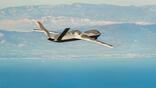
The Army has instead provisioned a subset of the fleet of General Atomics Aeronautical Systems Inc. MQ-1C Gray Eagles, a fixed-wing, turboshaft-powered derivative of the Predator design, to play the armed scout role. The MQ-1C uses launched effects to plug any gaps in its onboard sensor and weapons capabilities, but Arnott argues that recent operations prove the design is too vulnerable for modern warfare. Although its larger sibling, the MQ-9A Reaper, was named the “most valuable aircraft” of Operation Epic Fury [the 2026 U.S.-led military campaign against Iran] by U.S. Air Force Chief of Staff Gen. Kenneth Wilsbach, that distinction came with heavy losses due to flying at medium altitudes and relatively slow speeds.

“Anyone can see that that type of system, that type of [concept of operation] flying at that level, is just not competitive in the future fight,” Arnott said.

In addition to weapons loaded into an internal bay within the fuselage, the Thunder also features payload bays in the nose and aft for an array of sensors. The sensors could include passive systems for detecting air-to-air attack drones and other threats at low altitude, Arnott said.

The reveal of the Thunder on the first day of Farnborough comes as the U.S. Army searches to replace the MQ-1C fleet with an armed VTOL or short-takeoff-and-landing (STOL) aircraft UAS. The Army held an industry day event in March for a Group 4+ short- or vertical-takeoff-and-landing (S/VTOL) UAS.

GA-ASI is expected to offer the Mojave, a derivative of the Gray Eagle modified with a wing that makes it capable of STOL operations. But Anduril is taking an approach that emphasizes VTOL capability and very low-level flying with an autonomous UAS.

“The intent is for it to be nap-of-the-Earth for most of its life. That's where it will be spending its time,” Arnott said.

The Thunder design represents Anduril’s offering to the U.S. and international military markets. Archer also has the rights to market a dual-use version of the aircraft for other markets, Arnott said.

Anduril has been testing the autonomy software for the Thunder UAS for two years, Arnott said, adding that the company plans to start flight testing the UAS in 2027. The Thunder represents Anduril’s vision for reclaiming the low-altitude airspace lost to maneuver forces on the ground in recent years.

“Maneuver warfare is at a stalemate in the current environment, as we got further and further up and higher and higher, we got comfortable because we own the air,” Arnott said. “But things have changed. We’re seeing that in Ukraine. We're seeing that in Epic Fury. The Iranians, etc., have got systems that are just knocking that type of [high-altitude UAS] off its feet, and it's just not relevant anymore. So that's why we're going back to the surface. That's where the survivability is for these types of systems, which is to fly low and fast.”

Steve Trimble

Steve covers military aviation, missiles and space for the Aviation Week Network, based in Washington, DC.