This article is published in Aerospace Daily & Defense Report part of Aviation Week Intelligence Network (AWIN), and is complimentary through Mar 05, 2026. For information on becoming an AWIN Member to access more content like this, click here.

Airbus Exploring Reconfigurable High-Speed Rotorcraft

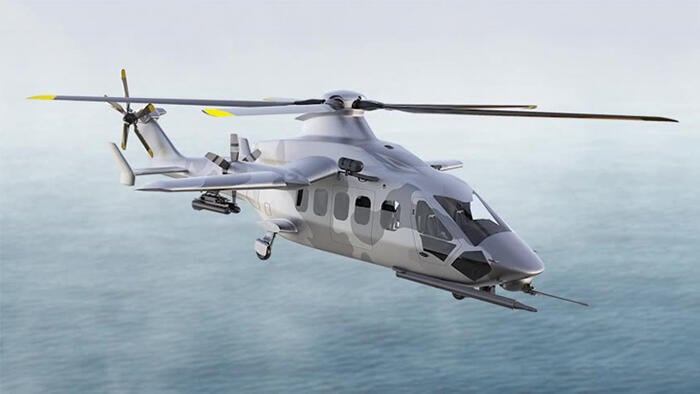
Airbus concept

Airbus has unveiled next-generation rotorcraft concepts.

Credit: Airbus

LONDON—Airbus is exploring the potential of a reconfigurable compound rotorcraft that would allow military users to both install and remove a proprotor system that would give the aircraft additional cruise speed performance.

The idea is being explored through the company’s internal Next Generation Rotorcraft System initiative that supports the company’s work on NATO’s Next Generation Rotorcraft Capability (NGRC) and the European Next Generation Rotorcraft Technology (ENGRT) projects.

The vision is to use a common airframe that would be equipped with a main gearbox like that fitted to the company’s Racer demonstrator, which features two pusher proprotors fitted to a box wing.

On the Racer these proprotors are also used to provide anti-torque and are linked to the gearbox by a supercritical shaft that runs through the upper box wing to the gearbox.

The proposed common military airframe would feature a similar gearbox, but with three linkages for the two proprotors on each side of the fuselage and a third for a conventional tail rotor.

Operators would be able to choose whether to fit both the wings and proprotors, or just the wings depending on the mission requirements.

Both options would improve cruise and range performance, but the proprotors would provide a much-increased speed capability.

“The idea is to be able to put the wings aside, when they are not needed, and putting wings on for high-speed missions,” an Airbus Helicopters subject matter expert told Aviation Week on the sidelines of the Military Helicopter Conference on Feb. 24.

The company illustrated the idea with a graphic showing a notional H175 platform fitted with Racer-like wings and with personnel also removing them in a hangar.

A tail rotor would be needed because the proprotors fitted mid-wing on the common airframe would lack the yaw moment they would have if they were fitted to the wingtip.

Having the tail rotor also means that the aircraft still has an anti-torque system, even if the proprotors are damaged by enemy fire, Airbus officials point out. Notably, the company has not opted for a Fenestron shrouded tail rotor as it would have to be of considerable size.

One trade-off is that the aircraft would have to fly around with a larger, heavier gearbox as well as fixtures and fittings to accommodate the wings and proprotors, but the company claims the aircraft would be highly flexible and more suitable to the concept of operations of several European militaries who insist on nap-of-the-earth flying for survivability. They claim other proposed rotorcraft configurations are too complex for operations in the field or could not be flown as low as a helicopter, impacting survivability.

Details of the ideas emerged a day after the company released more information and images of its NGRC concepts, but without mentioning the reconfigurable airframe, stating only that modularity and simplicity were “core tenets” of its NGRC proposal. Weight of the airframer’s NGRC proposal has not been disclosed, but officials said they were much lower than the 17 metric ton limit.

“The two concepts will be highly connected and will share commonalities in terms of maintenance, training, weapons and systems,” the Airbus proposal states. “With this [compound] configuration we have had a lot of surprises, it is not just speed for speed’s sake.” 

As well as higher cruise speeds, Airbus’ Racer technology also enables higher acceleration and rapid deceleration as well as a tight turning radius that means that targets can be kept in sight during a change in direction. They also note that higher cruise speeds are more compatible with inflight refueling, reducing the need for fixed-wing tankers like the Lockheed KC-130 Hercules or the Airbus A400M to fly as slowly as they must when refueling conventional helicopters.

Another benefit, Airbus suggests, is that the rotorcraft could also be transported on an A400M or a Boeing C-17. A tiltrotor, on the other hand, would need to be ferried.

Tony Osborne

Based in London, Tony covers European defense programs. Prior to joining Aviation Week in November 2012, Tony was at Shephard Media Group where he was deputy editor for Rotorhub and Defence Helicopter magazines.