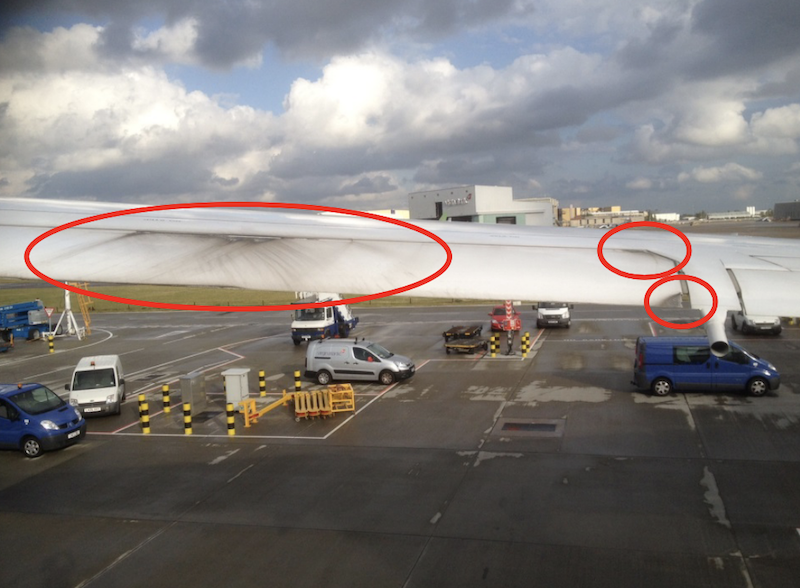
Locations circled in red are the lightning attachment points near the aileron of the United 787.
Properly designed and maintained bonding straps and grounding connections are vital for the protection of the aircraft and its occupants according to Australian Civil Aviation Safety Authority Advisory Circular (AC) 21-99, “Aircraft Wiring and Bonding.” In the event of a lightning strike bonding straps allow current to pass through the airframe with minimum arcing. They also prevent the accumulation of static charge that can interfere with radio and navigational equipment.
Bonding connections must be done so that vibration, expansion or contraction or relative movement incident to normal service will not break or loosen the connection. They are purposely designed to be flexible and to move with the control surface. However, over time they are susceptible to fatigue and corrosion.
Pre-flight and post-fight inspections should include the grounding and bonding straps to ensure they are free of corrosion which will adversely affect performance, and are not frayed or cut to more than 25% of the original straps. Given the critical function of bonding straps, these must be in an airworthy condition prior to flight.
Post Strike Maintenance
The post-flight inspection after a possible lightning strike is a multi-step process. The Cessna Model 550 Maintenance Manual points out that the current from a lightning strike enters the jet at one point and exits at another, usually an opposite extremity. Wing tips, nose, and trailing edges of flight control surfaces to include the flaps, spoilers and speed brakes are most likely to show the damage.
A post-flight inspection may find burning, pitting or eroding of small surface areas of the skin. The static dischargers should also be inspected for damage.
Communication and navigation antennas should be checked for burning or pitting. According to NASA research, when an externally mounted electrical apparatus, such as navigation lights or antennas, happen to be the lightning attachment point, protective globes or fairings may shatter and permit some of the lightning current to enter associated electrical wiring directly.
Even if only a small fraction of the total lightning current enters the wires, they may be too small to conduct the thousands of amperes involved and thus be melted or vaporized. The accompanying voltage surge may cause breakdown of insulation or damage to other electrical equipment powered from the same bus.
Lightning traveling on the exterior skin of an aircraft creates an electromagnetic field that has the potential to induce transient currents into wires or equipment beneath the skin. Some of these electromagnetic fields induce transient voltage surges in the aircraft’s electrical wiring, which in turn may damage electrical or electronic equipment, or cause the electrical equipment to malfunction. These effects range from tripped circuit breakers to computer malfunctions to physical damage of circuits.
The most frequent damage to radomes are holes in the structure caused by static discharges according to FAA AC 43-14, “Maintenance of Weather Radar Radomes.”
As an aircraft flies through an electrically charged atmosphere, electrical charges accumulate on its surface, resulting in high voltage streamers being discharged from pointy surfaces, to include the radome. Protection is afforded by the application of lightning diverter strips along the outer surface of the radome. These strips can be solid metal bars or a series of closely spaced buttons of conductive material affixed to a plastic strip that is bonded adhesively to the radome. They are sized and spaced carefully according to simulated lightning attachment tests, and do not significantly interfere with the radar.
The engine inlet needs to be visually inspected.vIf the inlet cone or LP compressor blades show evidence of pitting or scaring, the engine must be removed from service and sent to an approved overhaul facility for lightning strike inspection.
The Cessna 550 Maintenance Manual also instructs ground crew to complete the “Lightning Strike/Static Discharge Incident Reporting Form.” The form includes an overhead drawing of the Cessna 550 for the technician to mark points with damage. Further description of the diameter of holes, damage to the paint and the condition of the lightning diverter strips are important information for an adequate analysis of the severity of the lightning strike
Summary
On a positive note, many aircraft struck by lightning each year are able to safely land. Unfortunately the cost for repairing a lightning strike afterward can be expensive. The damage incurred by these lightning strikes causes approximately $2 billion annually in airline operating costs and passenger delays.
It is comforting to appreciate that immense research and post-incident investigations by many organizations have refined the certification standards of modern aircraft. The design and testing procedures necessary to prove an aircraft’s design is airworthy are extensive. Despite the frequency of lightning strikes to aircraft, modern design standards have proven their worth by bringing these aircraft safely back to the runway.

Related Content