This article is published in Aviation Week & Space Technology and is free to read until Nov 26, 2026. If you want to read more articles from this publication, please click the link to subscribe.
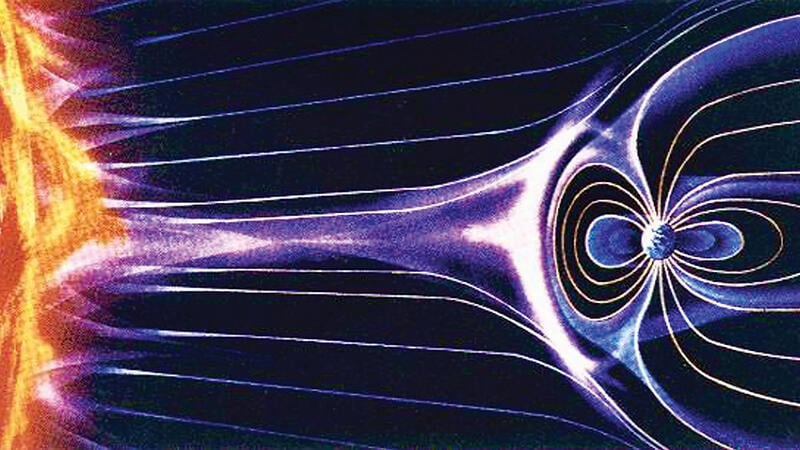
The magnetosphere is a vast, comet-shaped bubble that shields the Earth from solar and cosmic radiation as well as from the solar wind.
The aviation industry underestimated the effects of space weather until an incident on Oct. 30, 2025, when a JetBlue Airbus A320 flying from Cancun, Mexico, to Newark, New Jersey, experienced an uncommanded nose-down pitch, resulting in a sudden drop in altitude.
A post-incident investigation revealed that high-energy particles from a solar flare had corrupted data in the elevator aileron computer, affecting the aircraft’s altitude control.
The European Union Aviation Safety Agency (EASA) and the FAA required immediate action for operators of 5,900-6,200 A320s to correct the software vulnerability. This resulted in significant flight schedule disruptions as airline maintenance technicians worked feverishly to perform the mandatory repairs during the holiday travel rush.
Solar radiation storms, geomagnetic storms, ionospheric storms, coronal mass ejections and solar flares are commonly linked under the name “space weather.” Collectively, they cause serious disruptions to high-frequency (HF) communications and satellite navigation system errors; degrade satellite tracking, which in turn induces GPS positioning errors; and increase the risk of errors or failures in the microelectronic components in an aircraft’s flight and engine management computers.
The effects can vary from day to night, as well as geographically. They generally are greatest at higher latitude (north of 50 deg.) and grow potentially worse during polar operations (north of 78 deg.).
Protective Shields
There is a magnetic field surrounding the Earth called the magnetosphere. NASA describes this as a giant magnetic bubble that deflects most of the energy carried by charged particles that travel at close to the speed of light. The shape of the magnetosphere resembles a comet and fluctuates depending on the orientation to the Sun as well as the intensity of solar radiation. Constant bombardment by intense solar radiation compresses the Sun-facing side of the magnetosphere and causes a fluctuation in the shady side, which stretches for considerable distances.
The unique shape of the Earth’s magnetosphere deflects cosmic and solar radiation closer to the surface near the poles. This is an important reason why space weather becomes a large factor in aviation operations during polar flights.
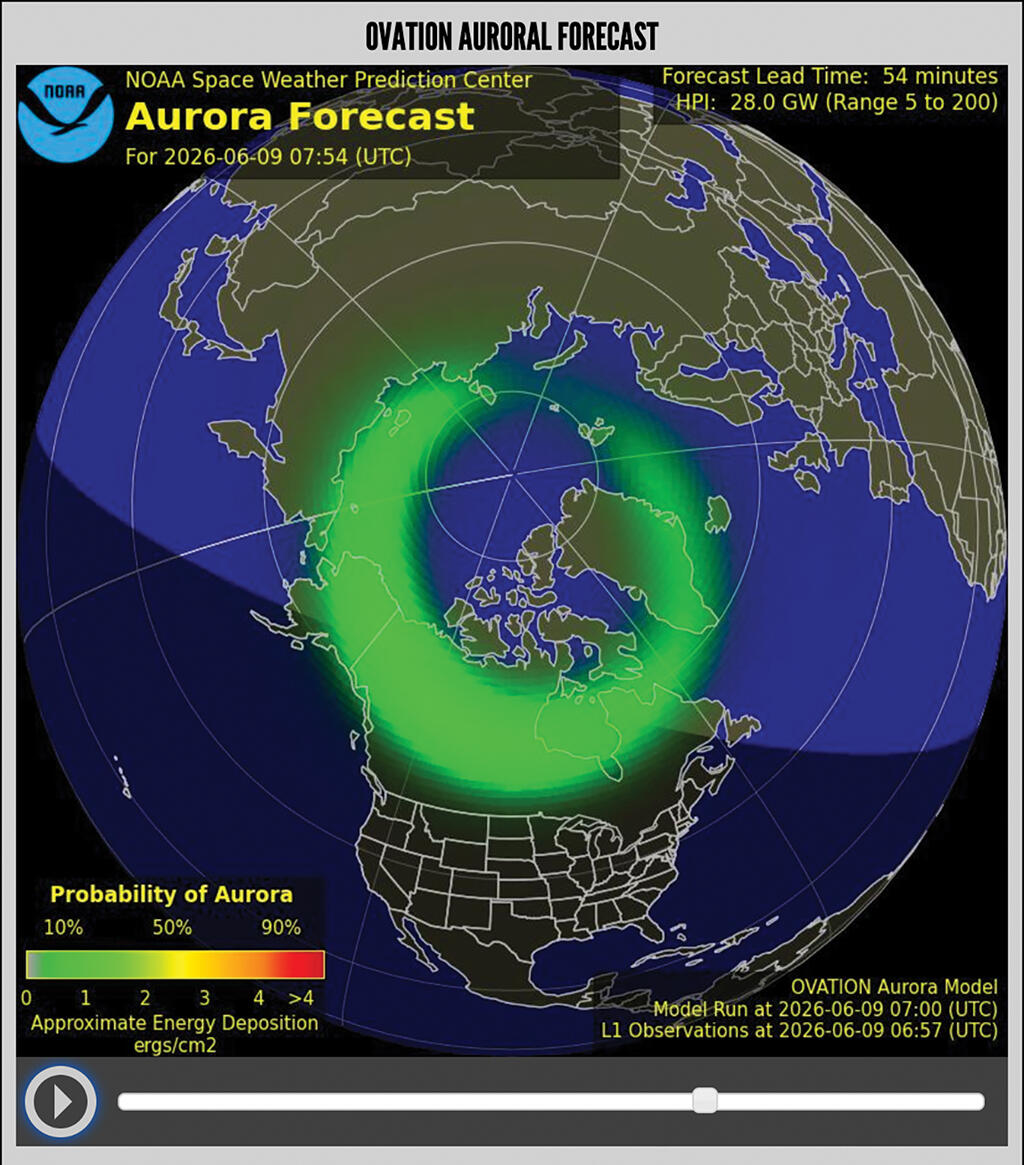
High-energy charged particles entering the magnetosphere in the northern hemisphere produce aurora borealis, commonly called the Northern Lights. The same phenomena occurs in the southern hemisphere as aurora australis. Larger concentrations of incoming charged particles produce the strongest auroral events, which cause widespread effects on aviation communication, navigation and equipment reliability.

The ionosphere is another critical region that plays a direct role in aviation operations, beginning at roughly 50 km (31 mi.) in altitude and extending outward. Aviation communication signals utilize the ionosphere to reflect HF radio signals over long distances.
The lower frequencies need the ionosphere because it reflects shortwave radio around the curvature of Earth. The ionosphere changes significantly from day to night. Technical documents, including the International Air Transport Association’s (IATA) “Space Weather Effects in Regard to International Air Navigation,” describe the many ways in which highly charged particles interfere with GPS and satellite communications. Simply put, highly charged particles distort and damage the information carried on electrical communication and navigation waves.
Solar Weather Types
The Earth is bombarded by high-energy charged particles from the Sun and outer space. Some of these events last days or longer, some are continuous, and some are short-lived.
The solar wind is “the continuous flow of charged particles and magnetic field from the Sun,” according to the IATA report. It takes about four days for a parcel of plasma to travel from the Sun to Earth. For severe space weather events, the solar wind speed may be three, four or even five times faster.
Solar flares release X-ray, ultraviolet and radio emissions that disturb the ionosphere in the sunlit hemisphere for minutes to hours of duration. They can send out high-energy particles that can arrive in the Earth’s atmosphere within 30 min. These particles are diverted along the Earth’s magnetic field lines, which tend to concentrate them in the upper atmosphere in polar regions.
Solar radiation storms, usually called solar proton events, contain large quantities of charged particles. IATA’s report points out that the Earth’s magnetic field and atmosphere offer some protection from this radiation, but that varies with altitude, latitude and the magnetic field’s strength and direction. For example, since the magnetosphere’s field lines bend downward to the Earth’s surface at the poles, the polar regions are bombarded with larger concentrations of these charged particles.
These particles increase the radiation dose to humans and the possibility of electronic abnormalities. The Earth’s magnetic field and atmosphere offer some protection from this radiation, but that shielding decreases with altitude, latitude and magnetic field strength and direction.
The explosive release of coronal mass ejections from the Sun’s outer atmosphere can rapidly shower the Earth with energetic particles. About 1-4 days after a solar disturbance, a plasma cloud can reach the outer boundaries of the Earth’s magnetosphere, leading to a geomagnetic storm. Immense electrical currents of up to 1,000,000 amperes can flow through the ionosphere and magnetosphere, changing the direction of the Earth’s magnetic field by several degrees at the surface.
This dynamic weakens the amount of protection the field provides to deflect incoming charged particles. The effect is most pronounced in the auroral regions. How long do these events last? According to IATA, the average duration is several days, but stronger storms may persist for nearly a week.
High-energy rays from outer space collide in the Earth’s upper atmosphere, producing a cascade of secondary particles that shower through the atmosphere. The intensity of cosmic radiation builds to a maximum at 60,000 ft. and then slowly drops off closer to the Earth’s surface due to some protection provided by the atmosphere.
Aviation crews who fly at high latitudes and altitudes can be exposed to more radiation than any other type of profession. In June, the National Academies of Sciences, Engineering and Medicine issued a special report recommending that the FAA “exert its existing regulatory authority over ionizing radiation as an occupational hazard to ensure the health and safety of airplane flight crews.”
According to the National Academies’ press release, the report found that “inflight cosmic radiation exposure warrants attention as an occupational hazard, but current approaches to monitoring exposure and communicating with affected workers are inconsistent and insufficient.”
Communications Effects
HF communications at high latitudes and polar regions can be adversely affected for long periods, sometimes days, due to bad space weather.
Solar radiation storms produce a unique type of disturbance called a polar cap absorption that can last for many days. When energetic particles enter the atmosphere over the polar regions, the enhanced ionization produced at these lower altitudes absorbs HF radio signals, causing HF blackout throughout the polar regions. Airlines have diverted flights due to this communication loss, resulting in an additional 3 hr. of flight time.
Transoceanic flights have long used HF for communication due to its ability to “skip” off the lower limits of the ionosphere around the curvature of the earth, unlike very high frequency (VHF) communications that require line-of-sight transmission. However, HF signals suffer deterioration on the day side of the Earth during solar flare events. According to IATA, these disruptions are typically short, “from tens of minutes to a few hours.”
One principal effect of solar flares is HF radio degradation or blackouts extending to middle and low latitudes. IATA advises operators that radio blackouts primarily affect HF signals (3-30 MHz). Detrimental effects may also spill over into VHF (30-300 MHz). Extreme solar flares can trigger a complete HF radio blackout on the entire sunlit side of the Earth, lasting for hours. This can result in reduced aircraft flow rates through the remote and busy airspace regions that rely on HF for air traffic management.
Even relatively minor space weather disturbances can seriously disrupt HF signals in the North Atlantic and Pacific Ocean. Vast regions of South America and Africa as well as the Indian Ocean rely on HF for communications. The IATA introduced air-to-air position reporting over most of Africa using the VHF of 126.9 MHz to avoid traffic conflicts. A disruption of these air-to-air frequencies in conjunction with HF loss can have an immediate effect.
Controller-pilot data link communications (CPDLC) rely on HF signals that bounce off the ionosphere. Space weather that causes ionospheric disturbances can degrade data communications. CPDLC also uses satellite communication (satcom) networks, but these, too, are negatively affected by space weather.
While the IATA report goes into technical detail on the exact mechanisms, for the purposes of this article, let us summarize that even portions of the equatorial region can experience signal degradation and blackout from sunset to midnight, and operators in high-latitude and polar regions have experienced satcom signal disruption. Operators have experienced receiver loss-of-lock and fading issues during geomagnetic and ionospheric storms.
For these reasons, communication equipment requirements are more stringent in high latitudes. Polar flights departing North America use VHF communications and transition to Arctic Radio, which relays messages between flight crews and air navigation service provider Nav Canada. In lower latitudes, a flight crew can generally communicate with Arctic Radio on VHF, but eventually will need to switch to HF (3-30 MHz). Satcom is considered a backup during polar flights but is rarely available above 82 deg. latitude.
Navigation Effects
Global navigation satellite systems (GNSS)—the collective term for the U.S. GPS, Russian Glonass, European Galileo and Chinese BeiDou systems—are susceptible to degradation in accuracy by space weather. Each of these systems operates by transmitting precisely timed radio signals from satellites that are received by aircraft. The radio signals must pass through the ionosphere, where variations due to solar and geomagnetic activity can affect the accuracy of satellite signals.
One of the adverse effects of space weather on GNSS signals is the considerable increase in position error. Large influxes of solar particles and electromagnetic radiation are particularly problematic for these systems, impeding receivers from locking on to a signal. The duration can last from a few minutes for a short-lived dayside flare disturbance to days-long prolonged events.
Recent research has found that solar flare bursts affect GNSS systems by attenuating the carrier-to-noise ratio, thus degrading their radio signals. These bursts can last from tens of seconds to a few hours.
The FAA’s Wide Area Augmentation System (WAAS) augments GPS signals with corrections for time, slight variations in GPS satellite orbits and the ionosphere. One of the greatest challenges for WAAS is maintaining availability during extreme geomagnetic events. Events of this magnitude occurred on Oct. 29, 2003, and Nov. 20, 2003. Approaches with vertical guidance were unavailable over the entire continental U.S. for approximately 15 and 10 hr., respectively.
Avionics Effects
The loss of the elevator aileron computer in the A320 cited above is an example of how space weather affects aircraft microcircuits. Digital circuits are silicon-based components that represent data as binary values of zero or one. If a high-energy space particle strikes the silicon of a memory cell, it can change the value of the memory from one to zero or vice versa. Depending on the function of the microcircuit in an avionics component, this could lead to erroneous commands, high current drain or burnout.
Systems that have been affected by highly charged space particles include fly-by-wire, autopilot, flight warning, communications, navigation, displays and Full Authority Digital Engine Control. Autopilots have “tripped off” and flight instrument units have gone into nonstop “test modes.”
Flight performance computers have been withdrawn from service when bit errors accumulated in their random access memory (RAM) after exposure to highly energized neutrons. As the latest aircraft integrated circuit components are produced in ever decreasing sizes, they become more susceptible to damage. Unfortunately, these space particles are so energetic that shielding is useless.
Higher-flying aircraft are more susceptible to these failure modes. The UK’s Defense Evaluation and Research Agency found that 100 MB of RAM in laptops would suffer upsets every 2 hr. at 40,000 ft.
When pilots report these malfunctions after a flight, retesting may not reproduce the system malfunction because of its transitory behavior. This can result in a “no fault found” or “could not duplicate” entry in the aircraft’s maintenance log.
Earth Effects
Lead time is essential for customers of the information and particularly for aviation operators, who need ample time to put precautions in place and prepare for an event. If and when a space weather event is predicted or underway, operators need to know what is expected to happen, the magnitude of the event, when and where it will happen, how long it will last and the potential impact on an aircraft’s occupants as well as its mechanical airworthiness.
The Space Weather Prediction Center, a branch of the U.S. National Oceanic and Atmospheric Administration, is the official source for space weather warnings, watches and alerts for the U.S., providing information that is useful for aviation and other vulnerable industries worldwide. When a solar event occurs, the center issues event-driven Alert, Warning, Watch and Summary notices.
Some space weather events can occur with little advance notice of an impending eruption until a solar flare or coronal mass ejection is observed. For example, 8 min. after a solar flare or coronal mass ejection erupts from the surface of the Sun, the first blasts of extreme ultraviolet and X-ray emissions reach the outer limits of the ionosphere. This will affect HF communications.

Related Content