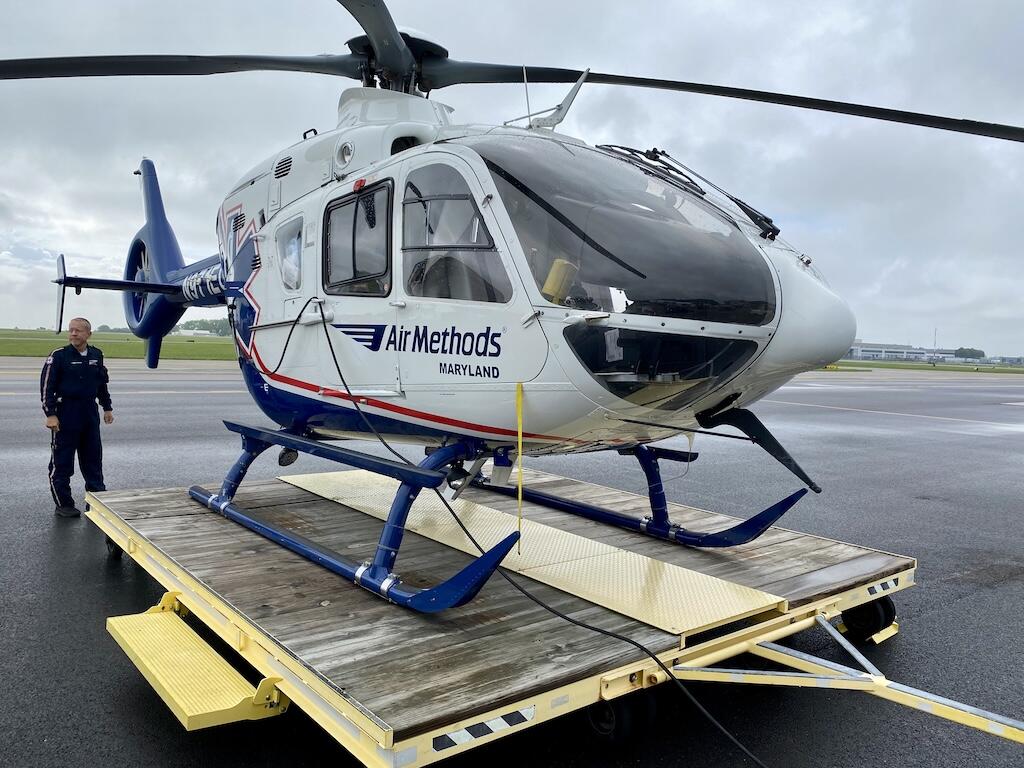
LifeNet 8-1’s EC135 was parked on a trailer near Air Methods’ Hagerstown Regional Airport base.
Air Methods helicopter emergency medical service (HEMS) bases have small but capable maintenance facilities that support 24/7 availability of their helicopters.
“We’re only limited by the size of the space, but all the mechanics are rated to do every level of maintenance on the aircraft up to a 1,000-hr. inspection—the major [Airbus Helicopters] inspection,” which requires a complete teardown of the aircraft, says Andrew Lewis, lead maintenance technician with LifeNet 8-1 in Hagerstown, Maryland.
“We’ll bring the equipment in if we need it,” Lewis adds. “We have engine slings, but we don’t have the gantry crane that we need to lift the aircraft off the ground to be able to change the landing gear. I’ve been asked if we would do a 1,000-hr. inspection here, but you need that gantry crane just in case we have to change any of the landing gear.”
A 31-year veteran maintainer, Lewis hosted BCA during a visit to LifeNet 8-1’s maintenance hangar at Rider Jet Center, the sole fixed-base operator at Hagerstown Regional Airport. Having earned his master maintenance technician rating from Airbus Helicopters, he is certified with factory training on the single-engine EC130 and twin-engine EC135 and AS365 Dauphin helicopters.
LifeNet 8-1 operates an EC135 T2+ light twin powered by Turbomeca Arrius 2B2 engines.
Lewis notes that he has also worked on aircraft Air Methods doesn’t operate, including the Leonardo AW139 medium twin and Cessna Caravan single-engine turboprop, and learned to disassemble and repair flight helmets.
More recently, he replaced the bulb in a steerable searchlight. Without the light, the helicopter would not have been allowed to respond to an accident scene at night.
Air Methods has line technicians, lead technicians, senior lead technicians and regional maintenance directors for nine regions, Lewis says. As a lead technician, he is responsible for bases in Hagerstown as well as in Gettysburg and Lebanon, Pennsylvania.
Maintenance technicians are required to respond to a base within an hour of being called.
Lewis recalls that one mechanic was called in on a recent Sunday morning to repair an oil leak. The job involved removing the engine cowlings, firewalls and driveshaft of the helicopter and pulling the pinion gear out of the main gearbox.
“He had to change an input seal on the No. 1 engine,” Lewis explains. “The engine has a drive shaft that powers a pinion gear that powers the main gearbox. There’s one on either side. The pilot noticed on the pre-flight inspection that there was a lot of oil on the deck, so called the mechanic in.”
Adds Lewis: “It was probably eight o’clock in the morning. He diagnosed the problem, ordered the seal, ordered the tools that are needed. They were sent in by courier and they had the aircraft back up in service by 2200.”

Related Content