This article is published in Aviation Week & Space Technology and is free to read until Nov 08, 2026. If you want to read more articles from this publication, please click the link to subscribe.
Flying High And Running Out Of Fuel
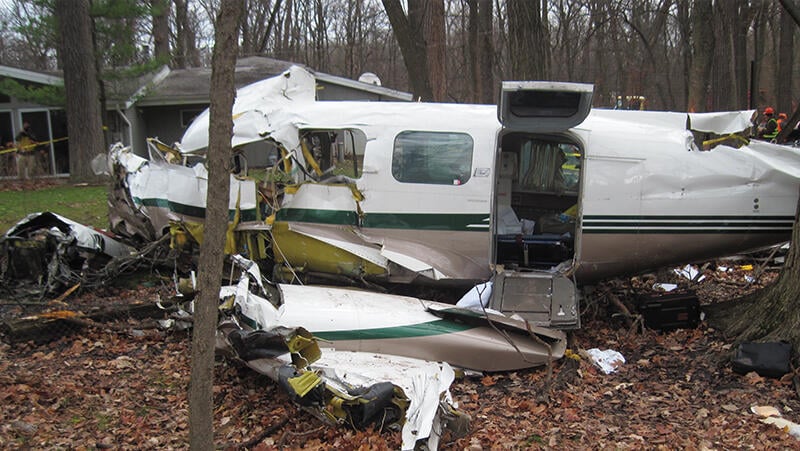
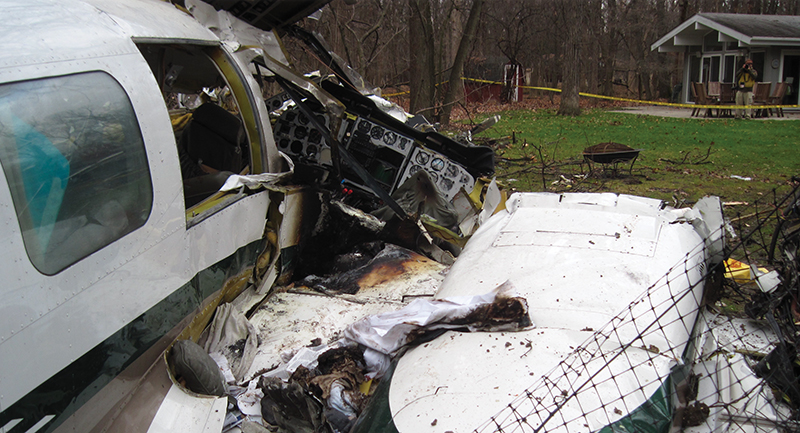
View of the right side of the Piper Chieftain that crashed short of Chicago Executive Airport.
Out of gas, in the dark, the 1976 Piper Chieftain (PA-31-350) crashed on approach to the Chicago Executive Airport (KPWK) on Nov. 18, 2011. The 58-year-old pilot, the air ambulance’s patient and an accompanying family member died, but a pilot-rated passenger and flight paramedic survived with serious injuries.
The pilot had a history of substance abuse, including a pair of DUIs—in 1997 and 2002—and the NTSB would later report that he had “tetrahydrocannabinol and tetrahydrocannabinol carboxylic acid (marijuana) in his system.” At the time of the crash, he had been on duty for more than 15 hr.
The pilot held an ATP certificate with multi-engine and type rating in SA-227 aircraft. A Federal Aviation Administration (FAA) 8410-3 Airman Competency/Proficiency Check Form showed that he passed a 1-hr. checkride in the PA-31-350 with the operator’s chief pilot on June 7, 2011. The operator reported that the pilot had accumulated 6,607 hr. of total flight time and 120 hr. of total flight time in the PA-31-350.
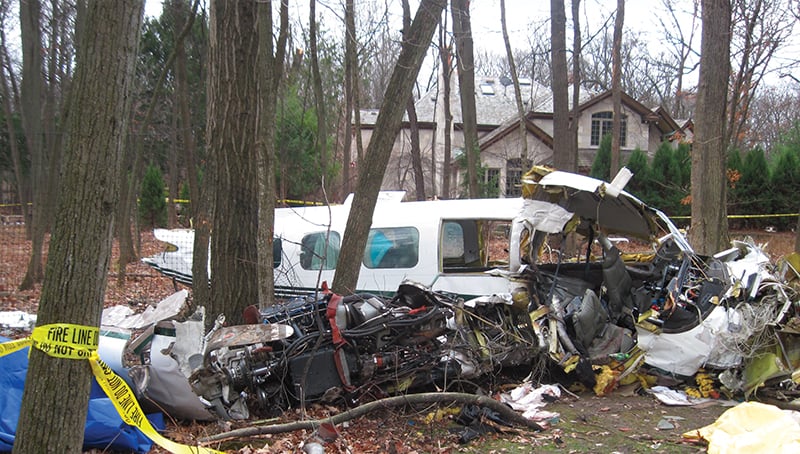
The NTSB found the accident’s probable cause to be “the pilot’s inadequate preflight planning and inflight decision-making, which resulted in a loss of engine power due to fuel exhaustion during approach.
“Contributing to the accident was the pilot’s decision to operate an airplane after using illicit drugs,” the NTSB said.
What role the marijuana played in the pilot’s decision chain remains open to interpretation, but there were issues from the get-go.
The flight began that morning near Crawfordsville, Indiana (KCFJ) at 7:00 a.m. local time, arriving at Palm Beach, Florida (KDJT), at 2:30 p.m. local. The manifest listed the pilot-rated passenger as pilot-in-command and the pilot and the paramedic as “other crew” for this first leg, which allowed the captain to skirt crew-hour work requirements. The flight enplaned the patient and patient’s relative and departed KDJT at 5:53 p.m. as Lifeguard N59773 and the 58-year-old pilot officially became the pilot in command. It landed in Jesup, Georgia, at 7:36 p.m. local time and onboarded 165 gal. of avgas, departing at 7:58 p.m. for KPWK.
The pilot-rated passenger would later tell the NTSB that the pilot-in-command switched to auxiliary fuel tanks as the flight approached the south shore of Lake Michigan. The aircraft then set up for the approach to Runway 16 at KPWK. North of the airport, the right fuel flow warning light illuminated, and the pilot turned the crossfeed valve to “on” and the light extinguished. The pilot’s request for direct to the outer marker was denied by air traffic control (ATC), the fuel light reilluminated and the pilot declared an emergency. The flight was then cleared direct and the right engine began shutting down, followed by the left. The aircraft exited the cloud cover at 700 ft. above ground level, turning from west to south. Just before 10:39 p.m. local time, the nose pitched up and the aircraft impacted trees 2.5 nm northwest of KPWK. The flight had been in the air for 3 hr. and 41 min.
The Chieftain holds 192 gal. of fuel, 182 of which are usable. Fuel is stored in four flexible fuel cells, two in each wing panel. The outboard cells hold 40 gal. each and the inboard cells hold 56 gal. each. The aircraft’s twin Lycoming TIO-540 engines collectively typically burn 35-42 gal. per hour (gph) at cruise power settings. However, the NTSB estimated the actual fuel burn of this flight at 47 gph. The right-side engine was new, having been installed 2.5 weeks earlier. The pilot-rated passenger told the NTSB that “the right engine’s gauges (CHT, oil temp, oil pressure) were not accurate during the flight. The pilot bumped up the mixture on the right engine about 1 gph due to its break-in.” A single Lycoming TIO-540 can burn as much as 28 gph at cruise power settings during the break-in period of 25-50 hr., according to the OEM. Accurate engine gauges are essential to the process, and the engine should be run 100-150F rich of peak.
Fuel management was an issue early into the flight, according to the NTSB. At KDJT (then KPBI), the aircraft only onboarded 75 gal. of fuel—enough to make it to KJES, but without the legally required 45-min. reserve. While the straight-line distance from KJES to KPWK is 696 nm and the flight had a 20-kt. tailwind overall, the NTSB concluded: “Based on distance alone, fuel exhaustion on the final leg would be predicted. However, the tailwind made a non-stop from Jesup-Wayne County Airport to Chicago Executive Airport a possibility, albeit close.
“A factor that the accident pilot may not have considered was the additional ATC vectoring over Lake Michigan that was required because of traffic in the Chicago area. The pilot ultimately declared an emergency and requested priority handling from ATC. However, the airplane was already out of fuel.”
Was the pilot capable of making good decisions? According to the NTSB, the pilot-rated passenger “indicated that the pilot acted abnormally sporadic and weird in Florida.
“The pilot flight-planned the route by himself and [the pilot-rated passenger] did not find out the fuel stop (in Jesup) until the flight started.”
A toxicological report on the deceased pilot found traces of tetrahydrocannabinol (THC, the active ingredient in marijuana) in the pilot’s liver, lung and blood. A variety of studies dating back to the 1970s show significant degradation in pilot performance up to 24 hr. after consuming THC including significant impairment in the areas of attention, coordination and decision-making. Most concerning, pilots may not even realize that they are impaired.
A 1991 study published in Aviation, Space and Environmental Medicine, found that “very complex human/
machine performance can be impaired as long as 24 hr. after smoking a moderate social dose of marijuana, and that the user may be unaware of the drug’s influence.”
In 1973, the FAA’s Civil Aeromedical Institute examined the impact of marijuana use on pilot performance and found that it impaired psychomotor performance, cognition and complex tasks. Acute effects include reduced attention, coordination and judgment.
Recreational marijuana is currently legal in 24 states, and recreational and medical use is legal in a combined 44 states. The federal government is in the process of evaluating whether to move it off the Schedule 1 (most dangerous) drug list.
But the FAA prohibition remains unchanged. Marijuana remains a prohibited substance under 14 CFR 91.17 and Part 120. Any use is disqualifying, and no special issuance is applied for any related medical condition, such as chemotherapy treatment for cancer.
The pilot in this accident had two prior DUIs. His employer was aware of the convictions but did not select him for random drug testing administered in July 2011. Nor did the employer request a background report on the pilot before he was hired.
A variety of studies have shown that individuals who misuse alcohol have a significantly higher propensity—40%—
to abuse cannabis, according to a study published by the National Institutes of Health in 2021.
The NTSB noted that the Pilot Records Improvement Act (PRIA) of 1996 requires air carriers and air operators to adequately investigate a pilot’s background before allowing that pilot to conduct commercial air carrier flights.
The Airline Safety and Federal Aviation Administration Extension Act of 2010 substantially changed how PRIA works, requiring employers to give all records they must report under PRIA to the FAA, which enters them into a pilot database and retains them until the agency is notified of the pilot’s death. Previously, certain legal enforcement records were expunged after five years.
Whether any of this would have made a difference in this accident is still up for debate. A chain of bad pilot decisions left Lifeguard N59773 short of the runway and up in smoke.
Related Content