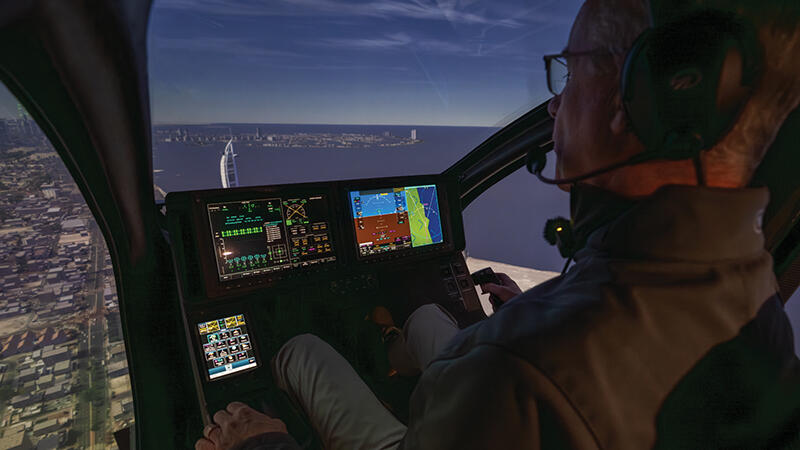
Joby took delivery of its first simulator developed jointly with CAE in January.
As electric vertical-takeoff-and-landing (eVTOL) aircraft move closer to commercial service, developers are increasingly leaning on simulation to overcome challenges that span pilot training, engineering and aircraft design.
In pilot training, extensive use of simulators is needed to address key limitations of eVTOL aircraft. Most notable are the lack of dual controls for side-by-side instruction and the range constraints of battery-electric designs, which make it difficult if not impossible to accumulate the flight hours required for certification. Those constraints were recognized in the FAA’s final Special Federal Aviation Regulation (SFAR) for powered-lift aircraft, which allows eVTOL pilots to complete a far greater portion of their training in simulators than is permitted under conventional fixed-wing or rotary-wing programs.
Beyond pilot training, developers are relying heavily on engineering simulators to model challenging flight regimes—such as transition from thrustborne hover to wingborne cruise—to derisk aircraft designs ahead of prototype manufacturing and reduce the likelihood of costly redesigns later in the program.
Joby’s Simulators
Among eVTOL startups, Joby Aviation has moved furthest in the use of simulators for its pilot training program. The company’s S4 embodies many of the training challenges the SFAR was written to address. The eVTOL has a single pilot station without dual controls and was designed for short missions, making it difficult to log long training flights even if an instructor seat were available. Those characteristics left Joby little choice but to lean heavily on simulation.
“We don’t have dual controls, so you can’t instruct in the airplane and you can’t carry an instructor in an airplane who isn’t instructing, because then they’re a passenger, and you’ve got to be certified to carry a passenger,” Joby Chief Operating Officer Bonny Simi tells Business & Commercial Aviation. “This is where you have to have a simulator, and the regulations actually require that for Part 135, a simulator has to be a Level C [full flight simulator].”
Simi says that Joby recognized early on that simulator development would be one of the longest-lead items in the entire eVTOL program. The company began internal planning in 2020, issued a request for proposals in 2021 and ultimately selected CAE as its partner in 2022. The two companies are developing the simulators jointly. CAE provides the hardware—the simulator, motion platforms, image generation and instructor stations—while Joby supplies the aircraft models and flight control laws.
Joby in January took delivery of its first of two CAE simulators, which will be installed in its pilot training facility in Marina, California. The two simulators are based on CAE’s 3000-series helicopter flight simulator family and are equipped with 300 X 130-deg. visual systems using CAE’s Prodigy high-fidelity image generators. The first delivery was a Level 7 flight training device, and the next will be the Level C full motion simulator. Around 90-95% of the training can be completed at Level 7, Simi says, but a “handful of maneuvers” can only be done at Level C.
She adds that the simulators can replicate the urban operating environment, too, which is crucial, considering the operational challenges posed by building-induced turbulence and unpredictable low-altitude weather patterns.
“You can simulate weather conditions that would be very difficult to find in the real world except in edge cases,” Simi says. “A certain wind coming around a certain building from a certain angle—something you may not get in a year in real life—but we can practice it over and over again. . . . Think of it as a digital twin not only of the aircraft, but a digital twin of the environment.”
Eve's Joint Venture
Like Joby, Eve Air Mobility is working with CAE to procure its simulators through a joint venture called Embraer-CAE Training Services. In early February, the company announced its first purchase of a Level C full flight simulator.
Unlike eVTOL developers that are already flying piloted prototypes, Eve is still in a phase where simulation plays a key role in both aircraft development and human-machine interface design. On a recent tour at Eve’s main facilities in Sao Jose dos Campos and Gaviao Peixoto, Brazil, executives repeatedly emphasized that beyond pilot-training devices, simulators are being used more broadly as engineering tools.
“The simulator that you see here is all software-in-the-loop,” Eve Chief Technology Officer Luiz Valentini explained during the tour. “Then what we call the iron bird has hardware-in-the-loop. What we’re doing is a step-by-step process. We increase the complexity and the maturity of the testing as we move along so we don’t have to run as far as having a prototype and then say, ‘Oh, no, that doesn’t work. Let’s go back to the drawing board.’
“Think of it like building blocks,” Valentini added. “We go step by step, and we guarantee the right maturity level for each step we’re in. We don’t want to get certification and suddenly realize this architecture doesn’t qualify or doesn’t meet requirements.”
Eve executives emphasized that the engineering simulator is not intended to function as a certified training device. Instead, it is being used to validate models, refine control laws and explore flight regimes—such as the transition between hover and cruise—that are difficult to model.
Executives acknowledged that some portions of the flight envelope cannot be fully validated without flight testing. But they emphasized that simulation allows Eve to explore human-machine interfacing and control law behavior in parallel with remotely piloted flight tests using the company’s engineering demonstrator, which made its first flight in late December.
“Even for hover, there is development that comes from the engineering prototype flight,” Valentini said. “But the simulator lets us explore the elements we don’t have on the remotely piloted aircraft.”
During a demonstration of the simulator, executives repeatedly relayed the theme of simplicity. They stressed how cockpit design and control laws are intended to reduce pilot workload and avoid skill traps, particularly as Eve looks to attract pilots from both fixed-wing and helicopter backgrounds. That philosophy is reflected in the company’s control scheme, which uses a single inceptor to control all axes while preventing pilots from going beyond safe operating limits.
“The word that drives our decisions has been simplicity,” Valentini said. “The intention is to design a machine that doesn’t require special skills. If the pilot has the intention to go up, they pull the stick back and the machine will accommodate that intention. To go down, you move the stick forward, and twist sideways to yaw. No matter if you’re flying as a helicopter or as an airplane, the machine will accommodate you.”

Related Content