This article is published in Business Aviation & AAM Report part of Aviation Week Intelligence Network (AWIN), and is complimentary through Oct 26, 2026. For information on becoming an AWIN Member to access more content like this, click here.
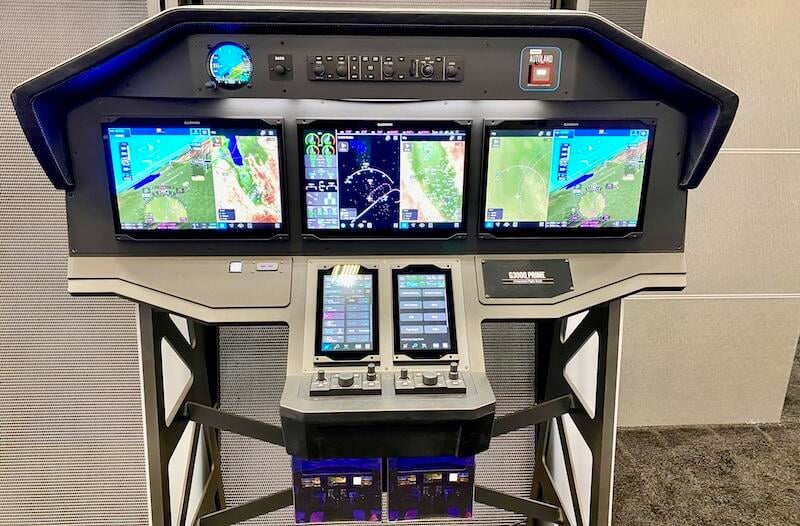
Garmin G3000 flight deck on display.
LAS VEGAS—Understanding automation in the cockpit is a skill that pilots should regard with confidence, knowing when to intervene if necessary to correct a flight, says former Brazilian Air Force instructor pilot Alex Fiorini.
Opening the National Business Aviation Association-Business Aviation Convention & Exposition (NBAA-BACE) Single-Pilot Safety Standdown on Oct. 19 here, Fiorini advised that pilots should understand how to use automation properly and recognize when it has stopped helping during a flight — for example, justifying a go-around or asking air traffic control for new vectors.
“Automation is often sold, and correctly so, as a workload-reduction tool,” said Fiorini, a member of the NBAA Safety Committee who flies for a large fractional jet operator. “Most of the time it is, right? But it doesn't necessarily remove the workload. Sometimes it just changes the workload. Now we're monitoring; we are anticipating; we are programming; and sometimes even troubleshooting.”
Fiorini drew his presentation from a 1997 study by R. Parasuraman and V. Riley, “Humans and Automation: Use, Misuse, Disuse, Abuse” that Fiorini says is still relevant today.
“After reading it, I thought about how much authority has been transferred from the human to the system and how easily can the human intervene?” he asked. “There are different levels of authority in automation. Sometimes it assists me, sometimes it recommends something, sometimes it executes something. As more authority moves toward the automation, I think the ability of the human to understand and intervene becomes increasingly important.”
Fiorini advised that pilots should ask themselves what automation is doing now, what it will do next and, if the response comes as a surprise, “What is my simplest, safest option?”
Pilots should verbalize, even when alone, what the aircraft is doing, set personal “gates” such as when to go around, and practice reverting to simpler levels of automation, even to the point of hand-flying, he says.
“I know it feels like a failure when we're approaching, we have to slow down and [air traffic control] says, ‘OK, cancel approach clearance,’” Fiorini said. “We're all pilots; we feel that failure, right? But I try to think of that as a second chance to review everything and fix something that we may have done wrong.
“Try to be stable. When at the end, if we don't think that [an approach] is safe, go around. It's not a failure.”

Related Content