This article is published in Aviation Week & Space Technology and is free to read until Nov 11, 2026. If you want to read more articles from this publication, please click the link to subscribe.
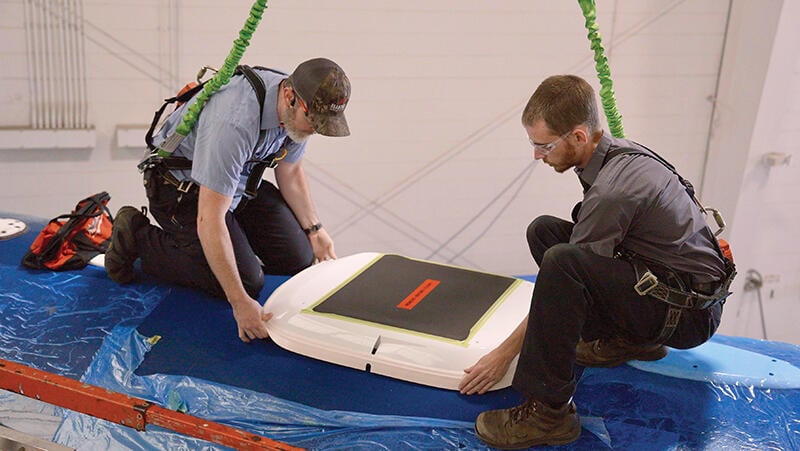
Elliott Aviation’s inflight connectivity STCs include one for installing Starlink antennas on Bombardier Challenger 605s like the one pictured.
Installers report sustained demand for new low-Earth-orbit satellite connectivity systems, and Starlink Aviation is holding its leading market position despite significantly raising subscription costs.
“Demand for Starlink Aviation remains extremely strong, particularly since the introduction of the Block 5 antenna,” says Bill Forbes, Elliott Aviation senior vice president of sales and avionics programs. “The Block 5 hardware represents a significant step forward because it enables access to Starlink’s latest network capabilities, including support for the V3 satellites that are currently being deployed.”
Elliott Aviation is an authorized dealer for both Starlink and Gogo Galileo, Starlink’s main competition for low-Earth-orbit (LEO) satellite connectivity serving business aviation. The Moline, Illinois-based maintenance, repair and overhaul provider has developed and obtained supplemental type certificates (STC) covering more than 70 aircraft models and variants for inflight connectivity installations.
Scottsdale, Arizona-based StandardAero is “seeing high demand” for Starlink, Galileo and other connectivity solutions, says Colleen Back, the company’s vice president of aircraft programs. “Our customers enjoy that each product provides stellar Wi-Fi access in the air, paired with widespread global coverage.”
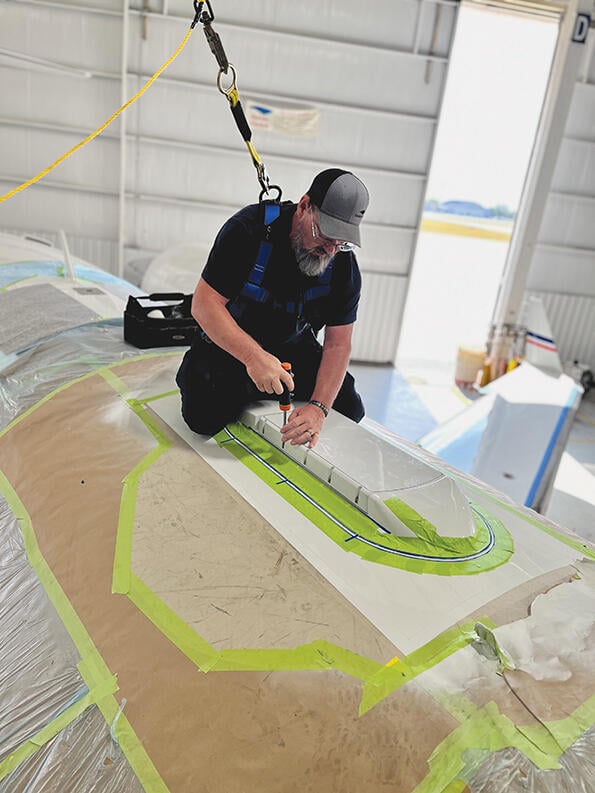
StandardAero says it has access to connectivity STCs developed in-house as well as to third-party and factory STCs that support the aircraft it specializes in—Dassault Falcon; Bombardier Challenger, Global, and Learjet; Embraer Legacy and Praetor; and Gulfstream jets.
As an approved Embraer Service Center, StandardAero can install Starlink on Legacies and Praetors. As a Gogo channel partner, “we were uniquely chosen to develop Galileo FDX/HDX STCs for the Bombardier Challenger 600 series and FDX STCs for Global Express-series jets,” the company says.
The Challenger-series STCs are available to other Gogo authorized dealers to purchase. The STC to install the FDX terminal on Global Express jets will be available later this year.
SpaceX entered the aviation market with its Starlink offering in 2022-24, delivering inflight internet via a low-profile Aero Terminal with an electronically steered, phased array antenna that mounts to the top of a fuselage. The service accesses SpaceX’s constellation of now more than 11,000 LEO satellites operating primarily in Ku-band.
Starlink’s next-generation V3 satellite is designed to support 1 Tbps of downlink and 160 Gbps of uplink capacity, representing tenfold and 22-fold increases, respectively, over its V2 satellites. SpaceX launched the first operational V3 satellites onboard its Starship-Super Heavy launcher Sept. 28, following a successful suborbital test deployment in July.
Gogo, a legacy provider of air-to-ground (ATG) cellular communications, rolled out its Galileo satellite broadband service in 2025. Galileo uses the Eutelsat OneWeb constellation of currently 650 first-generation LEO Ku-band satellites. Separately, Gogo’s new 5G ATG network entered service earlier this year.
Four years after entering the aviation market, Starlink “continues to drive the majority of new inquiries,” Forbes says. One of the most significant drivers of recent interest in Starlink, he says, was the release of new Block 4 and Block 5 antennas.
“That transition created additional demand as operators waited for the latest hardware capabilities before moving forward,” Forbes says. “The resulting product offers meaningful advantages for larger-cabin aircraft and operators who routinely travel internationally to destinations in Europe, Asia and other regions where reliable global connectivity is essential. As additional aircraft certifications become available, we expect demand to remain strong.”
SpaceX notified subscribers in July that it was updating Starlink entry-level and unlimited service plans for business aviation, introducing a new mid-tier regional plan and instituting regional service boundaries “so they better reflect how operators use connectivity across regional and global operations.” The changes became effective on the next billing cycle after Aug. 7.
Starlink’s Business Jet 20 GB plan, priced at $2,000 per month prior to the plan change, became an Aviation Regional 25 GB plan priced at $4,000 per month. The new plan allows 25 GB of data use monthly with speeds up to 250 Mbps within one continental region. Additional data will cost $250 per gigabyte.
The $10,000 Business Jet Unlimited plan transitioned to an Aviation Global Unlimited plan for $20,000 per month. The new plan offers unlimited worldwide data at speeds of up to 1 GBps, fast enough to support online activities by multiple passengers simultaneously. But achieving the maximum speed requires installing a Starlink Aviation Performance Antenna, SpaceX says.
A new, mid-tier Aviation Regional Unlimited plan, priced at $12,500 per month, allows for unlimited data at speeds of up to 500 MBps, covering one continental region. The coverage region is assigned based on a subscriber’s billing address.
Earlier in 2026, SpaceX notified users of its Roam and Priority service plans that it was capping the maximum in-motion speed it supports at 100 mph (87 kt.), while introducing two new aviation tiers—300 mph for $250 per month and 450 mph for $1,000 per month—both allowing 20 GB of data. The reduced permitted speed for the Roam and Priority plans effectively ruled out most general aviation aircraft.
An executive who contacted BCA decried the pricing and coverage changes to business aviation service plans, saying they restructure an offering that owners of long-range bizjets had “bought into” and invested in the required equipment.
“I was one of the first Bombardier Global 6000 owners to install Starlink Aviation in 2024, investing over $300,000 in equipment and installation,” the executive said in an email. “This feels like a story with real relevance to how private aviation connectivity providers treat early adopters and long-term customers.”
Even with the rate increases and Gogo’s entrance into the market, Elliott Aviation has not seen any cooling in demand for Starlink overall, Forbes says.
“While Galileo has generated significant interest and Starlink subscription pricing has prompted some operators to evaluate alternatives, we have not seen a meaningful reduction in overall Starlink demand,” Forbes says.
“Starlink remains the benchmark solution today,” he adds. “Galileo is providing healthy competition and creating additional options in the marketplace, but it has generally expanded customer choice rather than displaced demand for Starlink. In fact, continued growth in aircraft certifications have helped sustain strong demand despite pricing adjustments.”
Since its market entrance, Galileo has given operators an alternative to consider against Starlink with its longer track record, Back says.
“There has been an increase in Gogo Galileo demand since its introduction to the market—our installations for the product have quadrupled in 2026 versus 2025,” she says.
“Starlink has made a name in the industry starting in 2024, and that success has rendered some product availability challenges,” Back adds. “Paired with the Starlink service subscription price increase and a new performance antenna add-on, many operators have been given new considerations to evaluate related to Gogo Galileo’s continued STC development release and differentiated pricing structure, among other factors.”
Gogo’s Guarantee
Gogo CEO Chris Moore says his company decided to offer three-year secured pricing for Galileo and 5G service before Starlink announced its price increases. Relative to the competition, Gogo’s price lock is a differentiator that resonates with customers, he says.
“The main competition in LEO is Starlink,” Moore says. “They increased their pricing by 100%. Before they did that, we had already made the decision to tell customers that we were guaranteeing the pricing if they signed up with Galileo or 5G services because these services are both new.
“We’ve guaranteed the pricing for three years,” Moore emphasizes. “It’s important to do that with customers. I think if you look at most flight departments and charter operators, they need to budget, and dropping big price hikes on them is a big problem. We’ve been around for a long time, and [it’s important] that they trust the service and more importantly that they can budget the service moving forward.”
Gogo offers two satellite terminals, both supplied by Hughes Network Systems. The Galileo HDX, designed for small to midsize jets and turboprops, is a flat-panel, half-duplex electronically steerable antenna (ESA) system that can transmit or receive data only at a given moment, not simultaneously. The Galileo FDX for super-midsize and larger business jets is a full-duplex ESA that can simultaneously transmit and receive data. Both work in conjunction with Gogo’s Avance modem-router platform to connect with OneWeb satellites.
Gogo’s 25GB plan (with a 25GB monthly data allowance) using the smaller HDX antenna costs $3,500 per month for three years. A 50GB plan using the FDX antenna is price-locked at $7,000 for three years. Three-year unlimited plans cost $10,500 monthly for HDX and $12,500 for FDX. Gogo also offers price-locked unlimited combination plans with air-to-ground connectivity ($11,500 for HDX and $13,500 for FDX).
“If you look at Starlink’s ‘all-you-can-eat’ unlimited global plan—I think it’s $20,000,” Moore says. “If you look to us for a similar [plan] we’re about $12,500. We’re very competitive. We’ve stood by our pricing and haven’t made any alterations.”
During its second-quarter earnings call Aug. 6, Gogo said it had shipped 518 Galileo terminals. Most of those were HDX terminals, for which there were 42 STCs available to fit the system on a wide variety of aircraft. The company expects orders for the larger FDX terminal will increase as STC installations are approved.
“We’ve only got four STCs [for the FDX] at the moment with another 20 STCs that we believe we’ll get between now and the end of the year,” Moore says. “We see FDX picking up quite a lot. The only reason it’s not as prevalent as HDX is STC availability.”
Late last year, NetJets appeared to upend a 2024 commitment with Gogo by entering into a multiyear agreement to install Starlink across 600 of its business jets in the U.S. and Europe. The world’s largest fractional fleet operator clarified that it planned to install Galileo on its Embraer Phenom 300E and Cessna Citation Ascend fleets in the U.S. and non-Starlink aircraft in Europe.
Gogo has a commitment from VistaJet to install either Galileo or upgraded Ku/Ka-band connectivity on 270 jets. Wheels Up is installing Galileo HDX fleetwide on its Embraer Phenom 300/300E and Bombardier Challenger 300/350s.
“Galileo from a LEO perspective is doing really well,” Moore says.

Related Content