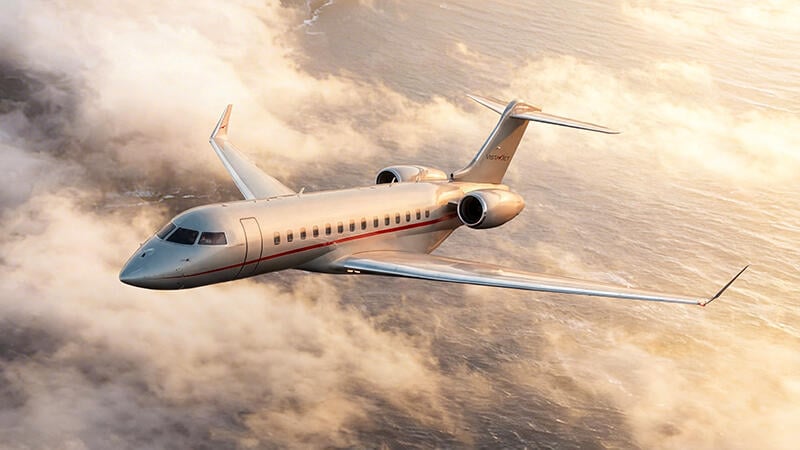
Vista accepted its first Bombardier Global 8000 on April 15. It plans to operate 18 of the jets, which have a top speed of Mach 0.95.
Bombardier increased its backlog to $20.3 billion at the end of the first quarter (Q1), generated revenue of $1.6 billion—$717 million of which was from its services business—and generated $60 million in free cash flow that quarter, the highest in almost two decades. While these numbers are impressive, “our performance this quarter demonstrates the resilience and diversification of our business,” says Eric Martel, Bombardier president and CEO.
Bombardier’s remarkable turnaround from being an overleveraged, nearly bankrupt company to a profitable one in six years is a story of good management, focus and a big cultural shift.
It was also about good leadership and a bit of luck.
Bombardier appointed Martel president and CEO on March 11, 2020—right at the start of pandemic when borders were closing. During Q1 2020, Bombardier lost $200 million.
Martel replaced Alain Bellemare, who had spent the past five years in the role trying to increase profit and cut debt. In his five years, Bombardier agreed to sell its C-Series program to Airbus, sell its Canadair Regional Jet program to Mitsubishi, sell its Belfast facility to Spirit Aerosystems and divest its Transportation (train) business to Alstom.
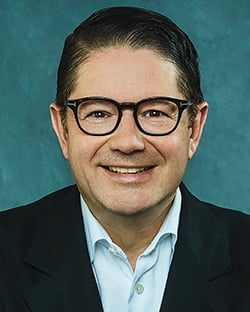
Bombardier launched its five-year turnaround plan on March 4, 2021, but “[we] first had to execute the first nine months [of 2020],” including bullish decisions to divest its Bombardier Transportation and sell the CRJ program, in a “very challenging environment,” he says. “We were very determined to reset the company” and focus it on business aviation, he says—in particular, the mid to long-range jet market.
A crucial part of the company reset was changing the company culture. From his first day, Martel wanted to shift Bombardier’s culture from crisis mode to one focused on customers, employees and being part of a collective team. “We’ve really walked the talk. It is not just a poster on a wall,” he emphasizes. “We also talked a lot about authenticity—putting a problem on the table and working it out together,” he adds. That continuous improvement mindset has delivered results for customers through aircraft and services orders, and for employees, whose engagement climbed to 80% from 40% in surveys.
The five-year turnaround plan set the following objectives for 2025: revenues of $7.5 billion (up from $5.6 billion in 2020); earnings of $1.5 billion (compare to $200 million in 2020); and free cash flow of $500 million (compared to a negative $1.9 billion in 2020).
In its 2025 annual earnings call Feb. 12, Bombardier revealed that it exceeded those targets by quite a bit. It logged revenue in 2025 of $9.55 billion—$2 billion higher than its goal. It hit its earnings goal almost exactly, but its free cash flow was $1.1 billion, so $3 billion more than five years before.
The increased revenue reimbursed its debt, the payment of which it accelerated from the original plan. Its net debt-to-EBITDA ratio improved to 1.9X by the end of 2025.
Accelerating aftermarket services was a key pillar of the turnaround plan—both to better support customers around the world and generate revenue. Last year, aftermarket revenue doubled to $2.3 billion last year from $1 billion in 2020 and significantly contributed to that increased cash flow. The services business “generates nice, predictable cash flown on a quarterly basis,” Martel says.
Along with services, “the other strategic choice we made was in 2022, when we created Bombardier Defense, which happened to also be the right choice,” Martel says. In 2022, the defense unit generated about $250 million in revenue. “Last year, we made a $1 billion, which is what we were hoping to achieve in 2030,” he says.
“Between the culture and making the strategic choices we’ve made, we are in a very different place today,” Martel says. “And today we’re generating $1 billion of cash, plus or minus, on a year basis, which gives us all kinds of options in terms of developing new product, investing [in] defense, maybe doing M&A, reimbursing more debt … we didn’t have that option six years ago,” Martel says.
“Our balance sheet has been repaired, and it gives us a lot of possibilities moving forward,” Martel says.
Customers, Fleet and Services
Bombardier’s future aligns around its aircraft, aftermarket services and defense offerings—the three pillars it identified during its turnaround. Fleet operators are a key part of two of those.
Its super-midsize Challenger 3500 and ultra-long-range Global 8000 are popular aircraft for fractional and fleet operators—including Flexjet (founded by Bombardier in 1995 and sold to Directional Aviation in 2013), NetJets, Vista Jet, Wheels Up and Bond—and Martel partly attributes Bombardier’s popularity with fractional and fleet operators to its MRO support and services. Fleet operators have a different business model and fly about 1,000 hr. annually. “They can be anywhere—in the middle of Africa. They can be in Europe. They can be in Latin America or in Asia, or anywhere in North America, and you have to be able to support them and also understand their business model and make sure that when they come in for a significant inspection, that you get that aircraft out of services as soon as possible,” Martel says. Lead time is important to them. Aftermarket support and services “is one place that Bombardier as an OEM has demonstrated that we can offer a very unique experience,” Martel says.
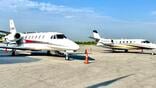
While Bombardier expanded its MRO footprint and capabilities during the turnaround, maintenance is not a new offering for the company. “I was president of [Bombardier] services when we signed our first contract with NetJets” in 2012, when the operator signed the landmark contract for up to 275 Bombardier Challengers and a 15-year service and maintenance agreement. The OEM has continued providing maintenance support for the large fractional since, so it has learned how to stock parts and have people available for support globally. Martel says that experience “is a bit of a secret weapon for us and the reason why we’ve been so successful with the fleet operator.”
In addition to considering new MRO locations, “we could go deeper” and start in-sourcing some of the work it outsources, Martel says. One example of that is the wheels and brakes maintenance shop that it set up in Wichita. He says further MRO capabilities could come through organic growth, like the wheels and brakes shop, or through acquisition.
“In the next five years, we are going to continue to grow services,” either “organically, which may require some internal investment, or it may be by acquisition,” Martel says. Bombardier purchased Velocity Maintenance in February, but “there could be others more significant,” he adds.
Growing its defense business also is a priority. And given the current geopolitical climate that is generating investment by countries around the world (see special mission story on p. 26), the defense business has momentum.
Bombardier obviously needs to keep up with fleet innovation, as well. Martel sees a shift “in the last couple of years that customers are looking for a bigger plane” and longer range, which was part of the tough decision to cease production of Learjet, the facilities of which now house the defense business.
Expect Bombardier to continue expanding its business jets, service and defense outlooks.
“We have transformed the business, reinforced our competitive position and established a clear and disciplined track record for growth, which we’ll carry forward,” Martel summarizes.

Related Content