Can you please describe your fleet and customer base?
The client base has moved to a lot younger for us and for the industry. Luxaviation UK operates a fleet of 18 aircraft, the majority of which are available for charter. They vary from the Embraer Phenom 300 as the smallest, to the Bombardier Global 6000, which is the largest in our fleet. We have the Phenom, four Cessna Citation XLSx, four Legacy 600s and 650s, a Challenger 604—and we are in the process of getting another one—as well as a Challenger 650, two Praetor 600s and two Globals. While this is the UK fleet, we are part of a bigger Luxaviation Group that operates 195 aircraft worldwide. Of those, about 60-70 are good for charter.
What is the relationship between Luxaviation UK and the group?
Luxaviation UK is fully owned by the Luxaviation Group, and under the Luxaviation Group umbrella, we have several entities such as Belgium, France, Luxembourg, Germany and the Middle East—which operate independently. When it comes to aircraft management, we all run our own individual entities. This is quite important because a lot of the clients don't necessarily want to be part of a bigger group, because they feel they might lose the personal touch or the attention that they deserve.
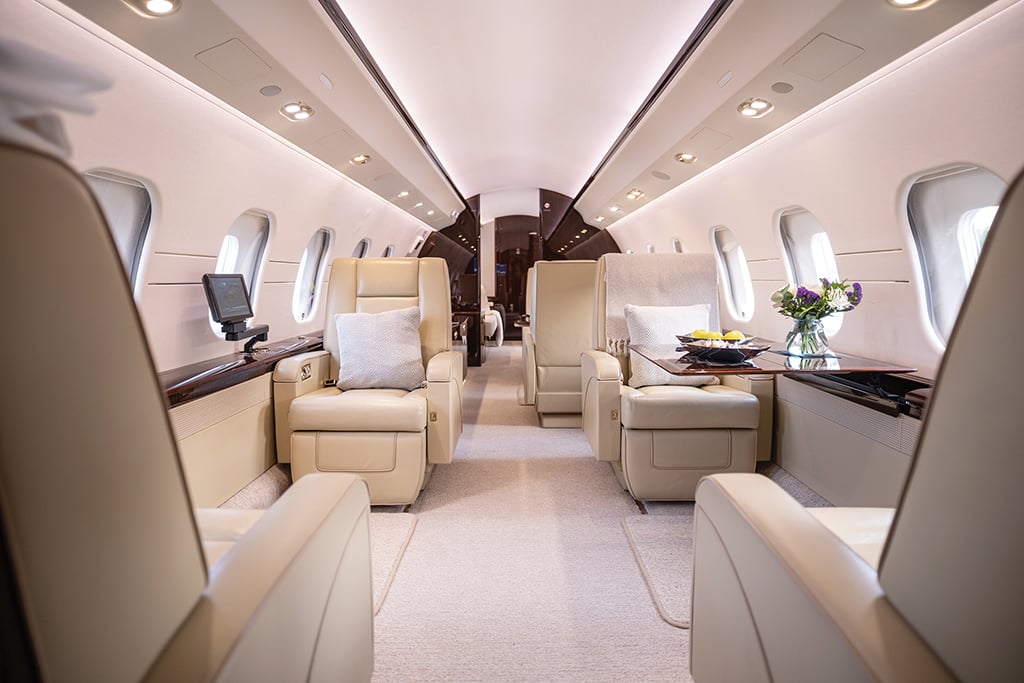
When it comes to charter, there's a lot of cooperation overlap. We have a group charter desk that receives inquiries and sends them to the most relevant entity. For example, an American client in Ibiza going to London would probably come to Luxaviation UK, unless there already was an aircraft in or around Ibiza. The individual entities operate independently but work together.
The group is keen for entities to remain independent and run their own business. We have slightly different business models from entity to entity. For example, Belgium has the Sky Club program, which is a kind of an aircraft timeshare between three or four owners. Some entities concentrate more on aircraft management than charter. In the UK, we've always been very much charter people, although we will manage any aircraft. In the summer, we give an average of 300-500 quotes per day. We're a quoting machine for charter.
A lot of benefits came from being part of a group—economies of scale and purchasing power, for example. There’s also a safety enhancement, because all the safety departments share information. For instance, if an issue arises in South Africa, we can all learn from it. I think the world's becoming very small—people prefer to deal with someone who has reach worldwide. So if one of our clients flies on a scheduled flight to Australia, we have the capacity there to give him an aircraft to fly around Australia or the South Pacific, which is a great benefit.
Where are you seeing the most charter demand in the UK and Europe?
The charter market is pretty good, but I wouldn't say it's booming. People are bit more cautious because there’s a lot of uncertainty around the world—uncertainty in the financial markets. More new aircraft are coming into the market and because a lot of people don’t think the older aircraft are economically viable, some of those will exit. Overall, I think we need more aircraft as an industry because there is enough demand.
How is the business landscape evolving in 2025? What are the challenges and where are the growth opportunities?
First of all, sustainability has been a challenge. Compared to 2024, things have calmed down a bit there, but sustainability is always going to be a serious issue in our business. We're not seen as an environmentally friendly people, and I think as an industry, we fell behind on explaining what we do to improve carbon emissions, including offsetting and all the different schemes that are available.
The biggest challenge at the moment is new taxes. France has imposed higher taxes, and that market has dropped a bit. We should be flying backward and forward between Nice and London, and to Cannes, San Tropez and Monaco, which are common destinations. On the other hand, Ibiza is booming. Mykonos was the favorite flavor the last couple of years, but it has dropped a bit. I think the "in crowd" that moved from Ibiza to Mykonos is now going back to Ibiza.
The UK imposed some environmental taxes this year, and more are expected to come next year. I think more and more countries will jump on the bandwagon. It's very politically driven—it’s the low-hanging fruit. At the end of the day, I don't think the money they collect is going to put the wealthy people off flying completely, nor is it going to help with the environment or the government coffers. Please your public. Make them happy that you are doing something against the rich.
Apart from that, another challenge is over-regulation from some authorities. It is not as straightforward to operate a UK-registered aircraft into Europe and within Europe, but it has gotten a lot better since the early Brexit days.
As an example, once a UK-registered aircraft is within the EU and you want to fly to another EU country, which comes under the seventh freedom, you need 48 hr. notice, which obviously prevents you from getting last-minute flights. So if we are sitting in Ibiza and someone says, ‘Would you take me to Berlin?’ You cannot take them straightaway. Conversely, they're not allowed to fly intra-UK, but that's fine with us, because we've got a UK fleet, and they will need equally to provide 48 hr. notice to fly from the UK to the U.S., for example. So those regulations make it a bit more challenging.
How have customer expectations changed? Is it mostly the need for increased connectivity?
Absolutely. Our lives have changed and we want to stay connected. Especially on larger aircraft, clients expect good internet. There are the existing systems that are too expensive to install and too expensive to run—the Ku-bands. But now we’ve got Starlink and Gogo’s Galileo system. We're evaluating both.
We are the first operator to put a Gogo system on a Legacy 650, which we're doing at the moment. They're both great systems and faster than the internet I get at home. They will become the norm going forward, and it's going to filter down to a smaller fleet. To install them, it varies between $250,000 to $350,000. That compares to $700,000 to $1 million before to install a system that will give you two or three megabits per second speed.

Related Content