This article is published in The Weekly of Business Aviation part of Aviation Week Intelligence Network (AWIN), and is complimentary through Jan 15, 2026. For information on becoming an AWIN Member to access more content like this, click here.
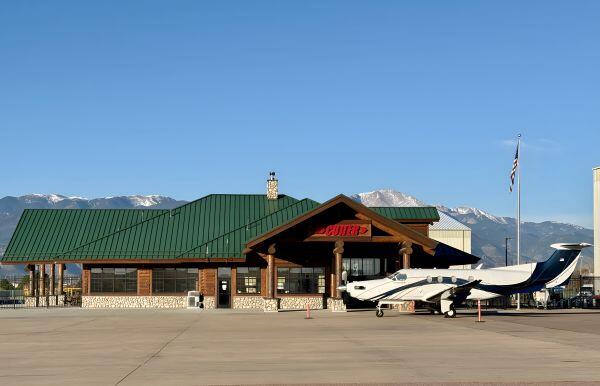
Cutter Aviation’s fixed-base operation at Colorado Springs Airport.
Nearing the century mark since it was established, family-owned Cutter Aviation is expanding its charter business from the U.S. southwest to the Rocky Mountains region with the opening of a new charter location at Colorado Springs Airport (KCOS).
The new location marks a strategic expansion beyond its southwestern roots for Cutter, an independent fixed-base operator (FBO), aircraft sales, maintenance and charter company based at Phoenix Sky Harbor International Airport. The company manages a fleet of 18 aircraft, including nine shared ownership Pilatus PC-12s and PC-24s.
Cutter Aviation is Pilatus Aircraft’s authorized sales center for the southwest.
Expanding the charter business north makes sense for various reasons, says Cutter Aviation President and CEO Will Cutter. The company already has a rustic, mountain lodge-style FBO at KCOS and MRO facilities at Centennial Airport in Denver and Rocky Mountain Metropolitan Airport (BJC) in Broomfield, Colorado.
Pilatus Aircraft’s U.S. completions center is located at BJC. The facility handles final outfitting, custom interiors, avionics installations and paint for PC-12s and 24s destined for the North and South American markets.
“We have hangars and fuel and already have offices and facilities in Colorado Springs,” Cutter explains. “It’s a known market to us, certainly in the FBO world. Then just up the street [in Denver], we’ve got our maintenance facility when needed. Either we fly the plane up or they run down in a car or a truck for anything we might need fixed right away.”
Cutter Aviation has two shared owners who use KCOS. “We fly from Phoenix to get them,” Cutter says. It plans to expand the shared ownership program in Colorado—which divides the value of a new Pilatus between six owners. Two new PC-12 turboprop singles and a PC-24 twinjet will join the fleet in 2026.
The company’s single-pilot-certified PC-12 NGs fly up to 1,800 nm and can seat eight passengers in the cabin and a ninth, if necessary, in the co-pilot’s seat. Cutter Aviation operates PC-24 light jets (max. range 2,000 nm) with two pilots. Those can be configured with double club seating for eight passengers. Another jet entering the shared program next spring has a three-place divan that folds out to a bed.
Both the PC-12 and 24 have enclosed lavatories and large pilot-side cargo hatches for ample luggage.
About 70% of Cutter Aviation’s charter business is drawn from the shared fleet; another 30% from aircraft the company owns or partly owns, including Cessna Citation Latitude and PC-24 models.
Charter aircraft are based at Phoenix Sky Harbor and Deer Valley airports, where Cutter Aviation has FBO facilities, as well as in Addison and Georgetown, Texas.
“We’re trying to break into the charter world up there and so far, it’s been quite successful,” Cutter says of the expansion to Colorado. “We’ve started contacting other owners of planes up there as well as high-net-worth individuals and businesses, and we’re already starting to fill the books up.”
Tariff Impact
Cutter Aviation sells Pilatus aircraft built in Stans, Switzerland, and completed in Broomfield, Colorado. Though they were lifted in mid-November, Trump administration tariffs that grew to 39% on products from Switzerland have been disruptive. The highest tariff prompted Pilatus to announce in August that it was pausing PC-12/24 deliveries to the U.S.
In November, the manufacturer delivered a new PC-12 PRO to a U.S. customer and committed to deliveries through 2025.
The cost of a tariff can be substantial and prohibitive for some buyers, including those who split the cost of a shared aircraft, Cutter says, using as an example the new PC-12 PRO, which lists at $6.8 million.
“That’s a tough thing to swallow,” he says of tariff cost. “We've had a couple of people that we’ve worked around and swapped and moved downstream—and we would take [an aircraft] for our shared program, but all in all we’ve not lost anybody because of the tariffs.”
Cutter adds: “On the PC-24, the Williams [FJ44-4A] engine is built in America, so that brought the cost down. It still was a very, very expensive amount, and so the dealer shared a good portion of it, the factory shared a good portion, and the end user had to share a big portion of that.
“We’ve absorbed a lot of them to keep everybody happy,” he says. “We’re doing this to live another day type of thing, and I just hope that other day comes along pretty soon because our margins are basically zero now for PC-12s and 24s during this whole tariff thing.”
The company has dealt with change before. Cutter’s grandfather, William P. Cutter, founded Cutter Flying Service in Albuquerque in 1928, and it survived the Great Depression and World War II by providing air charter services needed to reach far-flung ranches, towns and businesses across New Mexico, Arizona, and Texas.
As it expands its charter operations to Colorado Springs, the company is elevating a fourth generation of Cutters into leadership positions. In December, it named Will Cutter’s daughter, Anna Cutter, as vice president of Cutter Flight Management. In the new role, she “will guide the strategic direction of the charter flight department, overseeing day-to-day operations, advancing performance benchmarks and driving initiatives that support future growth and fleet development,” Cutter Aviation announced.
Will D. Cutter, who began his career at Piper Aircraft and most recently led FBO operations at Georgetown, has been appointed vice president of Texas operations.