Bizav Traffic Grows At Dubai Aerospace Hub
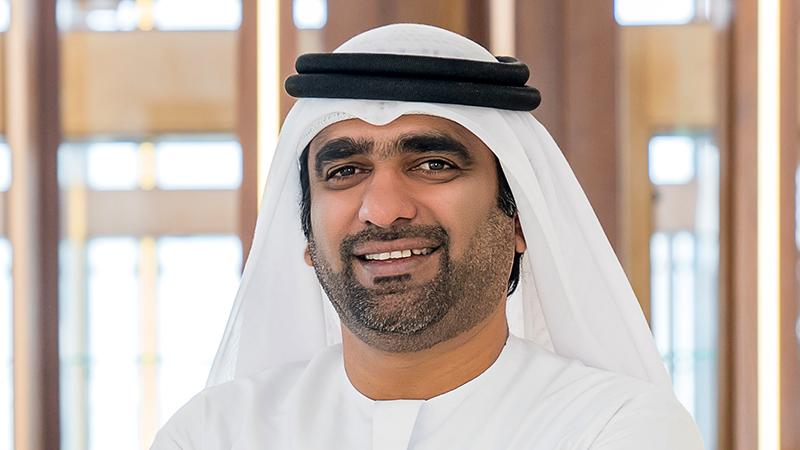
Mohammed Bin Rashid Aerospace Hub CEO Tahnoon Saif.
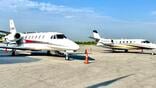
Business aviation traffic is ascending at the Mohammed Bin Rashid Aerospace Hub (MBRAH), a business and commercial aviation-focused district of the Dubai South master development rising up around Al Maktoum International Airport (DWC) in southern Dubai.
The aerospace hub recorded 9,753 private jet movements in the first half of 2025, a 15% increase over the same period in 2024. Last year, the hub experienced 18,000 movements, the highest-ever level of bizav traffic recorded in Dubai.
With 70% of its infrastructure built, the growing traffic lends credence to Dubai’s investment in the MBRAH, one of seven districts of the ambitious Dubai South “integrated ecosystem.” The emirate makes no secret of its intent to become the region’s leading destination for business travel and investment.
“This sustained growth reflects our leadership’s vision to make aviation a key pillar of Dubai’s economy and highlights MBRAH’s vital role in supporting that vision,” says aerospace hub CEO Tahnoon Saif. “With the expansion of Al Maktoum International Airport underway, we are confident that business aviation movements will see further acceleration, reinforcing Dubai’s position as the busiest and most attractive business aviation hub in the region.”
DWC, which anchors Dubai South, opened in 2010 for cargo services, followed by passenger flights in 2013. The emirate plans to relocate operations from its main airport—Dubai International Airport—to an expanded DWC in the 2030s.
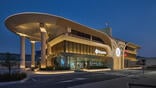
Dubai made early investments in infrastructure to support business aviation at Dubai South, building a runway, taxiways, apron, parking and a VIP Terminal that opened in 2016. The MBRAH, spanning 7 km2 (2.7 mi.2) is designed to support airline and business jet MRO facilities as well as business aviation operations. It is organized across four verticals: business aviation, maintenance and technical support, training and commercial real estate.
At the Dubai Airshow in November 2023, the MBRAH and flydubai signed an agreement to build the carrier’s first purpose-built MRO facility by 2026, a $190 million project. The carrier broke ground on the multi-bay maintenance hangar in July.
“What sets MBRAH apart is its integrated ecosystem, where business aviation seamlessly connects with commercial aviation, MRO and flight training—creating synergies unmatched in the region,” Saif says. “Combined with state-of-the-art infrastructure designed for efficiency, exclusivity and scalability, MBRAH continues to deliver a value proposition that is second to none.”
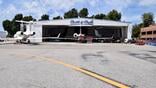
Within the business aviation vertical, work started in early 2023 on the second phase of the Dubai Helipark with partner Air Chateau International. Vertiport developer Vports announced plans in 2023 to open an Advanced Air Mobility World Integrator Center with pads for electric vertical-takeoff-and-landing vehicles by 2026.
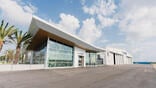
The MBRAH hosts five fixed-base operators (FBO)—Falcon Aviation, Jet Aviation and Jetex within the VIP Teriminal—plus DC Aviation Al-Futtaim and ExecuJet with their own facilities. The FBOs handle 90% of private jet movements in Dubai, a share that is expected to grow to 100% in the near future, the aerospace hub contends, by offering operators a variety of customizable options from a dedicated fuel farm with a 20-min. response time to dedicated catering options and maintenance facilities.
“Given the huge demand the region is experiencing from aviation-related companies, we are expanding our portfolio by launching new, state-of-the-art facilities, particularly for MRO services, which in turn strengthen the ecosystem and support the operations of our existing FBOs,” Saif says.
Recently, the MBRAH announced the launch of the “VIP Terminal Boulevard,” a new development designed to attract aviation companies and luxury retailers. Located adjacent to the VIP Terminal, the boulevard stretches 769 m (2,523 ft.) and features 16 buildings including retail outlets across a total development area of 204,000 m2 (2,195,840 ft.2).
With 70% of the infrastructure now completed, the remaining 30% includes hangarage, dedicated workshops, office spaces and supporting utilities, Saif says. He notes a “strong and growing demand” for hangar capacity. The projects are being built in phases, with completion timelines aligned to the expansion of DWC.
“Dubai has long recognized aviation as a cornerstone of its economic growth, guided by the vision of its wise leadership to position the emirate as a global hub for aviation, logistics and tourism,” Saif says. “Business aviation plays a vital role in this strategy, serving high-net-worth individuals and investors who rely on Dubai’s seamless connectivity and premium infrastructure.”
Related Content