This article is published in Business & Commercial Aviation part of Aviation Week Intelligence Network (AWIN), and is complimentary through Aug 11, 2026. For information on becoming an AWIN Member to access more content like this, click here.
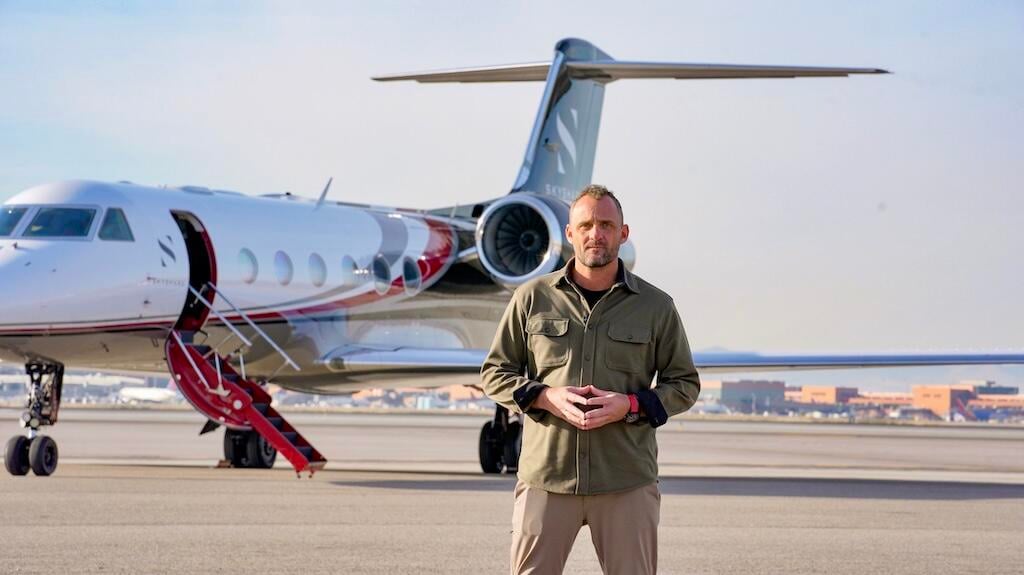
SkyShare founder and CEO Cory Bengtzen in front of a Gulfstream G450.
Currently focused on the western U.S. as its primary service area, fractional program and charter provider SkyShare aims to become a top-10 fleet operator nationwide by 2030.
Salt Lake City, Utah-based SkyShare maintained 27 aircraft across its fractional ownership, charter, and aircraft management divisions as of this summer. It had recently entered the heavy jet market, adding a Gulfstream G450 to its fractional fleet and a company-owned GV for charter services.
Founded in 2009 by Cory Bengtzen as an aircraft brokerage in a “one-room office” at Ogden-Hinckley Airport, Utah, the company has grown to 180 employees, including 80 full-time pilots.
Already named five times to both the Inc. 5000 annual list of fastest growing, privately held companies in the U.S. as well as to the Mountain West Capital Network 100 list of fastest growing companies in Utah, SkyShare has not slowed down. It aspires to join industry leaders NetJets and Flexjet among the top U.S. fractional ownership providers by hours flown.
“For us to make it to the top 10, which is our goal by 2030, we would have to offer our fractional programs across the country,” Bengtzen tells BCA. “To be able to support that, we’re going to be looking strategically at the right acquisition of another either charter or fractional company to give us the assets to be able to do it.”
SkyShare’s fleet consisted of 11 Pilatus PC-12 turboprop singles, Cessna Citation CJ2/M2 and Embraer Phenom 100/300 light jets, Cessna Citation Excel and XLS midsize jets, three Gulfstream G200 super-midsize jets, two G450 heavy jets (one fractionally owned, one managed), and a company-owned GV.
The company’s growth has accelerated in recent years, centered around an asset-light business model with a unique value proposition.
“I saw an opportunity about eight years ago, specifically in the western U.S., where there wasn’t a mid-tier fractional program,” Bengtzen explains. “[There was] PlaneSense on the East coast doing great work; Airshare in central U.S. and then the big ones—NetJets and Flexjet. But there was no one using smaller aircraft. Then it was like, OK, what’s next? What can we do to make ourselves very unique?”
SkyShare keeps costs down for fractional owners by acquiring pre-owned aircraft that have been through mechanical pre-purchase inspections. The company refurbishes the aircraft with new paint, interiors and WiFi. “You get all of the benefits of a new aircraft for a fraction of the price,” Bengtzen says.
Flexible Ownership Options
Another differentiator is the flexible ownership options SkyShare offers. The company’s SFX-12 program is built around the PC-12, known for its ability to access airports that are inaccessible to jets. The company’s SFX-Jet program “matches the aircraft to the mission,” providing access to four models from the PC-12 to a light, midsize or super-midsize jet. SFX+ is built around the Gulfstream G450, configured for 14 passengers with a dedicated cabin attendant. It includes guaranteed access to the SFX-Jet and SFX-12 fleets.
SkyShare’s fractional programs are focused on owners who live in 11 Western states. That limits the number of repositioning flights it must perform and keeps the program costs affordable, Bengtzen says.
“We’re very strategic and intentional in our primary service area,” he says. “I've seen so many fractional companies go out of business trying to be everything to everybody, selling ownerships on different coasts, and then you're deadheading airplanes. For the time being, we just do the 11 Western states. Our goal is to grow at the appropriate time, probably through acquisition. When we have more airplanes then we’ll start going east.”
SkyShare announced its entrance into the heavy-jet market with the G450 and GV in July. In parallel, the company said it has achieved a platinum rating from safety auditing firm ARGUS International and International Standard for Business Aircraft Operations Stage 1 certification, which is focused on an organization’s safety culture.
Achieving the voluntary business aviation certifications was a “defining moment” for the company, Bengtzen said in a press release.
“Independent validation matters,” he added. “Whether someone is purchasing a fractional share, chartering an aircraft, or trusting us to manage a multimillion-dollar aviation asset, they deserve confidence that safety is embedded into every aspect of our operation. These achievements reinforce that commitment.”
SkyShare on July 27 announced FAA approval of its Safety Management System (SMS) ahead of the compliance deadline for Part 135 operators. The FAA published a final rule in 2024 that expanded its Part 5 regulation beyond airlines to require SMS systems for Part 135 operators, Part 91.147 air tour operators and certain Part 21 manufacturers. Operators must comply by May 28, 2027.
In addition to its aircraft operations, SkyShare owns and operates fixed-base operations (FBO) at Salt Lake City South Valley Regional Airport (SVR) and Gnoss Field Airport in Marin County, California. These are part of an “integrated platform” that includes fractional ownership, charter services, aircraft management, maintenance, and hangar and office leasing and development.
The Salt Lake City Department of Airports selected SkyShare to operate the FBO and lead real estate development at SVR earlier this year. The company will oversee hangar and office leasing and development across 650,000 ft.² of property. It plans to begin construction later this year on 50 new T hangars and a large community box hangar for general aviation aircraft.
Located 10 miles south of Salt Lake City International Airport, SVR serves as a general aviation reliever airport with a 5,862 ft. runway. It’s where Bengtzen learned to fly and earned his private pilot’s license.
“South Valley Regional isn’t just another airport to me,” he said at the time of the announcement. “Being part of its future is incredibly meaningful.”
Bengsten and his business partner Tommy Aoki, friends since middle school, have managed to self-finance SkyShare’s growth from its start as a small brokerage.
“We've been really lucky in that we've been able to bootstrap it for the whole 17 years,” Bengsten says. “Between the two of us, we own 100% of the business. [Aoki] is the president and CFO; I'm the CEO and run the revenue generation side—the sales teams.”
“I don't know if that will forever be the way for us to go and acquire a very large charter or fractional company,” he adds. “We're probably going to need to bring in some investment. But up until now we've been able bootstrap it the whole way through a lot of hard work and really good team.”