This article is published in Business Aviation & AAM Report part of Aviation Week Intelligence Network (AWIN), and is complimentary through Sep 05, 2027. For information on becoming an AWIN Member to access more content like this, click here.
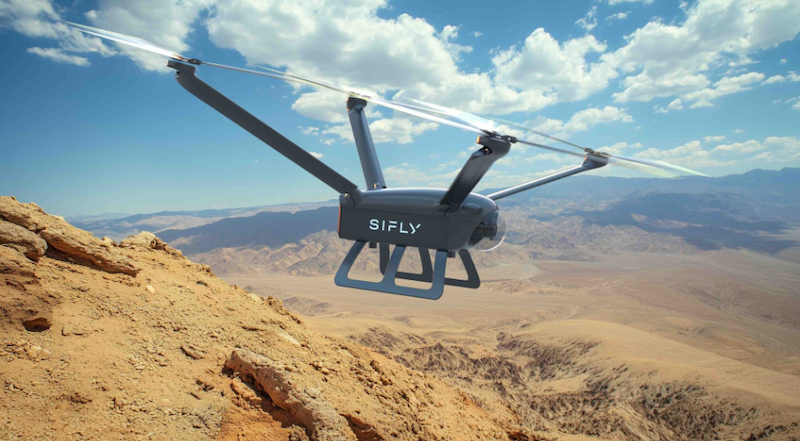
California-based startup SiFly Aviation has raised $20 million in Series A funding as it prepares to begin production of its long-endurance Q12 electric drone, targeting initial revenue-generating deliveries in the first quarter of 2027.
The financing was led by Shield Capital with participation from Qudit, BBK Capital and Alumni Ventures, among others. SiFly Founder and CEO Brian Hinman says the funding provides roughly 18 months of runway and will support Q12 production as well as continued development of the company’s DronePort infrastructure.
SiFly has not yet entered production but expects to ship roughly 1,000 Q12s next year. The company is negotiating a lease for a 15,000-sq.-ft. manufacturing facility in Sunnyvale, California, which Hinman expects will support operations for around 18 months. In the longer term, SiFly could relocate manufacturing to Arizona or Texas.
Hinman says demand is being boosted by U.S. restrictions on Chinese drones, although reshoring the supply chain is also raising costs.
SiFly currently sources motors from China, while its batteries are assembled in Malaysia. Hinman says assembling motors in the U.S. using globally-sourced components would currently cost roughly three times as much as sourcing them from China, with costs increasing further as domestic-content requirements extend deeper into the supply chain.
“The military wants to get to a place where all of the metal that goes into the making of the motor has to be dug out of the ground in the United States; the copper, the steel, and the big one now is neodymium,” Hinman said. “We need rare earths to make good magnets. That’s just not physically possible today.”
The Q12, a 30-lb. MTOW quadcopter optimized for endurance and forward flight, achieved a Guinness World Record in July 2025 with a 3-hr. 11-min. flight. SiFly is targeting public safety, infrastructure inspection and mapping, and agriculture applications.
The company is also developing DronePort, an automated base designed to accommodate three or four aircraft within the footprint of a 20-ft. shipping container. Drones would land on top and be lowered inside, allowing the system to occupy roughly a single parking space. Hinman says customer interest has increasingly centered on acquiring the aircraft and automated infrastructure as an integrated system.
SiFly is continuing architectural work on its larger Q250 heavy-lift drone, although the Series A does not provide sufficient funding for full development. The aircraft was initially conceived around agricultural spraying, a market Hinman believes has become increasingly attractive as restrictions affect Chinese suppliers that dominate the segment.
“We’re going to be building bigger things,” Hinman says. “Bigger drones allow us to carry more payload. Bigger drones are what give us the speed. Bigger drones give us endurance. There are so many applications: [agricultural] spray drones are the obvious one, but there’s cargo, there’s firefighting. It’s a long list of things that are requiring heavy-lift drones.”
Hinman says additional equity and potentially debt financing will be required to support those longer-term plans. But in the meantime, the company remains focused on manufacturing and shipping its first Q12s.
“Commercially, the first thing we need to do is get the Q12 into production, obviously, because nobody takes it that seriously until you’re shipping a lot of units out there, and there’s a bunch of people validating how awesome the product is,“ he said.

Related Content