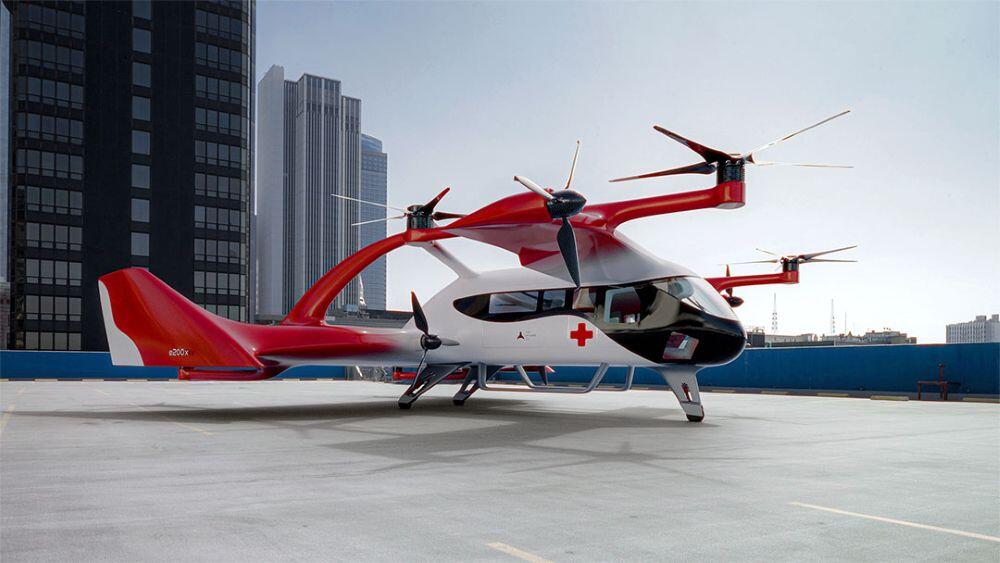
The ePlane Co.’s e200X eVTOL has six lift rotors and four pusher propellers in a lift-plus-cruise configuration.
The ePlane Co. is targeting the start of flight testing with a certification-conforming prototype in April 2027 as the Indian startup advances plans to bring an electric vertical-takeoff-and-landing (eVTOL) air ambulance to market before expanding into passenger transport.
The company, based in Chennai, India, is currently in the second of four phases of the type certification process with India's Directorate General of Civil Aviation’s (DGCA) for its e200X aircraft, CEO Satyanarayanan Chakravarthy told Aviation Week.
EPlane has drafted its means of compliance and is aiming for a preliminary design review by mid-October, followed by component and ground testing early next year. Separately, the company is in the third phase of a four-stage process to certify its propeller.
EPlane unveiled its first full-scale prototype this year, although the aircraft has not yet flown. Structural and avionics testing have been completed, and the company is now conducting high-voltage testing extending through the motors and rotors. A final ground-test phase will incorporate closed-loop flight controls before the aircraft begins flight testing.
The e200X uses a lift-plus-cruise configuration with six vertical-lift rotors and four cruise propellers. EPlane calls its approach “Synerglyft,” in which the lift rotors continue operating at reduced power during forward flight to increase airflow around the wing and generate additional lift.
“The sum total of the wing operating alone and the vertical rotor operating alone is still less than the total lift that you get out of the system,” Chakravarthy said, attributing the effect to the interaction between the flow field generated by the vertical rotors and the wing.
That interaction is intended to allow ePlane to use a shorter wing and fly at relatively low speeds, optimizing the aircraft for short trips within dense Indian cities.
The initial configuration will accommodate a pilot and two passengers. Rather than launching directly into the highly competitive air taxi market, ePlane plans to certify an air ambulance first, followed by a two-passenger taxi and eventually a four-passenger version.
“Ambulances are fewer than air taxis,” Chakravarthy said, allowing ePlane to match initially limited aircraft production with demand while charging higher prices for a life-saving service.
The ambulance configuration would carry a pilot, paramedic and patient.
EPlane says its India-based development and manufacturing strategy could also dramatically reduce the capital required to reach market. The company spent about $20 million through development of its first full-scale prototype and is seeking another $60-70 million to reach air ambulance certification, Chakravarthy said.
He estimates ePlane will ultimately require about $160-170 million to certify its ambulance, taxi and cargo variants, establish limited-series production and begin commercial operations in five Indian cities.
The company plans to establish a production facility next year and is planning for an initial output of about 80 aircraft annually. It envisions subsequently increasing annual production to 300, then 600 and eventually 900 aircraft.
EPlane is also working to localize more of its supply chain in India and the surrounding region to lower production costs. Supplier agreements announced at the recent Farnborough Airshow are intended to transition suppliers currently supporting prototypes toward production, Chakravarthy said.
“The indigenization will allow us to actually bring down the cost of the aircraft at production,” Chakravarthy said.
The company is encouraging suppliers to consider local production themselves or work with partners in the region as volumes increase.
Meanwhile, the startup is building out the ecosystem needed to support operations, including vertiports, charging infrastructure, pilot training, simulators and maintenance providers. Chakravarthy said the DGCA has already developed regulations addressing areas including vertiports, pilot training, maintenance, air operator permits, air traffic control and test pilots.
“The entire ecosystem, including regulations as well as all the different businesses that have to come together, will actually be ready by the time we are ready,” Chakravarthy said.
Beyond India, ePlane sees the Middle East and Indo-Pacific as its initial export markets, with potential FAA and European Union Aviation Safety Agency (EASA) validation farther out. The company has signed nonbinding agreements with prospective customers, including Apollo Hospitals.
Chakravarthy said an earlier agreement covers nearly 800 aircraft, although he acknowledged such commitments will need to be converted into preorders as certification progresses.

Related Content