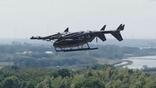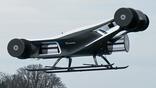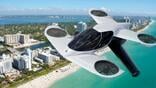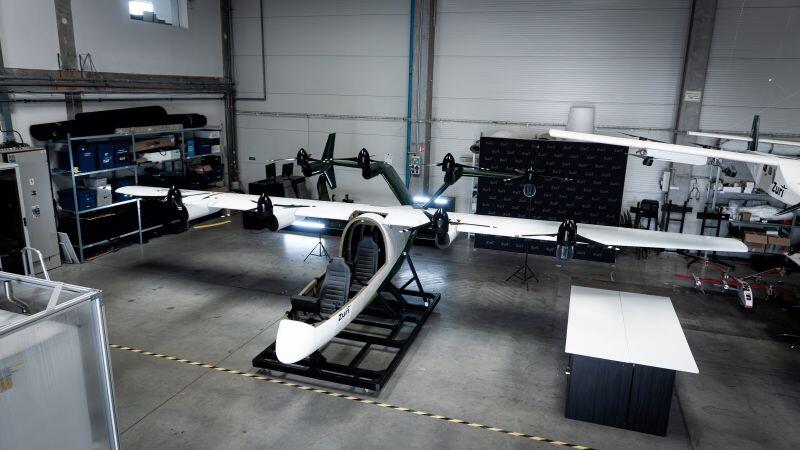
Zuri expects its in-development full-scale Technology Demonstrator 2.0 to be ready for first flight in early 2027.
Czech aircraft developer Zuri has unveiled an uncrewed hybrid-electric cargo VTOL as its first commercial product, seeking a faster path to revenue while continuing to pursue its longer-term ambition of developing a passenger aircraft.
The Prague-based startup is raising a €6 million ($7 million) first tranche of a Series A round to support flight testing of its full-scale Technology Demonstrator 2.0 (TD 2.0), which is undergoing systems integration and ground testing. First flight is planned for early 2027, followed by a roughly nine-month flight-test campaign.
For Zuri founder and CEO Michal Illich, the cargo aircraft represents a stepping stone toward the company’s planned passenger aircraft—and an opportunity to begin generating revenue without first pursuing passenger-aircraft type certification.
“We are getting a little bit impatient,” Illich tells Aviation Week. “I’m already working on this project for nine years, so I think it’s time to start selling and delivering something to customers in the next few years.”
Zuri plans to seek approval for initial operations in Europe’s Specific category using the Specific Operations Risk Assessment (SORA) framework. Illich says the company is already working with the Czech civil aviation authority on that process.
Initial missions are expected to focus on maritime and offshore logistics, including deliveries to oil and gas platforms, ships, islands and offshore wind installations. Besides offering a potential market for urgent resupply missions, those operations minimize exposure to people on the ground, simplifying the SORA risk assessment, Illich says.
The aircraft is designed to cruise at 220 kph (137 mph). Zuri says it will carry a 115-kg (254-lb.) payload up to 679 km (422 mi.), or 569 km with a 30-min. reserve. Payload can increase to 145 kg on shorter missions, while a lightly loaded surveillance configuration could achieve nearly 1,900 km of range.
Those ranges are enabled by a hybrid-electric powertrain built around an approximately 80-kW four-stroke piston engine driving a generator. The flex-fuel engine can operate on aviation gasoline, automotive gasoline or bioethanol, with an electronic control unit automatically adjusting for the fuel being used.
Illich says the complete hybrid system achieves approximately 1,500 Wh/kg of specific energy, compared with less than 300 Wh/kg for most aviation batteries. The system-level calculation includes the engine, generator, power electronics, fuel system and the fuel consumed during the mission.
“For the ranges that we want—hundreds of kilometers—the hybrid is the only way,” Illich says. He estimates a battery-electric version using the same basic aircraft architecture could support missions of roughly 50-100 km.
TD 2.0 is intended to demonstrate essentially the same performance as the cargo product, although several features will change before production. The demonstrator is currently undergoing component testing, including propulsion tests that have reached roughly 90% of nominal motor speed, with full-thrust testing planned next.
Commercial aircraft would operate with substantial onboard automation. Multiple redundant flight computers would handle functions including aircraft stabilization, waypoint navigation and landing, while a ground-based operator would supervise the mission and issue higher-level commands rather than manually flying the aircraft continuously.
Zuri says it has flown more than 15 test aircraft since 2018 and has raised €7.6 million to date, including €1.1 million already committed to the new Series A tranche. Illich says the company’s existing cash is sufficient to reach TD 2.0’s first flight, while the new funding would support completion of flight testing and development of the demonstrator into a commercial product.
While civil logistics remains Zuri’s primary focus, Illich says the uncrewed aircraft is also attracting interest for defense applications.
“The same aircraft, maybe with different sensors, can be used as well,” he says.

Related Content