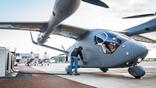
Fresh off the unveiling of its redesigned Valo eVTOL air taxi, UK startup Vertical Aerospace has embarked on a multi-city tour of the U.S., showing off a full-scale mockup of the aircraft and meeting with investors, press and the public. At a stop in Manhattan on Jan. 22, Simpson sat down with BCA to lay out his case for why operators will prefer the Valo over the competition. Read on for a peek into that conversation...
1. What is the reaction from existing and potential customers to the redesigned Valo aircraft?
It’s been off the scale. When we unveiled it in December [in London], we were immediately inundated with inbound calls. People were telling us, “Wow, this is amazing, this aircraft totally redefines the sector.” Customers and operators love the fact that you can have four premium business-class seats in a luxurious layout at launch, or six economy seats, which drives operator economics and provides the best passenger experience in the industry. We also can carry up to 12 suitcases in a separated luggage hold—no one else comes close. And unlike the others, we have a barrier in between the cabin and cockpit, which is great for pilot safety and really a prerequisite for a mass transport aircraft. Of course, the larger cockpit means we can carry an instructor along for pilot training, which most of our competitors can’t do.
We’ve modeled the business case. This can do eight flights a day and generate a $1 million profit with a four-seat aircraft, or that becomes $2.5 million profit with a six-seat aircraft. No one else comes close, and that’s before you even think about pricing in luggage.
2. The aircraft is also differentiated because it’s being certified to the same safety standard as commercial airliners.
That was a decision we made early on, and it originated from discussions with EASA [European Union Aviation Safety Agency], back when they were hugely excited about urban air mobility—and they still are—but they said that anything flying over European cities should have the same standard as a Boeing or Airbus because if one comes down, it’s catastrophic. So, if we’re going to get these into cities, it should have the same level of safety as an airliner. That came straight from EASA, it wasn’t a Silicon Valley idea.
3. The larger aircraft also makes it easier to modify with a hybrid-electric powertrain for longer range, right?
Absolutely. Right near the tail where the luggage is, the gas turbine shaves just a little bit off that space, but that’s the extent of it—there are no major modifications to the airframe. Now, we’ll have to do some more regulatory work, but it’s not as complex as for our competitors, who are all doing major redesigns of their airframes. In ours, the gas turbine powers the battery, and the batteries power the propellers. All you’re doing is putting a generator in to power the batteries, so actually the power system and the flight control architecture are all the same. That means it’s essentially the same aircraft and the certification pathway is essentially the same.
4. Are you still searching for a strategic industrial partner to help fund and scale the business?
Yeah. One of the things that holds our stock price back is that our peer group all has industrial partners, and we’d love to have one, too—but we’re not in a rush. The cultures must be aligned, because we don’t want someone just for their money. We want them because it’s a seamless blend where they bring some of their technology and expertise to help us scale. But we’re not desperate—we know how to manufacture, we know how to do the batteries, and we know how to bring this product to life. So, it’s got to be someone who is the right cultural fit.
5. What are Vertical’s plans for 2026?
We’re nearing the final phase of prototype testing, and we’re weeks away from a first piloted transition flight [from thrustborne hover to wingborne cruise]. We’re very close to doing that, and then we’ve proved out the whole concept.
The next big thing is the Critical Design Review, which is when every component has a supplier assigned to it. Today, we’ve got 75% of that finalized, and that includes every large, complex, long-lead-time item, with the remainder being low-risk, short-lead-time things like interior seat frames and wire harnesses. We’re aiming to have that completed by the third quarter, which should set us up to have Valo flying 12 months from now by the first quarter of 2027. And if we keep to that plan, we think we’re on track to certify by 2028.

Related Content