This article is published in Business Aviation & AAM Report part of Aviation Week Intelligence Network (AWIN), and is complimentary through Mar 18, 2026. For information on becoming an AWIN Member to access more content like this, click here.
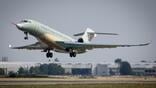
PARIS AND MERIGNAC, France—Dassault Aviation unveiled the long-awaited Falcon 10X business jet as it prepares for an intense period of flight trials to finally get the product into user hands.
The Falcon 10X is Dassault’s biggest bet yet on the business jet market, both literally and figuratively. The clean-sheet design marks the French manufacturer’s entry into an entirely new segment of flying with an aircraft that retails for around $80 million, before full cabin fitting. It comes with the largest cabin of any of its aircraft and introduces cabin and flight deck enhancements.
“The 10X represents our future,” CEO Eric Trappier said at the unveiling, projecting sales of hundreds of aircraft.
The first two aircraft have been assembled, with two more to support the development effort being built. The third and fourth aircraft will feature customer cabins to validate performance before the aircraft enter service.
Dassault would not be tied down on when the aircraft will enter service, given increasing certification demands. It will likely take 2-3 years from first flight to the aircraft being ready for customer deliveries, he said.
Dassault has completed more than 3,000 hr. of ground testing on the aircraft and 15,000 hr. on test benches. Low- and high-speed taxi testing is expected to begin soon, Philippe Reignier, Dassault’s Technical Sales Manager, told reporters here March 10. Flight trials will unfold at the French flight test center at Istres.
Dassault also is looking to boost sales to close a significant gap in business volumes to its chief rivals. In 2025, Dassault delivered 37 Falcon jets and forecast 40 deliveries for this year, with a relatively modest order intake of 31 aircraft. Gulfstream delivered 158 aircraft, including 136 large jets and 22 midsize jets, in 2025 and expects to hand over 160 aircraft this year. Bombardier, which delivered 157 jets last year, expects a higher figure for 2026.
Trappier said Falcon 10X production could reach around two aircraft per month. Falcon deliveries overall will likely get a boost to 40-60 aircraft per year, Trappier said, signaling that was a satisfactory rate.
The Falcon 10X’s development timeline reflects the challenges of recent years. The product is debuting about two years late due to disruptions stemming from the pandemic and industry-wide global supply chain issues. Delays Dassault suffered in getting the Falcon 6X certified also prevented the airframer from redeploying its limited engineering resources to the Falcon 10X.
The Rolls-Royce Pearl 10X-powered twin jet is designed for a range of up to 7,500 nm and a top speed of 0.925 Mach. It is optimized to fly between 0.85-0.9 Mach while preserving range, Reignier said.
Flying at Mach 0.9, the aircraft can connect New York to Dubai or Hong Kong to San Francisco.
The aircraft sports a composite wing, which has passed ultimate load testing, and like other Falcon business jets draws on Dassault’s military work on the Rafale fighter, Reignier said.
The wing has a high, constant sweep angle and low thickness to optimize drag at high Mach cruise. Dassault has also adapted its traditional tail design, with the horizontal stabilizer higher to support higher-speed performance. The wing’s flexibility helps dampen turbulence to improve flight comfort, Reignier said.
The wing also features a curved trailing edge that, combined with the leading-edge slats, aids slow-speed performance, Reignier said.
That helps the aircraft access constrained airports such as the steep approach required at London City.
Inside the cockpit, pilots will operate a new flight deck called NeXus.
The system is designed to deliver more intuitive interfaces using multi-function touch displays for reduced workload and better situational awareness, said Antoine Doussaud, a Dassault Falcon 10X project test pilot. The Falcon 10X also features a smart throttle, with a single lever controlling both engines, he added, and an upset recovery mode borrowed from the company’s Rafale fighter where it is used to help pilots in case of G-force-induced loss of consciousness. On the business jet, this feature is intended to help in the case of severe wake turbulence or similar scenarios.
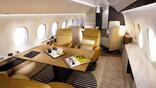
Inside the aircraft, the 2,780-ft.3 cabin is 53-ft. 10-in. long, with a cabin height of 6 ft. 8 in. and max width of 9 ft. 1 in. The cabin is modular so customers can adapt the four cabin modules to their preference.
The cabin pressure altitude is 3,000 ft. when the aircraft is flying at 41,000 ft. The 10X sports 38 windows that are 30% larger than those on the Falcon 6X.
The twinjet’s engine is Rolls-Royce’s first Dassault business jet application and the most powerful in the Pearl engine family to date at more than 18,000 lb. of thrust, said Philipp Zeller, Rolls-Royce Deutschland’s Pearl 10X project lead. The engine has a 10-stage high-pressure compressor and six blisked (bladed disk) stages. It has a two-stage shroudless high-pressure turbine and four-stage low-pressure turbine.
The Pearl 10X is the first time the company is applying additive layer manufacturing parts in the hot section for optimum combustion. That feature should yield NOx emissions and other benefits, Zeller noted.
The engine has accumulated around 3,500 hr. in testing, including 25 flights on a modified Boeing 747-200. The engines to power the Falcon 10X first flight have already flown on the testbed, Zeller said.
Rolls-Royce has built 10 engines to support the Dassault flight test program.
The aircraft can take off when operating at maximum takeoff weight below 6,000 ft., with a landing distance below 2,500 ft.