Corporate Angel Network Offers Hope With Wings
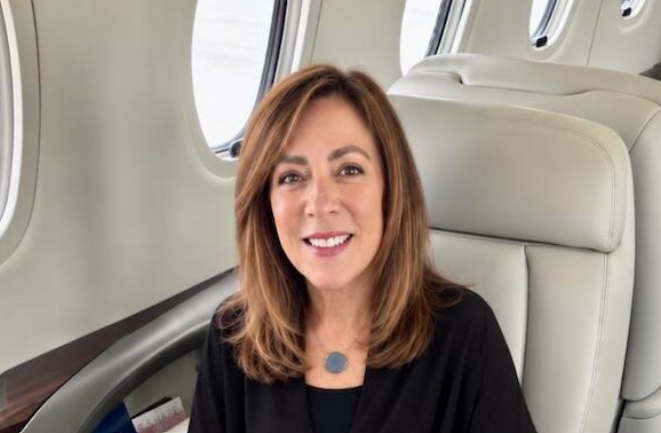
Stephanie Abrams is seated aboard a NetJets Cessna Citation en route to treatment at Memorial Sloan Kettering Cancer Center.
I have spent most of my life telling stories, initially as a television writer and producer and later as president and CEO of the New England Air Museum. I came to believe that facts may inform, but stories are what move us. They allow one to briefly enter another person’s life and understand something unknowable from the outside.
This is a story I never imagined I would share from the inside.
Twenty-two years ago, I was diagnosed with non-Hodgkin’s follicular lymphoma. I was treated with radiation therapy, experienced a recurrence a year later, and then went on to live without another sign of the disease. Two decades is long enough to begin believing that something frightening is forever in your past. You never completely forget cancer, but gradually it becomes something that happened to you rather than something that is happening to you.
Some months ago, I discovered a lump in my neck. And just like that, the past became the present.
There were biopsies, MRIs, PET scans . . . and waiting. My oncologist at Memorial Sloan Kettering Cancer Center in New York City confirmed that the lymphoma had returned, this time more aggressively. I underwent four immunotherapy treatments, and afterward my husband, Bob, and I came to Florida to be near family. That became so comforting that we decided to make our home there too.
Then came something I never anticipated. I have always been extremely active and athletic, accustomed to moving through life at full speed. Now suddenly, severe spinal stenosis reduced my mobility to a few painful minutes on my feet. Almost overnight, crossing a parking lot, standing in line or walking through an airport became an obstacle. For someone who had always measured her days by how much she could do, being constrained to so little movement was a shock.
And I needed to get back to New York for a PET scan that would tell whether the immunotherapy was working.
My neurosurgeon was unequivocal: the long drive from Florida risked permanent nerve damage. Normally, we would simply have flown commercially, but the immunotherapy had left my immune system severely compromised. My oncologist was equally firm: crowded airports and hours in an aircraft, surrounded by hundreds of people, posed a risk he did not want me to take.
The two ordinary ways of getting to New York had effectively disappeared.
That is when Corporate Angel Network (CAN) came forward.
I already knew CAN’s CEO, Bob Stangarone, well since he had served as board chair of the New England Air Museum before stepping away to lead CAN. Over the years, he became someone I deeply respected and admired, someone I turned to for advice, counsel and perspective. Through Bob, I learned about CAN and its mission of providing cancer patients free travel to and from treatment centers aboard participating business aircraft.
Now, with conventional transport back to Sloan Kettering deemed a serious medical threat, I turned to Bob once again. And days later, my husband and I were flying from Fort Myers, Florida, to New York’s Westchester County Airport aboard a NetJets business jet. Kelly Scanlon, CAN’s patient services manager, and the whole CAN team took care of all our travel details with extraordinary skill and kindness.
There is a considerable difference between knowing about such missions and suddenly finding yourself within one. As a patient entering that airplane, I realized that for the next few hours I did not have to worry about exposure to crowds, about pain, or whether I could make the long walk to an airport gate since the aircraft was only a few steps from the executive terminal. These enormous worries had simply been lifted away.
And then we landed at Westchester.
As we were leaving the airplane, our pilots did something I will never forget. They knew I was a cancer patient heading for a scan that would determine whether my treatment was working. They both came forward, hugged me and wished me luck.
It was such a simple gesture, but it meant more to me than they could possibly have known. During a journey filled with scans, diagnoses, uncertainty and fear, that moment felt deeply human. I wasn't simply another passenger they had flown to New York. I was a patient, someone they cared about, and they demonstrated exactly that. I will carry their brief gesture with me for a very long time.
And that, to me, is the heart of Corporate Angel Network. It is not simply about airplanes transporting patients from one city to another. Rather, it involves an entire community making that journey possible: companies donating seats on their aircraft, donors supporting the mission, CAN employees quietly managing countless details, flight crews welcoming patients aboard, and many others working behind the scenes. When simply getting to desperately needed medical care can feel impossible for someone fighting cancer, the CAN community makes it happen.
Our trip took one more unexpected turn. There was a problem with the radioactive isotope needed for my PET scan. The test was canceled, rescheduled, and the plans changed again. Anyone who has waited for the scan that will determine whether cancer treatment is working knows that time takes on a different rhythm.
Eventually, I had the scan.
The news was encouraging. I am responding to the immunotherapy, but we are not quite there yet. Some areas that had shown lymphoma were gone; others had improved significantly. There are still areas my doctors are watching, so this chapter is not finished.
But the results also allowed us to begin looking ahead. My oncologist and my neurosurgeon are now working together, and I can now move forward with surgery for the severe spinal stenosis while they carefully coordinate my continuing immunotherapy around the procedure. After months of one medical problem complicating the treatment of the other, there is finally a plan for both.
On the flight home to Florida, I looked out the window. Below us were clouds, and beyond them was that extraordinary, endless blue you can only really appreciate at altitude. I have spent much of my life around aviation and have looked out airplane windows hundreds of times. But that afternoon, the view felt different.
Maybe I was different.
For months, so much of my world had been filled with things I could not control: return of a cancer I thought I’d escaped, pain that had hobbled my mobility, tests, treatments, doctors and the waiting. Now, above the clouds, my husband beside me and encouraged by my medical news, I found myself hopeful.
Hope is not the same as certainty. My cancer is not gone. My treatment is not finished. There are still difficult things ahead.
But hope provides reasons to look beyond what is frightening at the moment.
And I realized that, in its own way, this is also what Corporate Angel Network gives its worried passengers—hope to look beyond their cancer.
Behind every CAN flight is a story most of us will never hear. Someone is traveling to an appointment they desperately need. Someone is awaiting an answer. A loved one is sitting beside them carrying fears of their own. Somewhere, a family is hoping for good news.
CAN makes access to lifesaving medical care possible when getting there is difficult, dangerous or impossible. It protects vulnerable patients and removes one enormous burden when a family may already be carrying more than it can bear.
That is why Corporate Angel Network deserves our support.
Every company that donates a seat, every flight partner, every donor, every employee, every crew member and every person who helps make these flights possible becomes part of a patient’s story. They may never know what the scan showed or what the doctor said afterward.
But I can tell them what their generosity feels like from the other side. It feels like someone has quietly taken something very heavy out of your hands when you are already carrying too much.
And sometimes, it feels like looking out an airplane window on the way home and realizing that clouds don’t cover the whole sky. There is blue beyond them. There is a way forward. There is still hope.
Related Content