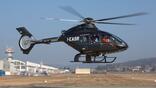
Leonardo Helicopters has expressed confidence that it can finally bring its AW09 single-engine light helicopter to market by year-end.
Following a lengthy development effort that began with startups Marenco and later Kopter Group—before the latter’s acquisition by Leonardo in 2020—the aircraft is now close to entering the highly competitive long light single-engine segment.
Test pilots are steadily working through the 5,000 test points required by regulators during daily flight trials with the 2.8-metric-ton rotorcraft. Function and reliability testing has also passed the halfway mark.
Leonardo is targeting European Union Aviation Safety Agency (EASA) CS-27 type certification for small rotorcraft in a passenger transport configuration first, and the company is hopeful that the U.S. FAA will validate the approval shortly thereafter.
FAA certification is crucial, as much of the interest in the AW09 comes from the U.S., where single-engine helicopters are permitted for urban operations. In Europe, such operations typically require twin-engine rotorcraft.
“We are almost there, and I think we are quite satisfied with the results we have achieved,” Leonardo Helicopters MD Gian Piero Cutillo told journalists during briefings ahead of next month’s Verticon industry event in Atlanta, Georgia.
Three aircraft are currently supporting the final stages of the certification campaign: two pre-series prototypes (PS4 and PS5) and the first serial-production-standard aircraft, S6. Serial production has already begun, with the seventh aircraft slated to be the first customer delivery. Leonardo has declined to disclose planned production rates.
Final assembly has been designed to be “very lean,” says Guglielmo Monguzzi, the head of programs and chief programs officer at Kopter, which still leads the development of the aircraft from Mollis, Switzerland.
He compares the AW09’s assembly to building a Lego set, with many of the aircraft elements—cabin, transmission, transmissions and blades, delivered with provisions in place for rapid assembly.
“Other Leonardo aircraft will spend months on the final assembly line. With the AW09, we are aiming at weeks,” Monguzzi says.
Following the acquisition of Kopter, Leonardo’s engineers reviewed the design choices made by Marenco and Kopter and have implemented significant changes. Originally envisioned to use Honeywell’s HTS900, the AW09 now uses the widely adopted and supported Safran Arriel. They also replaced the Safran avionics suite with a Garmin-developed system, the G3000H integrated suite. Flying controls were re-routed from running through the middle of the main gearbox to around the side of the gearbox housing, reducing the complexity of the transmission design.
Material choices were adjusted, and there have been multiple iterations of the main rotor blade as well as vertical and horizontal stabilizer designs. Other changes to the aircraft include new aerodynamic spats at the rear of the landing skids provide additional lateral stability.
Probably the one element of the AW09’s design that has not changed however is its cabin. At 6.5 m3, it is larger than that of some twin-engine rotorcraft, notably Airbus’ H135, at 4.9 m3.
The spacious cabin has helped generate 120 preliminary orders.
These will convert to firm contracts once certification is secured, Monguzzi says, adding that many customers have been waiting since Kopter’s formation in 2018. The cabin size and large windows make the aircraft attractive for aerial sightseeing, but more crucially for the emergency medical services (EMS) segment. The cabin’s size also supports residual value, as it allows relatively easy reconfiguration between missions.
Leonardo is also developing a VIP interior to be marketed by the airframer’s luxury brand, Agusta.
Once EMS interiors like those being developed by Metro Aviation are approved, and a four-axis autopilot and instrument flight rules capability is added, Leonardo believes they can reap the rewards of a replacement cycle in the U.S. EMS business that will enable it to supplant types like Airbus’ H125, H130 and Bell’s 407 as well as light twins such as the Airbus H135 and Bell 429. Monguzzi admits that the acquisition price of the AW09 will be higher than its competitors, “but our objective is to have operating costs compatible with the H125,” he says.

Related Content