Russ Meyer Jr.
WICHITA—Arguably the most influential leader in general and business aviation of the last 50 years, Russell Meyer Jr., the longtime chair, CEO and chairman emeritus of Cessna Aircraft, died March 4 in Wichita at the age of 93 after a brief illness.
Clyde Cessna, Walter Beech, William Piper and others built the early aircraft, but Meyer catapulted general aviation to the forefront, said Jack Pelton, former Cessna CEO, who followed Meyer in the role. He not only grew Cessna into a major aircraft manufacturer, but with his work in the broader industry, “he had this incredible vision of where this all could go,” said Pelton, now chair and CEO of the Experimental Aircraft Association.
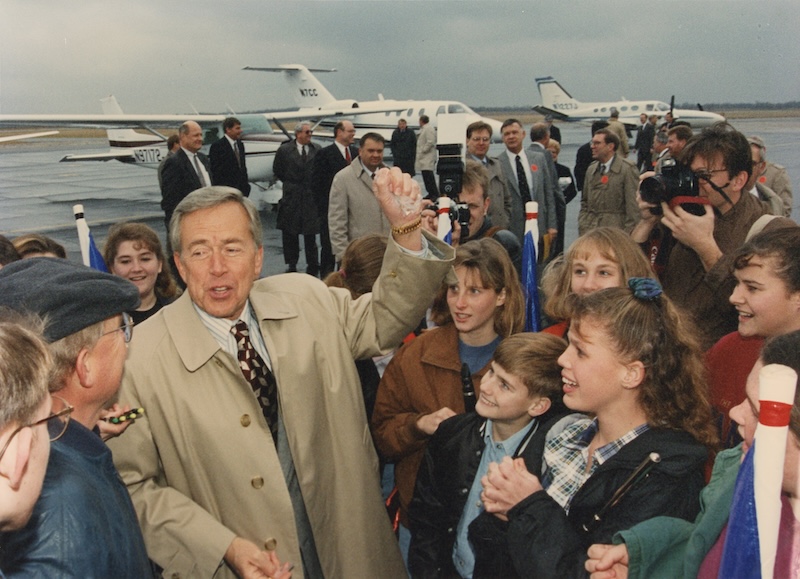
Born in Davenport, Iowa, Meyer was a Yale and Harvard Law School graduate and a former Air Force jet pilot and Marine Corps fighter pilot. Meyer, after practicing aviation law, became president and CEO of Grumman American Aviation Corp., serving until Dwane Wallace, Cessna board chair and Clyde Cessna’s nephew, invited him to join the company in Wichita in 1974.
Meyer served as chair and CEO of Cessna, now Textron Aviation, from 1975-2003, remaining as chairman emeritus.
Meyer will long be credited with saving the general aviation industry with the passage of a bill limiting manufacturer product liability.
Whenever there was an accident of any kind, it was the manufacturer who was sued no matter the cause, and costs skyrocketed.
As a result, Cessna, along with almost every manufacturer, halted production of all single-engine piston aircraft in the mid-1980s. It was the toughest decision of his career, Meyer once told Aviation Week. Paired with an economic downturn, employment dropped to a record low.
Meyer helped lead a lobbying effort in Congress, walking the halls, testifying and making the commitment that if it passed a law limiting product liability, the company would restart production. In 1994, Congress passed the General Aviation Revitalization Act.
Meyer was there when President Bill Clinton signed the bill into law.
Meyer immediately left the Oval Office, walked directly to the North Lawn of the White House and announced that Cessna would begin a search for a location to resume production, said Ed Bolen, president and CEO of the National Business Aviation Association.
Cessna opened its plant in Independence, Kansas, in 1996.
Serving three terms as chair of the General Aviation Manufacturers Association, Meyer also helped lead efforts for the creation of the Airport and Airway Trust Fund, bonus depreciation and FAA reauthorization, he notes.

“There is simply no one who has had a more positive and profound impact on general and business aviation than Russ Meyer,” Bolen said. “The planes he introduced, the monumental laws and regulations he shaped, the culture he created and nurtured – not just for the company he led for decades, but for the entire industry – is a tribute to his leadership, determination, grace, integrity and compassion. We will miss him, and we wish him Godspeed.”
Nicknamed the “father of the Citation line,” under Meyer’s leadership, Cessna delivered nearly 5,000 Citation business jets. His favorite was the Citation X, he once told Aviation Week, with a top speed of Mach 0.92, it was the fastest business jet built at the time.
Meyer loved to fly and was type-rated in every Citation model ever produced. He would sit in the left seat of the Citation X with his chief pilot, Dave Schmidt, on the right, said Dave Franson, a former Cessna manager of public relations.
Meyer liked to write many of his own speeches and comments.
Once while flying to Washington D.C. for an event, Meyer, as pilot-in-command, got to cruising altitude, set the autopilot, then took out a small legal pad and a No. 2 pencil. He then crafted his remarks for the event ahead, writing carefully on every other line, Franson said, resulting in, as typical, the most eloquent of speeches.
Meyer could converse with anyone from U.S. presidents, of which he met 10, including two who came to Wichita upon his invitation, to the person who picked up the trash at his house, with whom he would meet at the curb for frequent conversations, his son, Chris Meyer, a Wichita family physician, tells Aviation Week.

From his roots in Davenport, Iowa, the elder Meyer came from a humble background, his son said. “He did not grow up privileged.” He earned scholarships because of hard work and a desire for a better life for himself and his family. “He never forgot where he came from.”
Aviation was his passion, Chris Meyer said. “I don’t think I’ve ever seen a man so appropriately fit for a job ever; he loved what he did until the day he died.”
He never fully retired. On the Saturday before his death, Meyer had been preparing to hold a business meeting with his son, Russ Meyer III, and a potential partner about a new idea for a project, the younger Russ Meyer said.
Father and son, with support from two others, launched an Excel Eagle program in 2018 revitalizing older Citation Excels. They bought six used aircraft.
“I thought, Oh, jeez, I hope this works,” the younger Meyer said. “Boy, did it work; then I realized—never doubt my dad for anything.”
Al Higdon, a Wichita former advertising and public relations executive, met Meyer in the 1970s. Meyer became the big brother he never had, he said. At the time Meyer was a young Cleveland lawyer representing golfer Arnold Palmer, who had just purchased a Learjet. Meyer and Palmer bonded over a mutual love of aviation and became lifelong friends.
“[Meyer] was the guidepost for ethics and credibility and leadership,” Higdon said.
Meyer created a special atmosphere at Cessna where everyone was family, a former long-term employee said. Those years were “Camelot.”
“We all looked after each other and that started at the top,” said Teresa Ortega, an administrator in international sales, now co-owner of Ortega Aviation Services. One time, after many days in Europe culminating at the Paris Air Show, the team went to dinner at a rose garden. Meyer surprised Ortega at the dinner with a birthday party saying no one should be away from family on their birthday, and they were all family.
“There’s never going to be another one like him,” Ortega said.
Meyer launched the company’s Citation Special Olympics Airlift, recruiting Citation owners to donate their aircraft and pilots to fly athletes and coaches to the games and back.
NBAA’s Bolen and Meyer participated in the airlifts each year, meeting each aircraft, their players and coaches, as they arrived for the tournament. On one especially hot summer afternoon, Bolen finally stopped for a respite in the shade. Meyer, then in his 80s, kept a big smile on his face and never took a break the entire day, Bolen said.
Meyer also opened the Cessna 21st Street Training program in Wichita, touted by then-President Bill Clinton for providing skills training and jobs to struggling adults completing the program. He and his wife, Helen, spearheaded construction of a 42,000-ft.2 Boys & Girls Club facility and campaigns for GraceMed Health Clinics, providing healthcare to low-income families.
He helped create and promote the Be A Pilot program, a national initiative to reverse the decline in new student pilot starts.
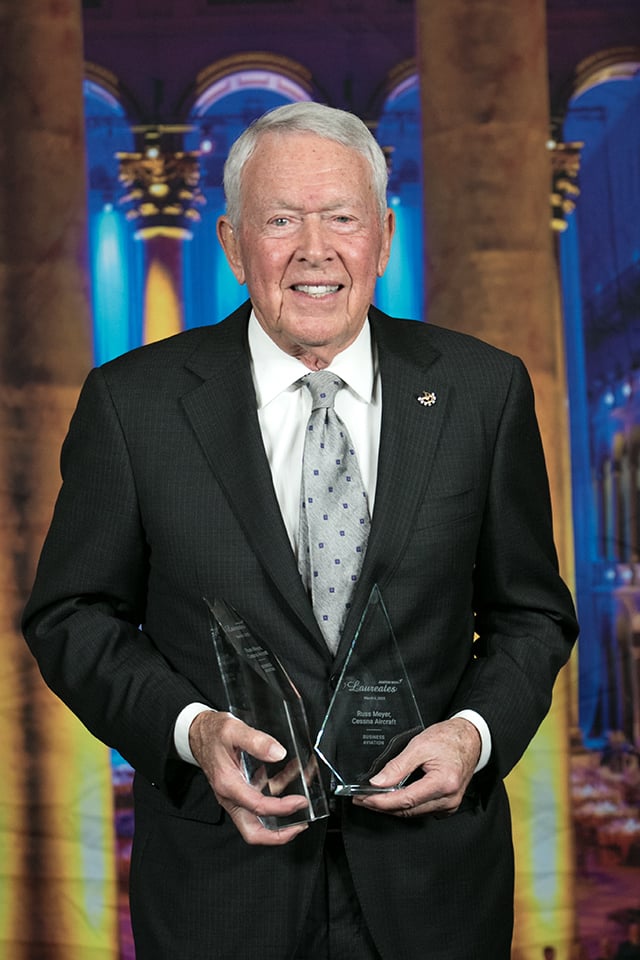
Meyer earned about every award one could earn in the industry—the Aviation Week Laureate Award in 2025, the Robert J. Collier Trophy, George S. Dively Award, Wright Brothers Memorial Award, Meritorious Service to Aviation Award, Kansas Aviation Hall of Fame, National Aviation Hall of Fame, the R.A. “Bob” Hoover Award and others.
Meyer is survived by his wife, Helen, and children Russ Meyer III (Janet), Elizabeth (Liz) Ferrari (Mark), Jeff, Chris and Carolyn and five grandchildren.
Editor's Note: Corrects spelling of Dwane Wallace.
Listen in to Molly McMillin's 2024 interview with Russ Meyer here.

Related Content