20/Twenty: The G550, Stretching Good Times
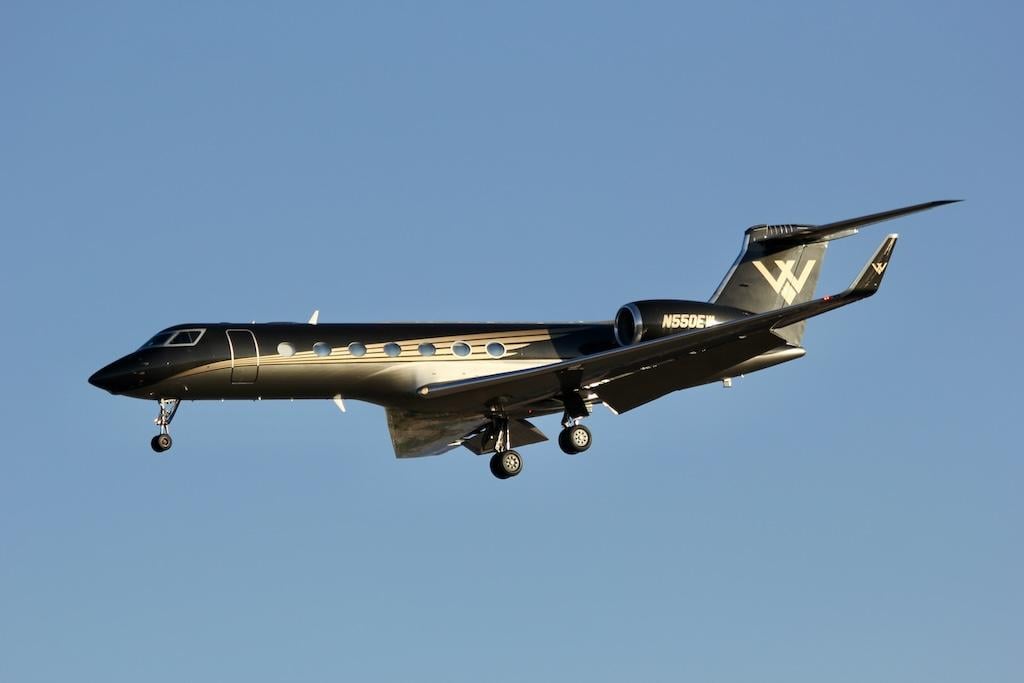
The G550 accommodates four main cabin layouts with seating for up to 19.
When it first hit the market in 2003, the Gulfstream G550 embodied the optimism of the era: a globe-girding magic carpet that can transport eight passengers and three crew from 6,000 ft. of pavement up to 6,750 nm cradled in four-zone luxury.
Gulfstream built more than 600 of the uber barges in a production run that spanned 18 years. Some 617 remain in service, with pre-owned prices ranging from $11.5 million for early serial numbers up to $34 million for the last ones off the line, according to the Aircraft Bluebook.
For an aircraft whose last iteration sold new for $62 million in 2021, this math could be viewed as an enormous bargain.
Indeed, the G550 has much to offer. Subtract the aft 170 cu. ft. baggage compartment and the cabin length measures 43 ft., 11 in. However, the cabin cross-section, at 7 ft., 4 in. wide and 6 ft., 2 in. tall—is basically the same one used on thousands of Gulfstreams since the original GI in the late 1950s. It’s four inches narrower than that on a Dassault Falcon 7X and a full 10 inches slimmer than that found on Bombardier Globals.
The comparatively narrow cross section helps the G550 to slip through the air at dash speeds up to 0.885 Mach and accommodates four main cabin layouts with seating for up to 19.
The most common cabin configuration features seating for 14 and includes a forward galley with crew rest area followed by a club grouping, a conference grouping, a three-place divan opposite a half club followed by an aft lavatory and wardrobe. Zones can be separated by optional pocket doors, and a few custom configurations even include a rear stateroom with an en-suite shower.
Market data suggests these kinds of custom configurations command a premium of several million dollars. Natural light floods the cabin through 14 large Gulfstream signature oval windows. The pressurization system maintains a sea level cabin through 29,000 ft. and maximum cabin altitude is 6,000 ft.
Making It Yours
Used G550s come in two basic flavors: Those 10 years old and newer and those older—sometimes much older. But it rare to find one of any age that with an inordinate number of hours on the airframe: 3,000-to-3,500 hr. is commonplace.
At this writing, 6.9% of the fleet was on the market, according to Gino Jooyan, a broker at Leviate Air Group who specializes in the model. “The absorption rate remains healthy,” he said, with newer models staying on market for a little over four months.
New owners typically are looking for exterior paint, interior re-rag, and to update the cabin management system (CMS), said George Bajo, senior completions sales representative for Duncan Aviation. Depending on fabrics selected, a typical makeover can run between $1 million and $2 million. The CMS update is particularly popular as the older system on early serial number G550s is largely obsolete and is not supported. Duncan Aviation also recently began installing Starlink satellite terminals on the aircraft.
Using an independent center for paint and interior can provide the customer with scheduling and cost advantages, Bajo notes. He points out that an increasing number of G550 buyers are individuals who want to personalize their aircraft.
However, when it comes to updating the jet’s PlaneView avionics, all roads lead to Gulfstream as it developed them in concert with Honeywell, based on the Primus Epic system, on a proprietary basis. This includes the digital avionics interface with the hydromechanical flight controls, a combination that delivers near fly-by-wire feel and control thanks to the hydraulic boost and low friction. Synthetic vision is a particularly popular upgrade.
Maintenance Plans
Power comes from a pair of Rolls-Royce BR710C4-11 turbofans (15,385 lb. of thrust each) that burn around 400 gallons per hour at long range cruise power (Mach 0.80). While engine maintenance is “on condition,” the regular inspection intervals for them, such as the core zone inspection due at 5,000 hr. can easily run $1.6 million per engine.
Most operators insulate themselves from these hits by enrolling in the engine OEM’s hourly-fee CorporateCare program along with similar plans from Gulfstream on the airframe and Honeywell for the PlaneView avionics and auxiliary power unit. Some operators also subscribe to third-party warrantors such as JSSI, which can provide a custom maintenance plan solution.
All of these hourly maintenance plans together can easily tack on $2,000 to hourly operating costs that can approach nearly $10,000 per hour. In total, the average annual costs associated with flying a G550 200-to-300 hours per year falls into the $3.5 million range, according to Jooyan.
But considering that for that price you get a 91,000-pound MTOW airplane that can take you just about anywhere you want to go, non-stop, that’s not bad.
BCA welcomes comment and insight from aircraft dealers and brokers for its monthly 20/Twenty pre-owned aircraft market feature. The focus aircraft for December 2025 is the Hawker 900XP. To participate, contact [email protected]
Related Content