This article is published in Aviation Week & Space Technology and is free to read until Sep 03, 2026. If you want to read more articles from this publication, please click the link to subscribe.

The MIT Dinner That Created Aviation Week

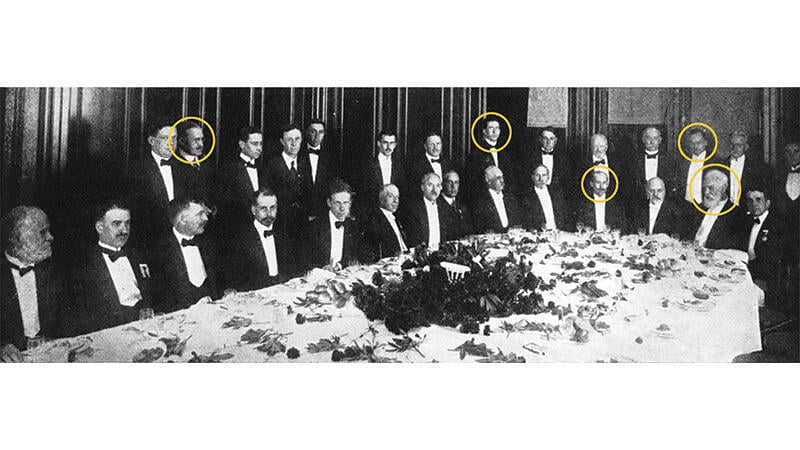
group of men at a dinner table with five heads circled

The 1916 dinner that led to the creation of Aviation Week included, circled left to right: (standing) Lester D. Gardner, Glenn L. Martin and Jerome Hunsaker and (sitting) Orville Wright and Alexander Graham Bell.

Credit: AW&ST Archive

For a business to be thriving after 110 years requires strong leadership, multiple rounds of reinvention and a bit of luck. Aviation Week was barely three years into existence when it faced its first big test.

It all began with a dinner at the Massachusetts Institute of Technology (MIT) on June 12, 1916. The guest of honor was aviation pioneer Orville Wright; the host was Lester D. Gardner, an 1898 graduate of MIT. Guests included inventor Alexander Graham Bell; Glenn L. Martin, a founding father of today’s Lockheed Martin; and Jerome Hunsaker, who taught the first course in aeronautical engineering and aviation design at MIT.

About a dozen years after Wright and his brother Wilbur made their historic flight at Kitty Hawk, North Carolina, Europe was surging ahead in aeronautical technology. World War I was proving how wrong French Gen. Ferdinand Foch had been when he remarked that airplanes were “interesting toys but of no military value.”

But in the U.S., scant technical information was publicly available on the emerging industry. Gardner used the dinner to drum up support from the luminaries to establish a magazine “which would provide the aeronautical profession with the latest and most helpful technical information.” The first issue of Aviation and Aeronautical Engineering debuted on Aug. 1, 1916, with Gardner as its editor-in-chief.

In its early years, the magazine resembled an academic journal, publishing in multiple parts a course on aeronautical engineering. Aviation and Aeronautical Engineering “immediately became one of the indispensable requirements for those who wished to keep informed as to the design, construction and operation of American aircraft,” Gardner recalled on the publication’s 10th anniversary.

But the magazine’s uniqueness began to fade following the end of World War I in November 1918, as technical information on aviation became widely available. Gardner rose to the challenge, simplifying the publication’s name to Aviation and making it “more of a trade paper, giving readers more descriptions and news and less engineering.”

That formula proved to be a winner during the Roaring Twenties. As aircraft became faster, bigger and safer and traveled longer distances, dozens of airlines were created. Manufacturers of aircraft and their components filled Aviation with advertisements. Charles Lindbergh’s solo flight across the Atlantic Ocean in 1927 landed him on three consecutive covers. In 1929, the 10-day National Air Race opened in Cleveland with 350,000 spectators and included a women-only cross-country race.

The magazine faced its next big test with the onset of the Great Depression. To survive, Aviation reduced publication to once a month and sold its cover to advertisers. For a decade that lasted well into World War II, nearly every cover was an ad for a Pratt & Whitney engine. In 1947, the magazine finally resumed weekly publication under the name Aviation Week.

The age of passenger jets arrived in the 1950s, and there were many entrants to cover: the pioneering square-window de Havilland Comet, Avro Canada C102 jetliner,  Sud Aviation Caravelle, Vickers VC10, Convair 880/990, Douglas DC-8 and Boeing 707. Aviation Week broke the news of development of the 707, initially called Boeing’s “Project X.”

The magazine’s reporting on space began early. “Whether or not you hold with the Buck Rogers school of thought that foresees interplanetary navigation in the 25th century on par with transcontinental trips of the 20th, you cannot laugh off Professor Goddard’s work as too visionary to rate serious attention,” read a 1936 write-up on rocket pioneer Robert Goddard. The words “Space Technology” were added to the magazine’s name in 1958, the year NASA was created in response to the Soviet Union’s orbiting of the Sputnik satellite. The agency’s Mercury, Gemini and Apollo missions were featured on dozens of covers throughout the 1960s and early 1970s.

The magazine’s reporting reached new heights with its in-depth coverage of the U.S.-Soviet space race and Cold War military technologies. “Celebrated for its superior technical reporting, Aviation Week has produced a steady stream of spectacular leaks and scoops—and enough duds to have earned the nickname ‘Aviation Leak and Space Mythology’ from its critics,” read a 1986 Washington Post profile titled “Aviation Week’s Soaring Success.”

Blue Moon lander
Designed to NASA’s safety requirements, Blue Origin’s MK2 lander is aimed at helping establish a permanent presence on the Moon. Credit: Blue Origin

The 1990s would bring more momentous challenges. The end of the Cold War led to a dramatic decline in military spending and consolidation of the defense industry. Stuffed with advertisements, AW&ST’s 1985 Paris Air Show edition ran 436 pages. By 1993, the Paris edition was 108 pages. The magazine’s staff endured painful layoffs.

A second, slower-moving challenge was the arrival of the internet, which would decimate print advertising across the media. But that also coincided with a fortuitous move.

In 1996, led by Publisher Kenneth E. Gazzola, Aviation Week created a maintenance, repair and overhaul (MRO) event to connect original equipment manufacturers, parts suppliers and aftermarket services providers. MRO ’96 took place in a ballroom in a Dallas hotel.

Although it was not apparent at the time, the fledgling event marked the beginning of a diversification of the business that would secure Aviation Week’s future as competitors reliant solely on advertising were squeezed. The company now hosts more than 30 events around the globe and has more than doubled in size under the ownership of Informa. This year’s MRO Americas show drew approximately 19,000 registered attendees and more than 1,000 exhibitors.

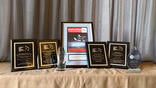
Meanwhile, the media side of the business has pivoted to remain relevant in the digital age. During the past two decades, it has evolved from primarily a weekly print magazine into a source of business intelligence across multiple digital, print and data platforms. Editors have taken steps to reach a broader audience via videos, webinars and podcasts. The Check 6 podcast last month won Best Multimedia at the Aerospace Media Awards in London.

Platforms aside, Aviation Week’s editors continue to strive for excellence. In May, they were honored with the Jesse H. Neal Grand Neal award, recognizing AW&ST as a pillar of trade journalism. The foundations of that pillar were laid 110 years ago at the dinner at MIT.

Gardner’s dream of making information on the industry widely available has been realized. A decade ago, with the support of Boeing, Aviation Week celebrated its 100th anniversary by creating a searchable digital archive for subscribers that contains every issue back to 1916: archive.aviationweek.com. The amazing history of the aerospace industry—and how it was reported in real time—is there for all to see.

Joe Anselmo

Joe Anselmo has been Editorial Director of the Aviation Week Network and Editor-in-Chief of Aviation Week & Space Technology since 2013. Based in Washington, D.C., he directs a team of more than two dozen aerospace journalists across the U.S., Europe and Asia-Pacific.